AI-Powered Crypto Exchange: What the AI Actually Does
An AI-powered crypto exchange uses machine learning for pricing, risk checks and support. Here is what the AI really does, and what to check first.
On this page
Short answer
An AI-powered cryptocurrency exchange is a trading platform that uses machine learning inside its normal work: matching orders, pricing assets, watching for fraud and answering customer questions. The AI does not replace the exchange; it runs inside the parts where speed and pattern-spotting matter most.
What is an AI-powered cryptocurrency exchange?
An AI-powered cryptocurrency exchange is a trading platform that uses machine learning inside its normal work: matching orders, pricing assets, watching for fraud and answering customer questions. The AI does not replace the exchange; it runs inside the parts where speed and pattern-spotting matter most.
Most exchanges already use software for these jobs, and AI changes how that software decides. Instead of fixed rules written by hand, the system learns from past trades, past fraud cases and past support tickets, then applies what it learned to the next trade, the next login or the next question.
The label is also used loosely, so it helps to ask what the AI actually does. Some exchanges use AI in one small feature, such as a support chatbot, while others build it into trading, risk and compliance. The rest of this article separates the real uses from the marketing. For teams building one, crypto exchange development covers the platform itself.
What does the AI do inside an exchange?
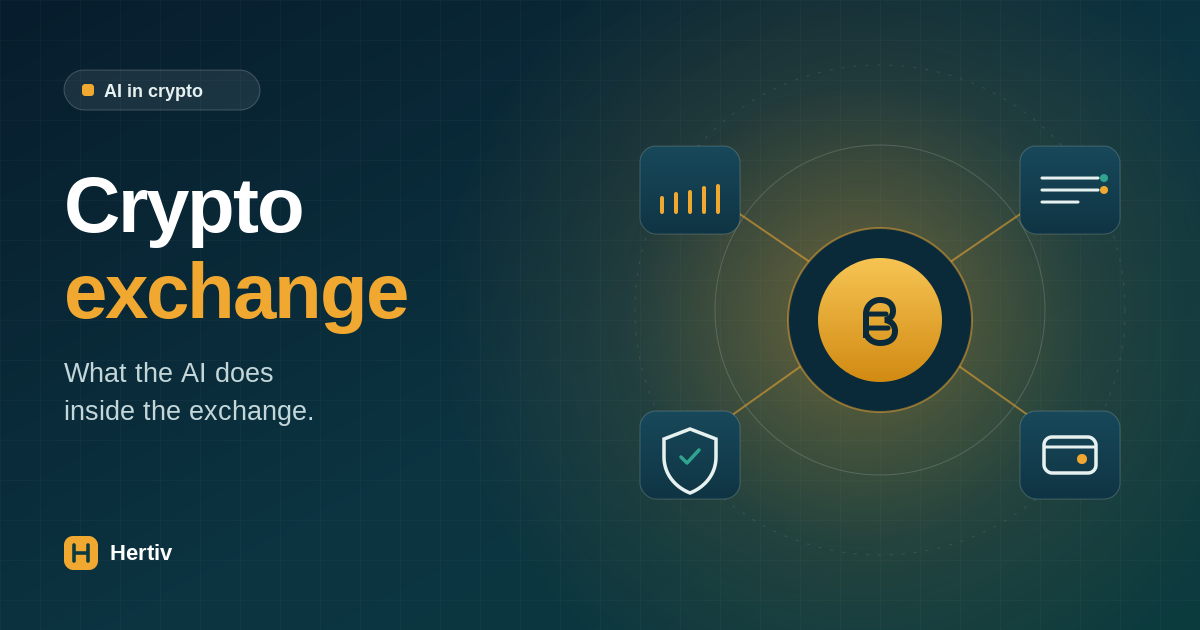
AI shows up in five places on a modern exchange, and each one solves a different problem. The table below gives the short version, and the next sections explain the three that matter most to users.
| Job | What the AI does | What it needs |
|---|---|---|
| Trading and pricing | Suggests prices and fills orders | Order book and past trades |
| Risk and fraud | Flags odd logins, withdrawals and trades | Account and transaction history |
| Customer support | Answers common questions and routes the rest | Past tickets and help pages |
| Compliance | Screens wallets and transactions for sanctions | Watchlists and chain data |
| Liquidity | Keeps buy and sell prices close together | Market depth and recent trades |
No single model does all five jobs. Each one is a separate system with its own data and its own failure modes, which is why an exchange can be strong in one area and weak in another.
How does AI help traders on an exchange?
For traders, the most visible AI is the pricing and execution help: the exchange suggests a price, fills an order across several price levels, or warns when a trade looks badly timed. These features save time, but they do not remove risk.
The help is only as good as the data behind it. A model trained on calm markets can misread a fast crash, and a model that copies past trades can repeat past mistakes. Traders who treat AI suggestions as orders, rather than as one input, give up the judgement the tool is meant to support.
Some exchanges also run AI market making, which means the system places buy and sell orders to keep prices tight. That can lower costs for everyone, but it can also pull back suddenly in a crash, which is when traders need liquidity most. A list of firms that build these systems is in top AI crypto exchange developers in the USA.
How does AI protect an exchange?
AI protects an exchange in two ways: it watches accounts for signs of takeover, and it screens transactions for crime. Both jobs run all the time, because attacks do not wait for office hours.
- Login checks. A new device, a new location or odd timing raises the risk score and can trigger an extra check.
- Withdrawal checks. A large withdrawal to a new address is held or reviewed before it leaves the exchange.
- Transaction screening. Transfers are compared with sanctions lists and with known scam patterns.
These checks create false alarms, and that is expected. A genuine user travelling abroad can look like an attacker, so the exchange needs a fast way to clear a real user. The alternative, no checks at all, is how stolen accounts get drained. The same idea applies beyond exchanges: AI-to-AI crypto transactions raise similar questions about who is really behind a transfer.
What should you check before using one?
Before trusting an AI-powered exchange, check the basics that have nothing to do with AI. The AI features matter less than whether the exchange is sound, honest about its limits, and able to help when something goes wrong.
- Licensing and location. Know which regulator, if any, covers the exchange and its users.
- Proof of reserves and audits. Look for independent checks, not just claims on a marketing page.
- Fees and spreads. Compare the real cost of a trade, not the headline rate.
- Support. Test whether a human answers when the AI cannot help.
- Withdrawal rules. Read the limits and the hold times before depositing.
Then ask what the AI does and what it cannot do. An exchange that explains its AI features plainly is easier to trust than one that hides behind the label.
Example (hypothetical): a small exchange adds AI risk checks
Example (hypothetical): a small exchange handles 20,000 withdrawals a month. Before AI checks, a team of four reviewers spent 15 minutes on each withdrawal flagged by fixed rules, and the rules flagged 2,000 withdrawals a month, which is 500 hours of review, or about 125 hours per reviewer.
With AI risk scoring, the exchange reviews only the 400 withdrawals with the highest scores, at 15 minutes each, which is 100 hours a month. The other 1,600 withdrawals pass through with automated checks. Of the 400 reviewed, 40 turn out to be fraud attempts, and the team estimates that 10 fraud attempts slip through the automated checks each month.
The arithmetic shows the trade: 500 hours of review becomes 100 hours, 40 fraud attempts are caught, and 10 are missed. Whether that trade is worth it depends on what those 10 attempts cost, which is a business decision, not a technical one.
What are the common mistakes?
The most common mistakes come from trusting the AI label instead of checking what sits behind it. A platform can call itself AI-powered while running one small chatbot and nothing else.
- Treating AI price suggestions as advice, and trading more than you can afford to lose.
- Assuming AI fraud checks make an account safe, and skipping two-factor authentication.
- Ignoring withdrawal limits and hold times until you need the money.
- Choosing an exchange for its AI features before checking its licence, audits and support.
AI can make an exchange faster and safer, but it cannot make a weak exchange strong. The platform, the rules and the people behind it still decide whether your money is safe. The safest habit is to check the exchange first and the AI features second, every time you move money to a new platform.
Key takeaways
- AI in an exchange covers trading, risk, support, compliance and liquidity, not one job.
- Price suggestions are inputs, not advice, and models can misread fast markets.
- Risk checks catch fraud but also flag genuine users, so fast review matters.
- Check licensing, audits, fees and support before trusting the AI label.
- AI can make a good exchange better, but it cannot fix a weak one.
Frequently asked questions
Is an AI-powered crypto exchange safer than a normal one?
It can be, if the AI runs real risk and fraud checks, but the label alone proves nothing. Safety depends on licensing, audits, proof of reserves, withdrawal rules and support, so check those first and treat AI features as a bonus, not a guarantee.
Can AI predict crypto prices?
No. AI can spot patterns in past prices and suggest likely moves, but crypto markets are volatile and past patterns often break. Any exchange or tool that promises to predict prices should be treated with doubt, and no trade should rest on a prediction alone.
Do AI exchanges charge more?
Sometimes. AI features can sit behind higher trading fees or paid tiers, and the cost may not be obvious from the headline rate. Compare the full cost of a trade, including fees and spreads, before choosing an exchange. See the vendor site for current pricing.
What happens if the AI blocks my withdrawal?
The withdrawal is usually held for review, and the exchange asks for extra verification, such as a code, a document or a confirmation. A good exchange explains why the hold happened and clears genuine users quickly; a slow or silent review is a warning sign.
Can I trade with an AI bot on any exchange?
Most large exchanges allow trading bots through an API, but the rules, limits and fees differ. Check whether the exchange supports the bot you want, what permissions the API key needs, and whether the bot can withdraw funds or only trade.
Is AI used for crypto compliance?
Yes. Exchanges use AI to screen wallets and transactions against sanctions lists, to spot patterns linked to scams, and to flag cases for human review. These checks help exchanges meet their legal duties, but they also create false alarms for genuine users.