What Are AI-to-AI Crypto Transactions?
AI agents can now pay each other directly in crypto, without a bank account or a card. Here is how machine-to-machine payments work and what makes them safe.
On this page
Short answer
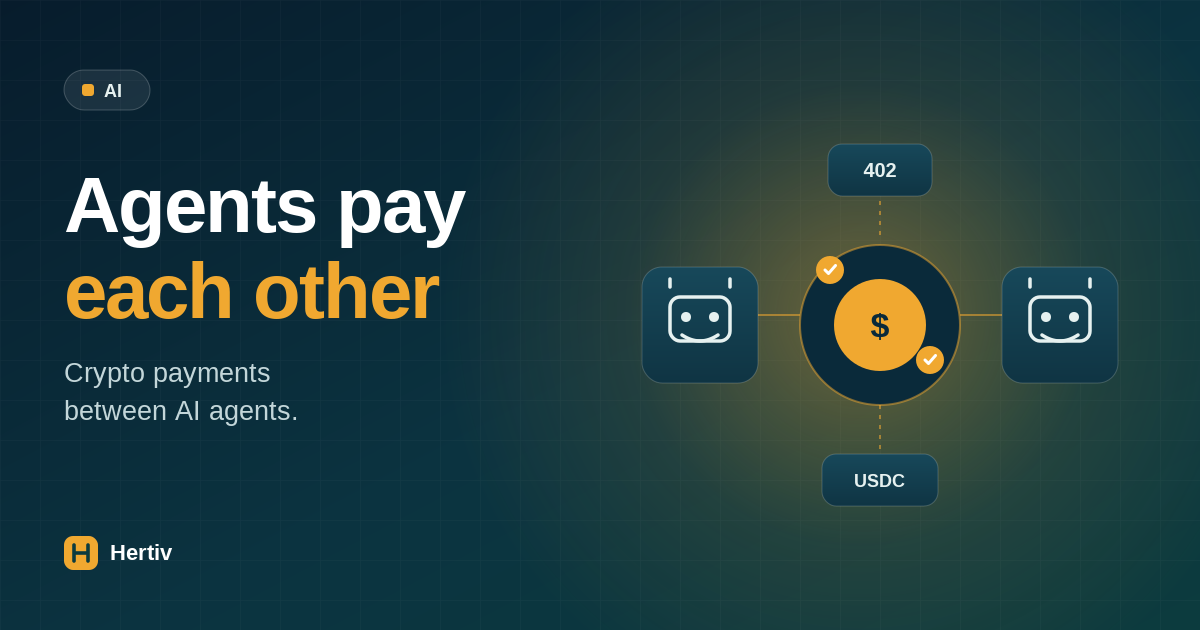
An AI-to-AI crypto transaction is a payment one software agent sends to another using cryptocurrency, usually a stablecoin, with no human clicking approve. One agent asks another for a service, the second agent quotes a price, and the first agent pays from its own wallet, so a whole chain of work can settle itself.
What is an AI-to-AI crypto transaction?
An AI-to-AI crypto transaction is a payment one software agent sends to another using cryptocurrency, usually a stablecoin, with no human clicking approve for each step. One agent asks another for a service, such as a data lookup or a computation, the second agent quotes a price, and the first agent pays from its own wallet.
Agents cannot hold a bank account or a credit card, and they cannot fill out a signup form or pass a card check. Crypto fits because a wallet is only a pair of keys, and a payment is only a signed message. That is why the first real machine-to-machine payments run on stablecoins rather than on card networks.
The simplest picture is a research agent that needs a weather forecast. It asks a data agent for the forecast, the data agent replies with a price, and the research agent pays in stablecoins and gets the data. For what an agent is in the first place, see what an AI agent is.
Why do AI agents need crypto to pay each other?
Agents work at machine speed and in tiny amounts, and traditional payment rails were built for humans. A card payment needs an account, a billing address and a fraud check, and the fees make a payment worth a few cents pointless. A stablecoin payment needs none of that, and it settles in seconds.
The second reason is autonomy. An agent that must stop and wait for a human to approve every payment cannot finish a multi-step job on its own. With a wallet and a spending limit set in advance, the agent can buy what it needs, when it needs it, and the human only reviews the total.
The third reason is that crypto payments are programmable. A payment can carry conditions, such as paying only when the work is delivered, or splitting a fee between two agents. That makes it possible to build chains of agents where each one is paid for its part. For the money itself, see what a stablecoin is.
How does an x402 payment work?
The x402 protocol, launched by Coinbase in May 2025, is the most widely used way for agents to pay for a service over the web. It revives the HTTP 402 Payment Required status code, which has sat unused in the web standard since the 1990s, and uses it to ask for a stablecoin payment inside an ordinary web request.
| Step | What happens | Who does it |
|---|---|---|
| 1. Ask | Agent requests a resource from a server | Paying agent |
| 2. Price | Server answers 402 with price, token and address | Server |
| 3. Pay | Agent signs a stablecoin payment and retries | Paying agent |
| 4. Check | Server or a facilitator verifies the payment on chain | Server or facilitator |
| 5. Deliver | Server returns the resource with a 200 response | Server |
The whole exchange happens inside one request cycle, with no API key, no subscription and no billing dashboard. The first version settled USDC on Base, and version 2, shipped in December 2025, added more chains and tokens. A facilitator can also screen the payment against sanctions lists before the server delivers the resource.
How do agents prove who they are?
Paying a stranger is risky, and agents are strangers by default, so a second standard answers the trust question. ERC-8004, proposed in August 2025 by authors from MetaMask, the Ethereum Foundation, Google and Coinbase, gives AI agents an on-chain identity, a reputation record and a way to have their work checked.
The standard defines three registries. The identity registry mints each agent as an ERC-721 token, so an agent has a portable identifier any app can look up. The reputation registry lets clients post signed feedback about an agent's work. The validation registry lets an agent ask an independent validator to check a piece of work and record a score.
The identity and reputation registries have run on Ethereum mainnet since January 2026, and the standard is still a draft, so its interfaces may still change. Even so, it is the main answer to the question every agent payment raises: how do you know the agent you are paying is who it claims to be, and whether it does good work?
How does permission work when an agent spends money?
Payment is only half the problem. The other half is permission: proving that a human approved this agent spending this money. Google's Agent Payments Protocol, known as AP2, answers it with signed mandates. AP2 was announced in September 2025 with more than 60 launch partners.
An AP2 mandate is a signed record of what was approved. A checkout mandate covers what is being bought, and a payment mandate covers how it is paid for. A merchant or payment provider can verify the mandate without talking to the user again, so the agent can complete a purchase the user already approved.
AP2 does not move money itself, and that is the point. It is payment-method agnostic: the same flow can end in a card payment, a bank transfer or a stablecoin transfer. For crypto, Google released the A2A x402 extension with Coinbase, the Ethereum Foundation and MetaMask, so an AP2 flow can settle in stablecoins through x402. For the contracts that enforce these rules on chain, see how smart contracts work.
Example (hypothetical): a research agent buys data
Example (hypothetical): a research agent is asked to compare hotel prices in three cities. It finds a data agent that sells live hotel prices at $0.01 per lookup, and it needs 500 lookups, so the data costs 500 x $0.01 = $5.00. It also buys three city guides at $2.00 each, which is 3 x $2.00 = $6.00, giving a total of $11.00.
The user set a daily spending cap of $15.00 for the research agent, so the $11.00 total fits inside the cap, and the agent completes the job without asking the user again. Each payment goes through x402 in stablecoins, and each data agent's identity is checked against the ERC-8004 registry before the first payment.
The next day the same job needs only 200 lookups, so the data costs 200 x $0.01 = $2.00, plus the same three guides at $6.00, giving $8.00 in total. The pattern is the same every day: small payments, a fixed cap, and a record of what was bought. For setting up the wallet the agent pays from, see how to create a crypto wallet.
What are the common mistakes?
The most common mistakes with AI-to-AI crypto transactions are giving an agent an open wallet, paying an agent nobody has checked, and treating a payment as proof of quality.
- No spending cap. An agent with an open wallet can spend without limit if it loops or is tricked. Set a per-transaction and daily cap before it starts.
- Paying an unknown agent. A wallet address is not an identity. Check the agent's reputation and registration before the first payment.
- Confusing payment with quality. A payment proves money moved, not that the work was good. Use validation or a small test order first.
- Forgetting the mandate. If a human did not approve the spending, the agent should not be able to spend. Keep the permission record with the payment.
- One chain only. An agent that can only pay on one chain cannot buy from agents on another. Plan for more than one settlement network.
- No audit trail. Without a log of who paid whom for what, a dispute has no evidence. Keep every payment and its mandate.
Key takeaways
- An AI-to-AI crypto transaction is one agent paying another in stablecoins, with no human approving each step
- Agents cannot hold bank accounts, so crypto wallets are the natural way for them to pay
- x402 uses the HTTP 402 status code to ask for a stablecoin payment inside a web request
- ERC-8004 gives agents an on-chain identity, a reputation record and independent validation
- AP2 proves a human approved the spending, using signed mandates, without moving the money itself
- Set a spending cap, check the agent's identity and keep an audit trail for every payment
Frequently asked questions
What is an AI-to-AI crypto transaction?
It is a payment one AI agent sends to another using cryptocurrency, usually a stablecoin, with no human approving each step. One agent asks for a service, the other quotes a price, and the first agent pays from its own wallet.
Why do AI agents pay in crypto instead of using cards?
Agents cannot hold a bank account or a credit card, and card fees make tiny payments pointless. A crypto wallet is only a pair of keys, and a stablecoin payment settles in seconds with no signup form or billing address.
What is x402?
x402 is a payment protocol launched by Coinbase in May 2025. It uses the HTTP 402 Payment Required status code so a server can ask for a stablecoin payment inside an ordinary web request, and the client pays and retries in the same cycle.
What is ERC-8004?
ERC-8004 is an Ethereum standard, proposed in August 2025, that gives AI agents an on-chain identity, a reputation record and a way to have their work validated. It helps one agent decide whether to trust another before paying it.
What is AP2?
AP2, the Agent Payments Protocol, was announced by Google in September 2025. It uses signed mandates to prove a human approved a specific purchase, without moving money itself. The same flow can settle by card, bank transfer or stablecoin.
Is it safe to let an AI agent spend money on its own?
It can be, with limits. Give the agent a per-transaction and daily spending cap, require a signed permission record, check the other agent's identity and reputation first, and keep a log of every payment so disputes have evidence.


