AI-Powered Contact Lenses: What They Can and Cannot Do
AI-powered contact lenses promise health sensing and displays worn on the eye, but none is on sale. Here is what the prototypes can and cannot do.
On this page
Short answer
AI-powered contact lenses are lenses worn on the eye that carry tiny sensors, a display, or both, with software that turns the signals they collect into readings or images. They are not on sale to the public, and every working example today is a prototype or a research device.
What are AI-powered contact lenses?
AI-powered contact lenses are lenses worn on the eye that carry tiny sensors, a display, or both, with software that turns the signals they collect into readings or images. They are not on sale to the public, and every working example today is a prototype or a research device.
The idea is simple: the eye sits close to blood vessels and tear fluid, so a lens can measure things that a wrist device cannot, and a display in a lens can show information without a screen in your hand. The engineering is hard, because a lens must stay clear, comfortable, safe and powered while sitting directly on the eye.
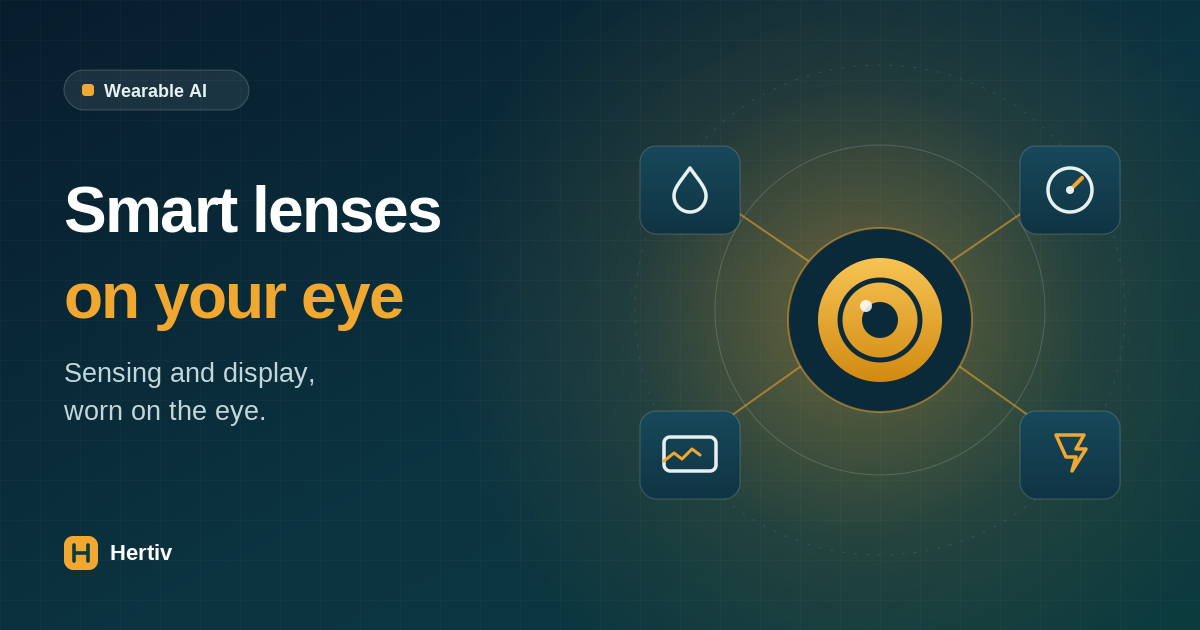
Three directions are being explored: sensing health signals from tears, measuring pressure inside the eye, and showing simple images in the wearer's view. Each one is at a different stage, and none of them is a finished product. For the wider field, wearable technology in healthcare covers what body-worn sensors can already do.
What can a smart contact lens sense or show?
A smart lens can in principle sense several signals from the eye, and show simple information back to the wearer. The table below separates what researchers have demonstrated from what is still only an idea.
| Capability | What it measures or shows | Status |
|---|---|---|
| Glucose in tears | Sugar levels in tear fluid | Research, no product on sale |
| Eye pressure | Pressure inside the eye, linked to glaucoma | Prototypes and early tests |
| Drug delivery | Slow release of medicine to the eye | Research stage |
| Micro-display | Simple text and icons in view | Prototype demonstrated in 2022 |
| Wireless power | Charging through the air, no wires | Prototypes shown in 2025 |
The gap between a demonstration and a product is wide. A lens that works once in a lab still needs to work all day, on many different eyes, without harming vision, before it can be sold.
How does the AI turn eye signals into readings?
A sensor in a lens produces raw numbers, not answers. The AI turns those numbers into a reading by comparing them with patterns learned from earlier tests, and by correcting for the ways eyes differ from person to person.
- Calibration. The system learns what normal looks like for one wearer, because tear chemistry and eye pressure vary between people.
- Filtering. Blinks, movement and dry eyes add noise, and the software has to separate signal from noise.
- Timing. Some signals lag behind the body, so the software must account for the delay before it reports a value.
This is where the glucose story went wrong. The best-known glucose lens project, run by Google's Verily, was stopped in 2018 because tear glucose did not track blood glucose closely enough for a medical device. The sensors worked; the biology did not cooperate. That lesson shapes every lens project since.
Where is the technology today?
No smart contact lens is on sale to consumers, and no lens has been cleared by a regulator to measure glucose. What exists is a set of prototypes, research papers and company demonstrations, each covering one part of the problem.
The display track went furthest in public. Mojo Vision showed a feature-complete augmented reality lens worn on the eye in June 2022, then stopped the lens project in early 2023 and moved its work to micro-LED displays.
The sensing track is still in research and early clinical testing, including pressure sensing for glaucoma and tear-based biomarker work. New prototypes, such as the lenses shown at MWC 2025, keep the field moving, but they are demonstrations, not products.
That means the honest answer to "when can I buy one?" is that nobody can say. Timelines in press coverage are forecasts, not release dates, and the history of this field is a reminder that a working prototype is not a product. The wearable field around it is further along, as building IoT wearables shows.
What are the limits and safety questions?
A lens sits on the most sensitive surface of the body, so the safety bar is higher than for a watch or a phone. Power, heat, oxygen and vision all have to be protected at the same time.
- Power. A lens needs energy, and a battery or wireless power must be safe to wear on the eye for hours.
- Oxygen. Sensors and electronics can block oxygen reaching the eye, which matters for long wear.
- Vision. Any display or opaque part must not block sight or distract the wearer.
- Data. Eye data is health data, so it needs the same protection as any medical record.
Regulators will ask for proof on each of these points before a lens can be sold as a medical device. A lens sold for display alone faces a lower bar, but it still has to prove it does not harm the eye.
Example (hypothetical): a clinic trials pressure-sensing lenses
Example (hypothetical): an eye clinic follows 40 glaucoma patients who need their eye pressure checked four times a year. A standard visit takes 30 minutes, so the clinic spends 40 times 4 times 30 minutes, or 80 hours a year, on pressure checks alone.
With pressure-sensing lenses, each patient wears a lens for one day each quarter and the clinic reads the results remotely. A review of one patient's day of readings takes 10 minutes, so 160 reviews take about 27 hours a year, and the clinic also sees pressure changes between visits that a single check would miss.
The saving is about 53 hours a year, but the real gain is the extra data, not the time. The clinic still needs in-person visits for anything the lens cannot see, and the lens readings still need to be checked against standard tests before anyone acts on them.
What are the common mistakes?
The most common mistakes come from treating prototypes as products. A demonstration video is not a release date, and a research result is not a medical claim.
- Assuming a glucose lens can replace finger-prick tests, when no such lens is approved.
- Trusting launch dates in press coverage, which are forecasts rather than commitments.
- Ignoring the safety questions: power, oxygen, vision and data protection.
- Buying into a "smart lens" product that is really a normal lens with an app.
The field is real and moving, but slowly. The right question is not when lenses arrive, but which problem each prototype actually solves, and what proof exists behind the claim. Until a lens clears those tests, every claim about it should be read as a research update, not a buying guide.
Key takeaways
- No AI-powered contact lens is on sale, and none is cleared to measure glucose.
- Lenses aim to sense tears and eye pressure, deliver drugs, or show simple images.
- The glucose lens failed because tear readings did not track blood sugar closely enough.
- Power, oxygen, vision and data protection are the safety questions that matter.
- A working prototype is not a product; timelines in press coverage are forecasts.
Frequently asked questions
Can I buy AI-powered contact lenses today?
No. As of 2026, no smart contact lens is sold to consumers, and none is cleared to measure glucose. What exists are prototypes and research devices from companies and universities, and any product claiming to be a smart lens for sale should be checked carefully.
Can a contact lens measure blood sugar?
Not reliably yet. The best-known attempt, Google's Verily glucose lens, was stopped in 2018 because tear glucose did not track blood glucose closely enough. Research continues, but no lens today replaces a blood glucose meter or a finger-prick test.
Are smart contact lenses safe?
That is still being tested. A lens must prove it does not block oxygen, heat the eye, harm vision or leak data before regulators will clear it. Early prototypes are tested under supervision, and long-term safety data does not exist yet.
What is the difference between a smart lens and AR glasses?
A smart lens sits on the eye and can sense the eye itself, while AR glasses sit on the face and show images on a lens in front of the eye. Glasses are on sale today; lenses are not, because fitting electronics into a lens is far harder.
Will smart lenses replace smartphones?
No, not in any timeframe that matters for planning. A lens can show simple information and sense health signals, but it cannot replace a phone's screen, keyboard or battery. The realistic future is a lens that adds sensing, not one that replaces the phone.
Who is working on smart contact lenses?
Research teams at universities work on sensing and drug delivery, and companies have shown prototypes for displays and pressure sensing. Mojo Vision demonstrated an AR lens in 2022 before stopping the project in 2023, and new prototypes continue to appear at trade shows.