AI-Powered Cameras: How They See and What They Do
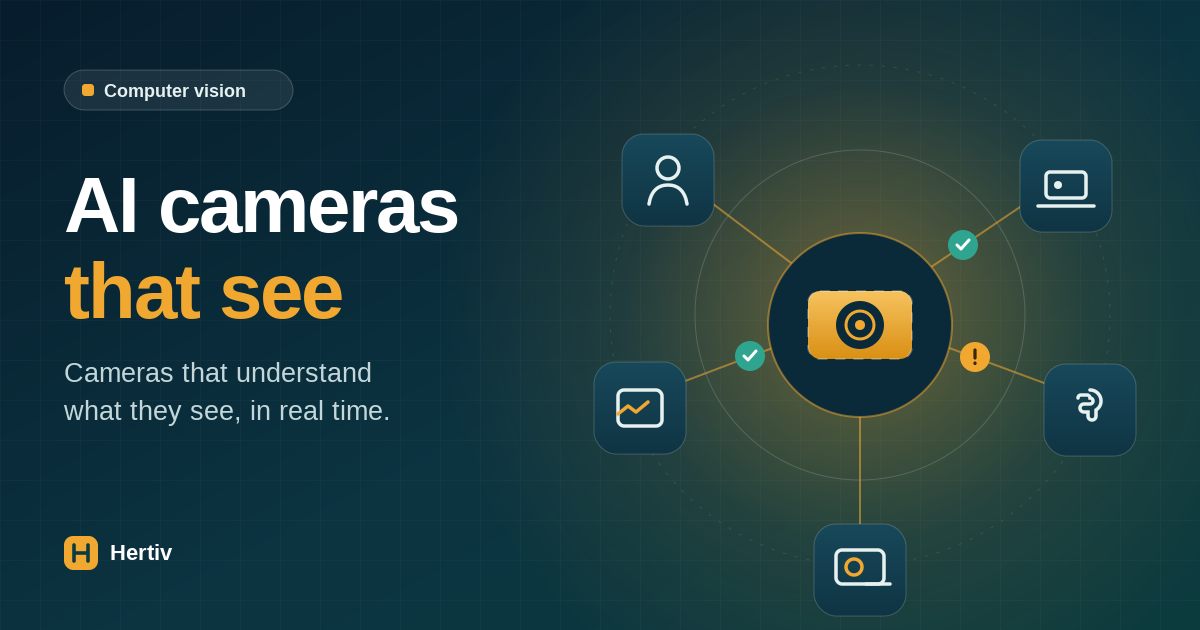
An AI-powered camera runs vision software on the video it records, so it can spot people, vehicles and events and act on them. Here is how it works.
On this page
Short answer
An AI-powered camera is a camera with vision software built in, either on the camera itself or on a nearby server. It watches the video feed, recognises people, vehicles, objects and behaviour, and then raises an alert, starts a recording or triggers another system. It does not watch everything; it looks for the events you told it to find.
What is an AI-powered camera?
An AI-powered camera is a camera that runs computer vision software on the video it captures, so it can understand what it sees instead of only recording it. A normal camera stores footage for a person to review later. An AI camera reviews the footage as it arrives and flags only the moments that match a rule you set.
The software can run on the camera, on a small box beside it, or on a server in the cloud. On-camera processing keeps the video private and works when the network drops, while cloud processing can run larger models. Most systems mix the two: the camera detects motion and shapes, and the server does the heavier checks.
| Use | What it watches | What the AI adds | Typical output |
|---|---|---|---|
| Security | Doors, yards, car parks | Person and vehicle detection | Alert with a short clip |
| Retail | Shelves, queues, entrances | Counting and heat maps | Daily footfall report |
| Traffic | Junctions, lanes, crossings | Plate and flow reading | Counts and violation flags |
| Factory | Lines, machines, exits | Safety-gear and fault checks | Alert to the floor manager |
| Farm and wildlife | Fields, barns, trails | Animal and intruder detection | Nightly summary of visits |
The point is not to replace people. It is to cut the hours of footage nobody watches down to a short list of events a person can check in minutes. For teams that already use vision on the factory floor, computer vision in manufacturing covers the inspection side in more depth.
How does an AI-powered camera work?
An AI-powered camera works in five steps: capture, detect, classify, decide and act. Each step narrows the video down, so only the events that matter reach a person.
- Capture. The sensor records video, usually at 1080p or higher, and sends frames to the vision software.
- Detect. A model scans each frame for shapes that matter, such as people, vehicles, animals or boxes.
- Classify. The model labels what it found: a person, a delivery van, a forklift, a dog.
- Decide. Rules compare the label with your settings, such as a person in a closed zone after 10 pm.
- Act. The system sends an alert, saves a clip, sounds a buzzer or opens a gate.
Most of the work happens in step two. Modern models can spot a person in a frame in a fraction of a second, which is why alerts arrive while the event is still happening. The model is only as good as its training data, so a camera trained on daylight street scenes may miss a person in a dark warehouse until it is tuned for that setting.
What can AI cameras detect?
AI cameras can detect people, vehicles, animals, objects and behaviour, and the useful ones combine several of these into one rule. A camera that only sees people is a motion sensor with a better name. A camera that sees a person, a ladder and a closed gate at 2 am is doing real work.
People detection covers counting, loitering, falls and entry into marked zones. Vehicle detection covers plates, vehicle type, speed and wrong-way driving. Object detection covers missing safety gear, a blocked fire exit, a parcel left behind or a shelf that is empty. Behaviour detection covers running, fighting, crowding and a person who has not moved for a long time.
Detection quality depends on the scene. A camera that watches a bright, open yard will do better than one that watches a dim corridor with glare from a window. Before you buy, test the camera in the exact spot it will sit, at the times of day that matter, and count how many alerts are real.
Where are AI cameras used?
AI cameras are used in security, retail, traffic, factories, farms and homes, and the job is different in each place. The shared pattern is the same: too much video for people to watch, and a short list of events that need a human decision.
In security, cameras watch perimeters and raise an alert only when a person crosses a line after hours. In retail, they count visitors, measure queues and show which shelves draw attention. In traffic, they read plates, count vehicles and flag blocked lanes. In factories, they check that workers wear helmets and gloves and that exits stay clear. On farms, they watch gates and barns at night and flag animals or intruders.
At home, the same idea appears in doorbell cameras that tell a parcel from a person. The scale is smaller, but the logic is identical: the camera filters the video so the owner only sees what needs a decision. Video monitoring software compares the tools that manage these feeds.
What are the limits of AI cameras?
AI cameras are limited by light, weather, false alarms, privacy rules and cost, and each limit shapes where they work well. A camera that performs in a test room may fail in rain, fog or low light, so field testing matters more than the brochure.
False alarms are the most common problem. A tree branch, a shadow or a pet can trigger a person alert, and if alerts fire too often people stop checking them. The fix is to tune the detection zone, set a minimum object size and require two signals, such as a person plus motion in a marked zone, before an alert goes out.
Privacy is the second limit. A camera that records staff, customers or neighbours must follow local law on notice, storage and access. Faces and plates are personal data in many places, so a deployment needs a written policy on who can watch, how long footage is kept and when it is deleted. Cost is the third limit: the camera is only part of the bill, and storage, licences and tuning add up.
Example (hypothetical): a warehouse with 40 cameras
Example (hypothetical): a warehouse runs 40 cameras, each recording 24 hours a day. That is 960 hours of footage every day, far more than any team can watch. The site has one guard per shift, and a guard can watch about 4 feeds at once with any care.
The team adds AI detection with two rules: a person in the loading bay after 9 pm, and a forklift entering a pedestrian walkway. In the first week the system flags 12 clips a day, each about 5 minutes long. That is 60 minutes of footage to review, down from 960 hours.
Of the 12 clips, 9 are real events and 3 are false alarms from a cleaning cart. The team narrows the detection zone and the false alarms fall to 1 a day. The guard now spends an hour a day on real events instead of watching feeds that show nothing. The arithmetic is simple; the hard part is setting rules that match the site, not the demo.
What are the common mistakes?
The most common AI camera mistakes are buying hardware before defining the events, skipping field tests, ignoring privacy and trusting every alert. Each one is easy to avoid with a short pilot.
- Buying cameras before rules. A camera without a defined event list is just a recorder. Write the events first.
- Testing in the wrong light. A demo in daylight says nothing about a dark yard at 2 am. Test at the worst hour.
- Skipping the privacy policy. Staff and visitors need to know what is recorded, who watches and how long it is kept.
- Alerting on one signal. A single motion trigger fires on shadows and pets. Require two signals for an alert.
- No review loop. If nobody checks whether alerts were real, accuracy never improves. Review a sample each week.
Start with one site and two or three rules, measure how many alerts are real, and only then roll out wider. Sites that watch workers should also read AI site safety monitoring for the safety-angle checks.
Key takeaways
- An AI-powered camera understands video as it arrives, instead of only recording it.
- Most systems detect, classify, decide and act in under a second.
- The value is filtering: 960 hours of footage becomes an hour of real events.
- Light, weather and false alarms are the main limits, so field testing matters.
- Privacy rules decide what you may record, who may watch and how long it is kept.
Frequently asked questions
What is the difference between an AI camera and a normal security camera?
A normal camera records video for a person to review later. An AI camera reviews the video as it arrives and flags only the events that match a rule, such as a person in a closed zone. The hardware can look identical; the difference is the software that watches the feed.
Do AI cameras need the internet to work?
Not always. Cameras with on-device processing detect people and vehicles without a connection, and only send alerts when the network is up. Cloud-based systems need a stable connection for the heavier checks, so many sites run detection locally and use the cloud for storage and review.
How accurate are AI cameras?
Accuracy depends on the scene, the light and how the camera was tuned. A well-tuned camera in a fixed spot can be right most of the time, while the same camera in rain or glare will miss events and fire false alarms. Always measure accuracy in the real location before you trust the alerts.
Can AI cameras read number plates?
Yes, many traffic and parking cameras read plates as part of their job, and the better ones do it on the camera itself. Plate reading is personal data in many places, so a deployment needs a legal basis, a retention limit and a plan for who can see the data.
Are AI cameras expensive to run?
The camera is only part of the cost. Storage, software licences, network bandwidth and the time spent tuning rules all add up. A small site with a few cameras can run cheaply, while a large site with hundreds of feeds needs a real budget for storage and review.
Do AI cameras replace security guards?
No. They replace the hours a guard spends watching empty feeds, not the guard. A person still needs to check alerts, decide what to do and handle the cases the software cannot judge. The best setups pair a short alert list with a guard who can act on it.