AI Portfolio Data Automation: How It Cleans Up Investment Data
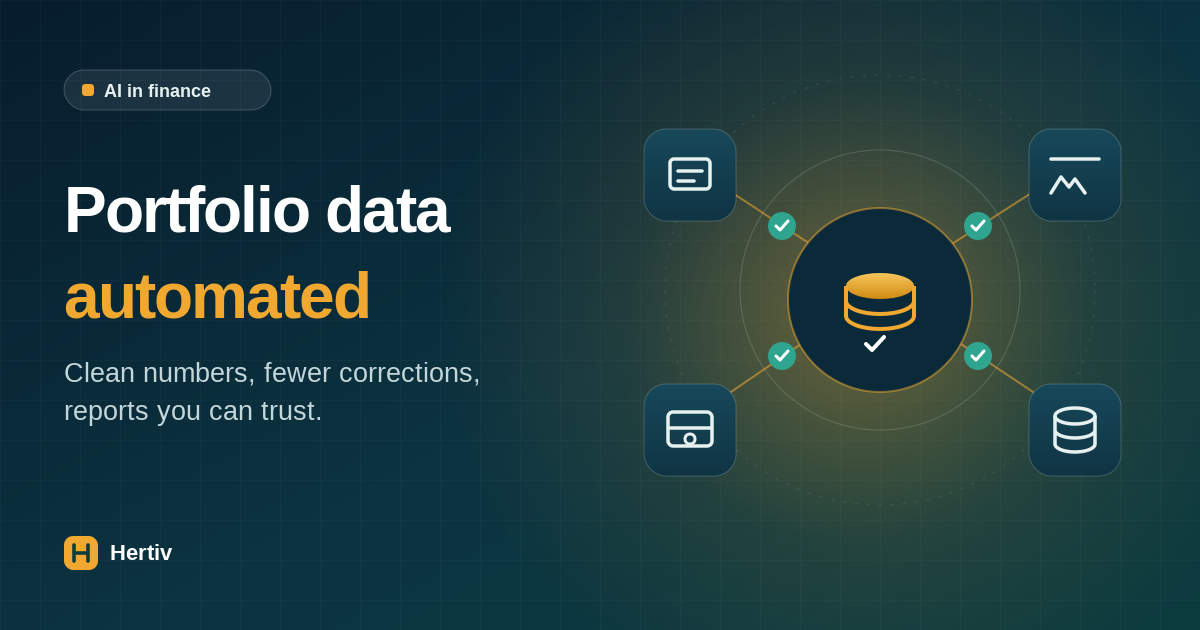
AI portfolio data automation gathers positions, prices and cash from every source, checks them against each other and hands advisors clean data they can trust.
On this page
Short answer
AI portfolio data automation collects investment data from custodians, brokers and market feeds, matches holdings and cash across sources, flags every break, and publishes only checked data. It removes the manual reconciliation that causes most reporting errors, while keeping a person in charge of the exceptions.
What is AI portfolio data automation?
AI portfolio data automation is software that collects investment data from every source a firm uses, checks it for errors and gaps, and turns it into clean, ready-to-use records without someone retyping or reconciling it by hand.
A portfolio is only as good as its data. Positions arrive from custodians, prices come from market data feeds, cash movements sit in bank statements, and corporate actions arrive as documents. When any of those disagree, reports, valuations and advice all go wrong.
The automation does three jobs at once:
| Data problem | What the automation does | Why it matters |
|---|---|---|
| Positions that disagree across sources | Matches holdings line by line and flags breaks | Reports show the same numbers everywhere |
| Stale or missing prices | Pulls fresh prices and fills gaps from a second feed | Valuations stay current |
| Corporate actions buried in documents | Reads the notice and applies the adjustment | Holdings stay correct after splits and mergers |
| Cash that does not tie out | Reconciles trades, fees and income against the bank | Clients see money they can trust |
| Reports built by hand | Builds the same report from the same checked data | Less rework before every client meeting |
The AI part is pattern matching at scale: spotting that a price moved far more than usual, that a holding vanished after a merger, or that a fee looks wrong for the account type. It does not decide what to buy. It makes sure the numbers behind the decision are right.
Where does portfolio data come from?
Portfolio data comes from at least four places, and each one speaks a different language. That is why the first job of any automation is to gather and translate, not to analyse.
Custodians hold the assets and report positions and transactions, usually as files or feeds. Brokers add trade confirmations and settlement details. Fund administrators send valuations for funds that do not trade on an exchange. Market data providers supply prices, exchange rates and reference data for each security.
On top of those feeds sit documents: corporate action notices, tax statements, fee schedules and client instructions. Some arrive as PDFs, some as emails, and some as scanned pages. A person used to read each one and type the details into a spreadsheet.
Good automation connects to the feeds directly and reads the documents with document AI, so the same holding is not typed twice in two systems. For firms that already run AI agents for finance teams, the data layer is the part that makes those agents useful instead of misleading.
The practical test is simple: can you name, for any client, where each number in their report came from? If the answer needs a phone call, the data is not yet automated.
How does the automation work, step by step?
The automation runs as a daily routine, not as a one-off project. Most firms run it overnight so the data is checked before the working day starts.
- Collect. Pull positions, transactions, prices and cash from every feed and inbox into one place.
- Normalise. Map each source's codes and labels to one shared set, so the same security is never counted twice under two names.
- Match. Compare holdings, trades and cash across sources and list every break, however small.
- Check. Run validation rules: prices within a sensible range, totals that add up, dates that make sense.
- Fix or flag. Correct the breaks the rules can prove, and send the rest to a person with the evidence attached.
- Publish. Lock the checked data and feed it to reports, dashboards and advice tools.
Steps three and four are where the AI earns its keep. A rule can say a price moved more than 5% in a day; the model can say the move matches a stock split, a dividend, or a genuine market shock, and route each case differently.
Nothing is deleted along the way. Every change keeps the original value and the reason, so an auditor can trace any number back to its source.
What breaks does it catch that spreadsheets miss?
Spreadsheets catch the errors a person happens to notice. Automation catches the ones nobody looks for, because it checks every line every day instead of the lines someone opens.
One common catch is the quiet price error: a bond priced from a feed that stopped updating, so a portfolio looks flat while the market moved. Another is the duplicate holding, where the same position arrives from a custodian and a broker under different codes and gets counted twice.
Corporate actions are the richest source of mistakes. A stock split halves the price and doubles the quantity; if only one half is applied, the holding looks wrong by half. A merger can rename a security, so the old name vanishes and the new one appears as if it were a fresh purchase.
Cash is another weak spot. Fees, tax withheld and income distributions all move money, and each one needs to land in the right account. When cash does not tie out, the usual cause is a fee taken from the wrong account or a dividend booked twice.
These are the same kinds of breaks that RPA in wealth management was built to chase, but rules alone cannot judge whether a price move is plausible. The AI layer adds that judgement, and it learns from every break a person confirms or rejects.
Example (hypothetical): a small advisory firm cleans up its data
Example (hypothetical): a firm with 12 advisors looks after 240 client accounts holding about 1,800 positions in total. Two analysts spend 10 hours each a week reconciling positions and prices by hand, which is 20 hours a week, and client reports still go out with corrections attached.
The firm connects its custodian feeds, a price feed and the inbox where corporate action notices arrive. Each night the automation matches holdings and cash, checks prices, and lists the breaks. Each morning one analyst spends 45 minutes reviewing the list, five mornings a week, which is 3 hours and 45 minutes a week.
The weekly reconciliation work falls from 20 hours to under 4 hours, saving about 16 hours a week. More useful than the time saved, the number of corrected reports drops: in the first month the system flags 38 breaks, of which 31 are real errors that would have reached a client report.
The firm keeps one rule: no number reaches a client until a person has seen the break list for that day. The automation does the checking; the advisor keeps the responsibility.
What checks keep automated data trustworthy?
Automation is only worth using if you can prove the data it produces. That proof comes from checks that run before anyone sees a report, not from hoping the system is right.
Start with source checks: every feed must arrive on time and complete, and a missing feed should stop the run rather than let old data pass as new. Then run value checks: prices inside a plausible range, quantities that match the custodian, and cash that ties out to the bank to the cent.
Keep a full audit trail. Every correction should record the old value, the new value, the source that justified it, and who approved it. If a client questions a number, you should be able to answer in minutes, not days.
Test the system the way you would test a person. Feed it a known set of tricky cases — a split, a merger, a missing price, a fee in the wrong account — and check it handles each one. Repeat the test whenever a rule changes.
Finally, keep a human in the loop for the breaks that matter. A model can rank breaks by size and likelihood, but a person should decide whether a large unexplained movement is an error or a real market event. That division of labour is also how AI white-label wealth management firms keep their launches safe: automation does the volume, people keep the judgement.
What are the common mistakes?
The most common mistakes in portfolio data automation are trusting the feed, skipping the audit trail, and automating a mess instead of fixing it first.
- Trusting every feed. A feed can be late, stale or wrong. Check that it arrived and that it is complete before you use it.
- Automating bad data. If two systems disagree about what a holding is called, automation will faithfully reproduce the confusion faster. Fix the naming first.
- No audit trail. If you cannot show where a number came from, you cannot defend it to a client or a regulator.
- Letting the system correct silently. Auto-fixes should be limited to cases the rules can prove. Everything else goes to a person.
- Forgetting corporate actions. Splits, mergers and dividends are where most errors hide, so test them explicitly.
- Measuring speed, not accuracy. A fast report with wrong numbers is worse than a slow one. Track breaks found and reports corrected.
Done well, the payoff is quiet: fewer corrections, faster reports, and advisors who trust the numbers in front of them.
Key takeaways
- Clean data starts with matching every holding and cash movement across sources, not with better reports
- Corporate actions cause most portfolio data errors, so test splits, mergers and dividends first
- Every correction needs an audit trail: old value, new value, source and approver
- Auto-fix only what the rules can prove; send the rest to a person with the evidence attached
- Measure breaks found and reports corrected, not how fast the report was produced
Frequently asked questions
What is AI portfolio data automation?
It is software that collects investment data from custodians, brokers and market feeds, checks holdings, prices and cash against each other, and produces clean records for reports and advice. It replaces manual retyping and spreadsheet reconciliation.
Does AI portfolio data automation replace advisors?
No. It replaces the checking work, not the judgement. Advisors still decide what to recommend and explain it to clients. The automation makes sure the numbers behind those decisions are correct and traceable.
What data does it need to work?
It needs position and transaction feeds from custodians and brokers, a price feed, bank statements for cash, and corporate action notices. The more complete the sources, the fewer gaps it has to flag.
How does it handle corporate actions?
It reads the notice, applies the split, merger or dividend to the holding, and checks the result against the custodian. If the numbers do not agree, it flags the break for a person instead of guessing.
Is portfolio data automation only for large firms?
No. Small firms feel the pain most, because one person often does the reconciliation by hand. A small firm can start with one custodian feed and one price feed, then add sources as the routine proves itself.
What should you check before buying a tool?
Check which feeds it connects to, how it handles breaks, whether it keeps a full audit trail, and what happens when a feed is late. Ask for a trial on your own data, not a demo on clean sample data.