AI Infectious Disease Surveillance: How Early Warnings Work
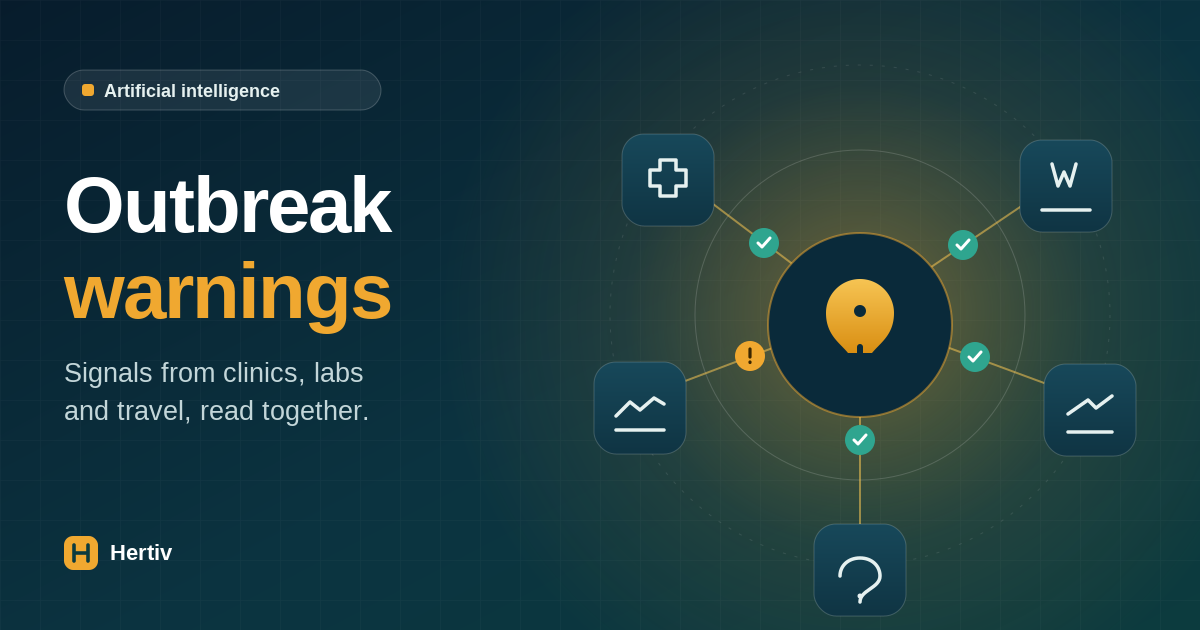
AI infectious disease surveillance reads clinic reports, lab results and travel data to spot outbreaks early. Here is how warnings are built and what they miss.
On this page
Short answer
AI infectious disease surveillance is the use of software to watch many health and behaviour signals at once, so that an outbreak of an infectious disease is spotted days or weeks earlier than it would be through clinic reports alone.
What is AI infectious disease surveillance?
AI infectious disease surveillance is the use of software to watch many health and behaviour signals at once, so that an outbreak of an infectious disease is spotted days or weeks earlier than it would be through clinic reports alone.
Traditional surveillance waits for doctors to diagnose cases and report them up a chain. That works, but it is slow: a patient has to fall ill, seek care, get tested and be reported before anyone sees a pattern. AI surveillance adds faster signals, such as pharmacy sales, school absences, search queries and wastewater testing, and looks for unusual changes across all of them together.
The goal is not to replace doctors or labs. It is to give public health teams an earlier hint that something is changing, so they can check, prepare and act while the number of cases is still small.
Where do the warning signals come from?
No single signal is enough on its own. A rise in cough medicine sales could mean a cold season, a holiday, or a real outbreak. The strength of AI surveillance is in combining several weak signals and checking whether they move together.
| Signal | What it shows | How fast it arrives |
|---|---|---|
| Clinic and hospital reports | Diagnosed cases and admissions | Days, after testing |
| Laboratory results | Confirmed infections by type | Days, after samples are processed |
| Pharmacy sales | People treating symptoms at home | Hours to a day |
| School and work absences | Groups falling ill together | A day |
| Travel and movement data | Where people may carry illness | Near real time |
| Wastewater testing | Virus levels in a whole area | Days, from sample to result |
Each source has gaps. Pharmacy sales miss people who do not buy medicine, and search queries can be driven by news rather than illness. That is why the systems compare signals against each other instead of trusting any one of them. For the patient-level side of prediction, see predictive diagnosis and disease forecasting.
How is an early warning built?
An early warning is built in stages, and a human reviews it before any public action is taken. The software flags a pattern; people decide what it means.
- Collect the signals. Reports, lab results, sales, absences and wastewater readings are gathered into one place, with dates and locations attached.
- Set the baseline. The system learns what is normal for each place and season, so a winter rise in coughs is not treated as an outbreak.
- Look for changes. It checks whether several signals are rising together in the same area, beyond what the baseline predicts.
- Score the pattern. A combined score weighs how strong the rise is, how many signals agree, and how unusual it is for that place.
- Send it for review. A public health analyst checks the raw reports, talks to local clinics, and decides whether to investigate, warn or wait.
- Track what happens. The outcome is recorded, so the system learns which patterns turned into real outbreaks and which were false alarms.
The human review step matters most. A score is a prompt to look, not a diagnosis, and a team that acts on every alert will soon stop trusting the system.
What can it catch, and what does it miss?
AI surveillance is best at catching outbreaks that spread through a community and produce symptoms people notice, such as flu-like illness or stomach bugs. It is weaker for diseases that spread slowly, have mild symptoms, or mainly affect people who do not seek care.
What it can do well:
- Spot a rise early. When several signals move together, a team can start checking days before case reports alone would show a trend.
- Show where it is spreading. Signals tied to places help teams see which districts are affected first.
- Track a known outbreak. Once an outbreak is confirmed, the same signals show whether it is growing or fading.
What it cannot do: it cannot diagnose a single patient, it cannot name the exact germ without lab tests, and it cannot work where the underlying data is missing or months out of date. A system fed by poor data will produce confident-looking warnings that are simply wrong. The limits of patient-level prediction are covered in AI in healthcare examples.
Who uses these warnings, and how are decisions made?
The main users are public health agencies, hospitals and health ministries. They use warnings to decide where to send testing kits, when to alert clinics, and when to warn the public.
A warning rarely triggers action on its own. The usual flow is: the system flags a pattern, an analyst checks the source reports, local clinics are asked whether they are seeing the same thing, and only then does a team decide to act. Small signals lead to small steps, such as extra testing, while strong signals across several sources can lead to public guidance.
Privacy rules shape every part of this. Health data is sensitive, so the systems work with counts and trends rather than named patients, and access is limited to the teams that need it. Any surveillance programme should publish what data it uses, who can see it, and how long it is kept.
Example (hypothetical): a city health team spots a rise
Example (hypothetical): a city health team watches 120 clinics. In a normal week, about 2 clinics report an unusual number of fever cases. One week, 8 clinics report it, pharmacy sales of fever medicine rise, and school absences in two districts climb on the same days.
The system scores the pattern as worth a look. The analyst calls the 8 clinics, confirms that most cases are a flu-like illness, and asks the lab to test samples from 20 patients. The tests show a seasonal flu strain, not a new germ.
The team sends extra flu vaccine to the two districts and alerts clinics to expect more cases. The outbreak was real, the cause was familiar, and the early warning bought the team about a week of preparation.
What are the common mistakes?
The most common mistakes in infectious disease surveillance are trusting one signal, ignoring the baseline, and acting before a human has checked the pattern.
- Trusting a single signal. Search queries spike when a disease is in the news, not only when people are ill. Always check a second source.
- Forgetting the baseline. Every winter looks like an outbreak if the system does not know what winter normally looks like.
- Acting on every alert. Too many false alarms teach teams to ignore the system, including the real warnings.
- Poor data coverage. A system that only watches wealthy districts will miss outbreaks where data is thin.
- No feedback loop. If nobody records which alerts were right, the system never improves.
For the research side of AI in health, see generative AI in life sciences.
Key takeaways
- AI infectious disease surveillance watches many signals at once to spot an outbreak earlier than clinic reports alone
- Clinic reports, labs, pharmacy sales, absences, travel data and wastewater each add a different signal
- A warning is a prompt for a human to check, not a diagnosis on its own
- The system is strongest for community-spread illness and weakest where data is thin or symptoms are mild
- Judge a surveillance system by its false alarm rate, not by its best catch
Frequently asked questions
What is the difference between disease surveillance and disease forecasting?
Surveillance watches what is happening now and flags unusual changes as they appear. Forecasting tries to predict what will happen next, such as how many cases a place may see in the coming weeks. Surveillance feeds forecasting, but the two answer different questions.
Can AI surveillance detect a brand-new disease?
It can flag that something unusual is happening, but it cannot name a new disease on its own. Naming a new germ needs lab testing and clinical investigation. The software's job is to point teams at the right place sooner.
Does AI surveillance replace doctors reporting cases?
No. Doctor and lab reports are the most reliable signal a system has. AI surveillance adds faster, weaker signals around them. Without the clinical reports to check against, the system cannot tell a real outbreak from noise.
What data does infectious disease surveillance use?
It uses counts and trends: clinic visit counts, lab result counts, pharmacy sales, school absence counts, travel patterns and wastewater readings. It should not need named patient records, and access should be limited to the public health teams that use it.
How accurate are AI outbreak warnings?
Accuracy varies by disease, place and data quality. Systems are best at spotting rises in common seasonal illness in areas with good data. The honest measure is how often alerts turn out to be real, which teams should track and publish.
Who should build an infectious disease surveillance system?
Public health agencies usually run them, often with help from universities or specialist firms. A single hospital or company rarely has the data coverage to run one alone.