8 AI in Healthcare Examples Worth Knowing
AI in healthcare already helps with scans, notes, drug research and bookings: here are eight real examples, what each does, and where it fits.
On this page
Short answer
AI in healthcare is already at work in hospitals and clinics, from reading scans to writing up visit notes and spotting patients who need extra care. These eight examples show what the technology actually does today, who uses it, and what it cannot do on its own.
What does AI in healthcare look like in practice?
AI in healthcare is not one product but a set of tools, each doing a narrow job: reading an image, drafting a note, predicting a risk or answering a routine question. The tools below are the ones hospitals and clinics use most often today.
| Example | What it does | Who uses it |
|---|---|---|
| Imaging triage | Flags scans that need a fast review | Radiology teams |
| Ambient scribing | Drafts visit notes from the conversation | Clinicians |
| Drug screening | Shortlists molecules for lab testing | Research teams |
| Risk prediction | Spots patients likely to need extra care | Care teams |
| Scheduling | Fills slots and reminds patients | Front-desk teams |
| Remote monitoring | Watches readings from home devices | Chronic care teams |
| Pathology review | Pre-screens tissue slides | Labs |
| Claims and coding | Suggests codes from the visit record | Billing teams |
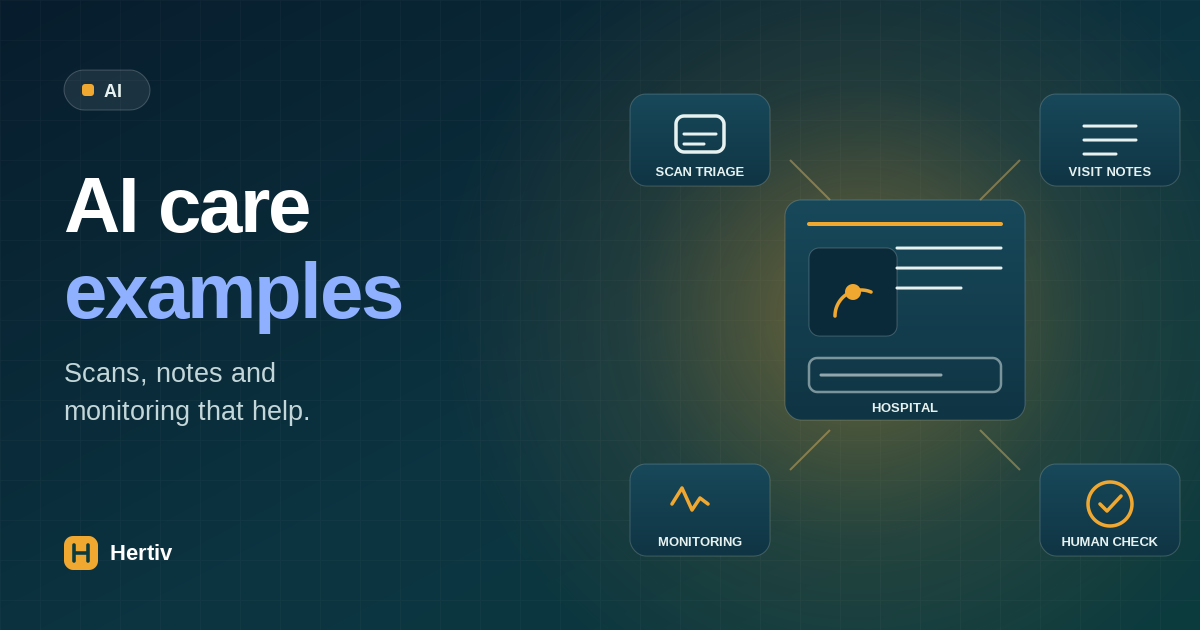
Every example below follows the same pattern: the AI does the repetitive first pass, and a person checks the result before it affects a patient. None of these tools replaces a clinician, and none of them should be used without that human check, a point AI use in healthcare makes in detail.
Imaging triage and ambient scribing
1. Imaging triage: best for busy radiology teams
Imaging triage tools read scans such as X-rays and CT images and sort them so the most urgent ones reach a radiologist first. A scan that looks like a stroke or a collapsed lung is flagged at once, while routine scans wait their turn in the queue.
The tool does not make the diagnosis. It ranks the worklist and draws attention to areas that look unusual, and the radiologist still reads every scan and writes the report. The gain is speed: urgent cases are seen sooner, and the team spends less time sorting.
- Pros: urgent cases reach a specialist faster; routine sorting takes less staff time.
- Cons: the tool can miss unusual cases and can flag normal scans, so every result needs a human read.
2. Ambient scribing: best for clinicians who write long notes
Ambient scribing listens to the visit, with the patient's consent, and drafts the clinical note from the conversation. The clinician reviews the draft, corrects anything wrong, and signs it off, instead of typing the whole note from scratch. The listening itself builds on speech recognition in healthcare.
The draft covers the history, the examination and the plan as discussed, which cuts the time a clinician spends on paperwork after the visit. The note is still the clinician's responsibility, and anything the tool misheard must be caught in the review.
- Pros: less time on notes after clinic; notes are written while the visit is fresh.
- Cons: the draft can mishear names, doses or numbers, so review takes care and time.
Drug screening and risk prediction
3. Drug screening: best for research teams with large libraries
Drug screening tools sort through huge libraries of molecules and shortlist the ones most likely to bind to a target, such as a protein involved in a disease. Researchers then test the shortlist in the lab, instead of testing everything.
The shortlist is only a starting point. Most candidates fail in lab tests, and the ones that pass still face years of safety and efficacy trials before they reach a patient. The value is in cutting the early search from millions of candidates to a manageable few hundred.
- Pros: narrows a huge search space quickly; lets labs focus on the best candidates.
- Cons: predictions are often wrong, and a good shortlist still needs years of lab work.
4. Risk prediction: best for care teams managing chronic illness
Risk prediction tools look at a patient's record, such as recent admissions, test results and medicines, and flag patients who are most likely to need hospital care soon. The care team then checks in with those patients first, for example with a phone call or an earlier appointment. The same record analysis underpins patient analytics in healthcare.
The flag is a prompt, not a decision. A nurse or doctor reviews the patient's situation and decides what to do, because the tool cannot see the full picture, such as whether the patient has family support at home.
- Pros: helps teams focus on the patients most at risk; catches problems earlier.
- Cons: can flag the wrong patients and can miss people with thin records.
Scheduling and remote monitoring
5. Scheduling and reminders: best for clinics with many no-shows
Scheduling tools fill empty slots, send reminders by text or call, and let patients rebook without phoning the clinic. When a patient cancels, the slot can be offered to someone on the waiting list straight away.
The gain is practical: fewer empty slots, fewer missed appointments and less time on the phone for front-desk staff. The tool needs the clinic's booking rules, such as which appointments need a longer slot, or it will fill the day with the wrong mix of visits.
- Pros: fewer empty slots and missed visits; less phone time for staff.
- Cons: needs accurate booking rules, and some patients still prefer to phone.
6. Remote monitoring: best for chronic care teams
Remote monitoring tools collect readings from devices patients use at home, such as blood pressure cuffs, glucose meters and pulse oximeters, and alert the care team when a reading falls outside the safe range. The team can then call the patient before a small change becomes an emergency.
The readings only help if someone watches them. A clinic that collects data without a clear process for acting on alerts will drown in notifications, so the team needs agreed thresholds and a named person on duty to respond.
- Pros: problems are spotted between visits; patients can stay at home longer.
- Cons: alert overload is common, and devices need charging, setup and support.
Pathology review and claims coding
7. Pathology slide review: best for labs with large caseloads
Pathology tools pre-screen digital slides of tissue samples and mark the areas most likely to contain abnormal cells. The pathologist then looks at those areas first, which speeds up the review of routine cases.
As with imaging, the tool ranks and highlights rather than deciding. The pathologist still examines the slide and signs the report, and the tool's suggestions are only as good as the slides it was trained on.
- Pros: routine slides are reviewed faster; unusual areas are highlighted.
- Cons: needs high-quality digital slides, and rare patterns can be missed.
8. Claims and coding: best for billing teams
Claims and coding tools read the visit record and suggest the billing codes that match what was done, such as the procedure and the diagnosis. A coder checks the suggestions, fixes mistakes and submits the claim.
The tool saves time on routine visits, but coding rules change often and vary by payer, so the suggestions need a coder who knows the current rules. A wrong code can delay payment or trigger a review, so the human check matters here too.
- Pros: faster coding of routine visits; fewer missed codes.
- Cons: rules change often, and a wrong suggestion can delay payment.
How to choose an AI tool for healthcare
Choosing an AI tool for healthcare starts with the problem, not the product. Pick one job that takes too much staff time or causes delays, then look for a tool that does that job well, instead of buying a platform that promises to do everything.
- Name the job: write down the task, who does it now, and how long it takes.
- Ask for evidence: who else uses the tool, and what changed for them?
- Check the data rules: where does patient data go, and who can see it?
- Run a small pilot: test with one team for a few weeks and measure the result.
- Plan the human check: name who reviews the output before it affects a patient.
The pilot is the most important step. A tool that works well in a demo can struggle with a clinic's real records, its real mix of patients and its real workflows. A short pilot with clear measures, such as time saved or cases reviewed, shows whether the tool earns its place.
Budget for training and for the review work, not just the licence. A tool that saves an hour of typing but needs an hour of checking has saved nothing, so count the total time, not just the part the tool automates.
Common mistakes
The most common mistake is buying a tool before naming the problem it should solve. A hospital that buys an AI platform because competitors have one ends up with a system nobody uses, because no team was asked what job it should do.
Another mistake is trusting the output without a review step. AI tools in healthcare make mistakes, and the mistakes are hardest to spot when the output looks confident and well written. Every tool needs a named person who checks the result before it reaches a patient.
Finally, many teams forget the data rules. Patient data is sensitive, and a tool that sends it to a server in another country may break the rules the hospital must follow. Check where the data goes and who can see it before the pilot starts, not after.
Key takeaways
- AI in healthcare is a set of narrow tools, not one product.
- Each tool does a first pass; a person checks the result before it affects a patient.
- Imaging, scribing and monitoring are the most widely used examples today.
- Choose by the job to be done, then run a small pilot and measure it.
- Budget for training and review time, not just the licence.
Frequently asked questions
Can AI diagnose patients on its own?
No. AI tools in healthcare flag, rank and draft, but a clinician makes the diagnosis and takes responsibility for it. Any tool used without a human check is unsafe, and hospitals that deploy these tools always name a person who reviews the output.
Which AI healthcare example is the most mature?
Imaging triage and ambient scribing are the most widely used, because they do a narrow job with a clear human check. Drug screening and risk prediction are also used, but their results need more testing before they change a decision about a patient.
Does AI in healthcare need patient consent?
It depends on the use. Ambient scribing, which listens to a visit, needs the patient's consent before recording starts. Other tools work on records the hospital already holds, and the hospital's privacy rules decide how that data may be used.
How much does AI in healthcare cost?
Prices vary widely by tool and by size of the hospital, and most vendors quote a price only after a discussion, so see the vendor site for current pricing. The total cost includes training, the review step and data setup, not just the licence fee.
Can a small clinic use AI in healthcare?
Yes, if it picks one narrow job, such as scheduling or note drafting, and runs a small pilot first. Small clinics usually start with tools that need little setup and no change to clinical decisions, then expand only if the pilot shows a real gain.
What should a clinic check before buying an AI tool?
Check where patient data goes, who can see it, and which country's rules apply. Then ask for evidence from other users, run a short pilot with clear measures, and name the person who will review the tool's output before it affects a patient.


