RAG in Healthcare: Where Grounded AI Answers Actually Fit
RAG in healthcare grounds LLM answers in your own clinical and operational content, with access control and citations. Here is where it fits and how to build it.
On this page
Short answer
RAG in healthcare connects a language model to your own approved content — guidelines, policies, formularies, patient education — so answers are grounded, cited and access-controlled. It is used mainly for clinician and staff support, patient-facing information and back-office work, not for autonomous diagnosis.
What is RAG in healthcare?
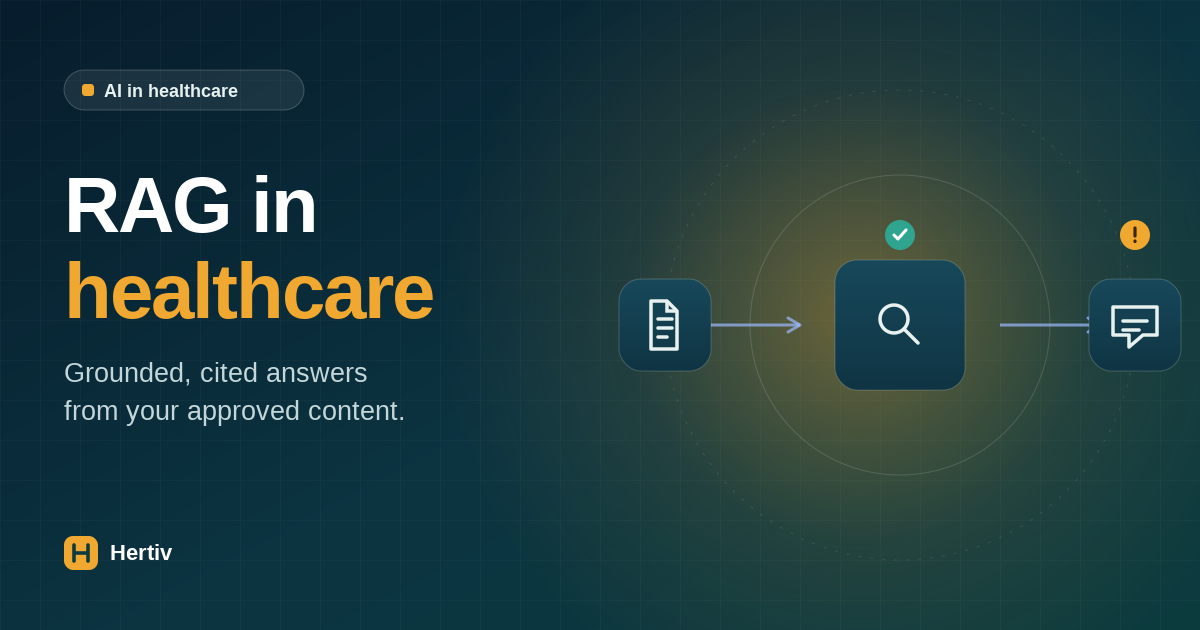
RAG (retrieval-augmented generation) in healthcare is an architecture that retrieves relevant passages from approved clinical or operational content and passes them to a language model so the answer is grounded in that content and can cite it. The model does not memorise your guidelines; it reads the retrieved passages at answer time.
A typical pipeline has four parts:
- Ingestion: clinical guidelines, policies, formularies, SOPs, patient education leaflets and internal knowledge bases are parsed, chunked and indexed.
- Retrieval: a user question is matched against the index to find the most relevant passages, filtered by the user's role and permissions.
- Generation: the model composes an answer strictly from the retrieved passages, with a citation to each source.
- Governance: logging, evaluation and review so you can show what the system said, on what basis, to whom.
That is the same shape as general enterprise RAG, but the constraints are tighter: content is permissioned, errors carry clinical or regulatory risk, and every answer may need to be auditable. Hertiv builds this pattern as part of its RAG development work and its AI for healthcare providers and health tech practice.
Where does RAG actually help in healthcare?
RAG helps most where staff or patients need fast, cited answers from a large body of approved text that changes over time. The table below sketches common patterns and what each requires.
| Use case | What it does | Typical data needed | Effort |
|---|---|---|---|
| Policy and SOP lookup | Answers staff questions with the current policy and a citation | HR and clinical policies, SOPs, version history | Medium |
| Formulary and drug reference | Surfaces approved formulary entries and prescribing notes | Formulary, local guidance, pharmacy notes | Medium |
| Clinical documentation support | Drafts summaries grounded in the patient record extract | Structured record extracts, note templates | High |
| Patient education answers | Explains conditions and next steps in approved language | Reviewed patient leaflets, care pathways | High |
| Coding and billing support | Suggests codes with references to payer rules | Payer policies, coding manuals | Medium |
| Onboarding and training | Answers new-starter questions from training material | Training decks, handbooks, competency docs | Low |
| Triage support for call centres | Suggests next steps from protocols, with escalation | Triage protocols, escalation rules | High |
Effort here means engineering and clinical review combined. The low-effort rows are usually the right place to start because the content is already written, owned and reviewed.
Which use cases should you avoid at first?
Avoid starting with autonomous diagnosis, treatment recommendation or anything that writes directly into the patient record without a human in the loop. Those uses carry regulatory and liability weight that a retrieval layer does not solve.
Safer boundaries for a first release:
- Staff-facing before patient-facing. Clinicians and administrators can judge a bad answer; patients cannot.
- Read and suggest, not act. The system proposes text or a next step; a person approves it.
- No new clinical claims. The answer must be traceable to an approved source, and the system should say when it cannot find one.
- No cross-patient retrieval. A user must never retrieve content they are not entitled to see.
Higher-bar uses are not forbidden forever. They need a clinical safety case, a review process and a clear regulatory position for your market, which is a separate project from the retrieval build.
What does a healthcare RAG architecture need?
A healthcare RAG architecture needs three things beyond a standard build: permission-aware retrieval, citation-first answering and an audit trail. Everything else is tuning.
- Permission-aware retrieval. Filters are applied at retrieval, not after generation. A nurse, a physician and a billing clerk see different corpora, and the index must enforce that.
- Citation-first prompting. The model must attach a source to each claim and refuse when the retrieved passages do not support an answer. A visible "not found in approved sources" response is a feature.
- Audit logging. Store the question, retrieved document IDs, the answer and the user, so a reviewer can reconstruct any answer later.
- Content pipeline with ownership. Each document needs an owner, a review date and a version. Stale content is the main cause of wrong answers.
- Evaluation set. A fixed set of real questions with expected sources, rerun whenever content or prompts change.
Security deserves its own review; see AI security for the threat model around LLM apps and agents. If the retrieval layer will trigger actions in other systems, the next step is usually agentic AI development with strict tool permissions.
How do you build and evaluate it?
Build a healthcare RAG system in small steps, with evaluation at each one. The order below keeps clinical review close to the engineering.
- Pick one narrow corpus and one user group. For example, HR and clinical policies for ward managers. Narrow corpora are easier to evaluate and to keep current.
- Define the answer contract. What a good answer looks like, which sources count, and when the system must refuse.
- Build ingestion with metadata. Tag documents by source, owner, review date and access group. Metadata drives both filtering and citation.
- Implement retrieval with filtering and reranking. Start with a simple dense retriever and add reranking once you have a baseline.
- Constrain generation. Prompt the model to answer only from retrieved passages, cite each claim and refuse otherwise.
- Create an evaluation set of 50 to 100 real questions. Score retrieval hit rate and answer correctness separately; the two fail for different reasons.
- Pilot with a small group and log everything. Review a sample of real answers weekly and fix content gaps before scaling.
Example (hypothetical): a pilot with 60 test questions might show 52 with the right source retrieved (about 87 percent) and 47 with a fully correct, cited answer (about 78 percent). The gap often comes from chunks that split a policy across sections, which is a content problem rather than a model problem.
What are the common mistakes?
The common mistakes in healthcare RAG are organisational as much as technical, and they show up after launch rather than during the demo.
- Ignoring document ownership. Content with no named owner drifts out of date and the system confidently repeats it.
- Filtering after generation. Applying permissions to the final answer instead of the retrieval step leaks content into the model context.
- Chunking policies badly. Splitting a rule from its exceptions produces answers that are technically sourced but wrong.
- Skipping the refusal path. Systems that always answer sound better in demos and are less safe in practice.
- No evaluation set. Without a fixed question set you cannot tell whether a prompt or content change improved anything.
- Treating it as a one-off build. A RAG system needs a content and review operation, not just a release.
How should you govern RAG in a clinical setting?
Governance for RAG in healthcare means documented ownership, review cycles, user-facing transparency and a route to report problems. It is lighter than a clinical device programme for staff-facing tools, and heavier for anything patients see.
A workable baseline:
- Named owners for each content domain, with a review interval and a retirement process for old documents.
- Transparency in the interface: users see the sources behind each answer and know the system can be wrong.
- Feedback capture so a wrong answer becomes a content ticket, not a lost complaint.
- Change control on prompts, retrieval settings and corpora, with evaluation results attached.
- Data protection review covering what is logged, for how long and who can read it, aligned with your local rules in the US, UK, EU or Middle East.
Hertiv's AI governance and responsible AI consulting work covers this layer, and AI consulting can help scope a first pilot you can fund and defend. For a four-week starting point, AI proof of concept development is a reasonable frame.
Key takeaways
- RAG retrieves approved source documents at query time, so the model answers from your content instead of its training data.
- The highest-value early use cases are staff-facing: policy lookup, clinical documentation support and formulary questions.
- Access control and audit logging must be designed first, because health content is permissioned by role and patient.
- Citations and refusal behaviour matter more than model choice in regulated settings.
- Plan for content ownership and review cycles; a RAG system is only as current as the documents behind it.
- Treat patient-facing uses as a separate, higher-bar project with clinical review.
Frequently asked questions
Is RAG in healthcare the same as a clinical decision support system?
No. RAG is a retrieval and answering technique; a clinical decision support system is a regulated product category with defined safety and validation expectations. RAG can sit inside a support tool, but the regulatory classification depends on what the tool does and who uses it.
Can RAG prevent hallucination in medical answers?
It reduces it but does not remove it. Grounding answers in retrieved sources and forcing citations makes errors easier to spot, and a refusal path handles missing evidence. You still need evaluation and human review for anything clinically meaningful.
What data can you use for a healthcare RAG system?
Most pilots use documents you already own and approve: policies, guidelines, formularies, SOPs, training material and reviewed patient information. Patient record data is possible for staff-facing documentation support, but it needs tighter access control, logging and a data protection review.
How do you keep the answers current?
Treat content as a maintained product. Each document gets an owner and a review date, the ingestion pipeline tracks versions, and stale documents are retired. A scheduled review is more reliable than re-indexing more often.
Do you need a special model for healthcare RAG?
Usually not. A capable general model with good prompting, citation enforcement and a refusal path performs well when retrieval is solid. Model choice matters less than content quality, filtering and evaluation.
How long does a first healthcare RAG pilot take?
A narrow pilot on one corpus for one user group typically fits in a few weeks if the content is already reviewed and owned. Wider coverage, patient-facing use or integration with the record system adds significant time for review and security work.


