AI in Triage Systems: How It Sorts Patients Safely
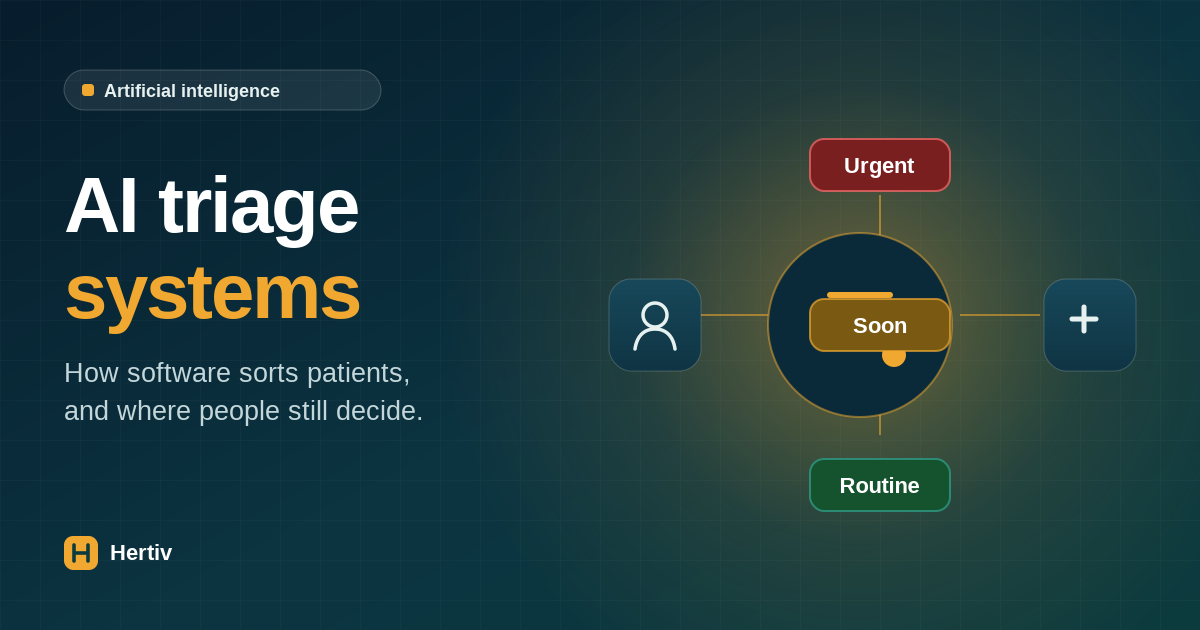
AI triage systems read symptoms, vital signs and history to rank how urgently a patient needs care, so the sickest are seen first.
On this page
Short answer
AI in triage systems is software that reads a patient's symptoms, vital signs and medical history and ranks how urgently they need care, so the most serious cases are seen first. It sorts and prioritises; it does not diagnose, and a clinician still makes the final decision about treatment.
What is AI in triage systems?
AI in triage systems is software that reads a patient's symptoms, vital signs and medical history and ranks how urgently they need care, so the most serious cases are seen first. Triage is the sorting step at the front of urgent care: it decides who is seen now, who can wait, and who can safely be directed elsewhere.
The system works from structured inputs. A patient answers questions about symptoms, pain, duration and history, and the system combines those answers with vital signs such as temperature, heart rate and oxygen levels. It then assigns a priority level, usually on a five-level scale from immediate to non-urgent, and explains which inputs pushed the score up or down.
The key point is that triage is a ranking task, not a diagnosis. The system does not name a disease. It answers one question: how quickly does this person need to be seen? That narrower job is what makes it possible to check the system against real outcomes, since you can measure whether the highest-priority patients were the ones who needed care fastest.
How does AI triage decide who is seen first?
AI triage decides who is seen first by scoring the patient's inputs against known risk patterns and local protocols, then placing the patient on a priority scale that clinicians can review and overrule.
| Input | What the system checks | Why it matters |
|---|---|---|
| Symptoms | Main complaint and red-flag phrases | Chest pain or breathing difficulty raises priority fast |
| Vital signs | Temperature, heart rate, oxygen, blood pressure | Abnormal values signal a deteriorating patient |
| History | Past conditions and medicines | Diabetes or heart disease changes the risk of a symptom |
| Age and risk factors | Age band and known risk markers | The same fever means more in a newborn than in an adult |
| Capacity | Current queue and staffing | Priority is relative: the sickest patient goes first |
Most systems use a mix of rules and learned patterns. Rules handle the clear cases, such as a very low oxygen level, while the model weighs combinations that are harder to spell out, such as a mild fever plus a complex history.
Every score should be explainable in plain language: which inputs mattered and by how much. If a clinician cannot see the reasoning, they cannot trust the ranking. AI in healthcare covers where these systems fit in the wider picture.
Where is AI triage used today?
AI triage is used in emergency departments, phone and online triage services, telehealth, and imaging workflows where sorting speed changes outcomes.
- Emergency departments. AI sorts arrivals by urgency, so a patient with chest pain is seen before a patient with a sprained ankle, even when the waiting room is full.
- Phone and online triage. Structured question sets guide patients to self-care, a GP appointment or urgent care, and flag the cases that need an ambulance.
- Telehealth. Before a video visit, the system collects symptoms and history so the clinician starts with a ranked summary instead of a blank form.
- Imaging triage. AI scans incoming images for urgent findings, such as a suspected stroke, and moves those cases to the front of the radiologist's queue.
- Mental health lines. Language models help sort crisis calls by risk, with a trained person taking over the highest-risk calls first.
In each setting the pattern is the same: the AI handles the first sort, and a person handles the judgement. The busiest services use it because the alternative is a queue sorted by arrival time, which is fair but blind to urgency.
How do you bring AI triage into a service?
You bring AI triage into a service by starting with one patient group, running the system alongside the existing process, and only switching over when its rankings match clinician judgement on real cases.
- Pick one group. Start with a defined flow, such as walk-in patients with minor injuries, not the whole department.
- Map the current process. Record how patients are sorted today, who decides, and what happens when the queue is full.
- Check the data. Make sure symptom records, vital signs and outcomes are captured in a consistent format the system can read.
- Run a shadow pilot. Let the system rank patients while clinicians rank them as usual, and compare the two lists daily.
- Set the overrule path. Give every clinician a one-click way to change a priority, and log each change with a reason.
- Audit outcomes. Check whether high-priority patients were seen first and whether any low-priority patient deteriorated while waiting.
The shadow pilot is the step most teams skip, and the one that matters most. It produces the evidence that the system ranks correctly on your patients, not just on the vendor's test data. AI in clinical trials shows how the same evidence-first thinking applies to medical AI more broadly.
Example (hypothetical): an urgent care clinic sorts its queue
Example (hypothetical): an urgent care clinic sees 240 patients a day. A nurse sorts arrivals by hand, taking about 4 minutes per patient. Sorting the full queue takes 240 x 4 = 960 minutes, or 16 hours of staff time a day.
The clinic adds an AI triage step. Patients answer questions on a tablet, and the system ranks them. A nurse reviews the top 30 urgent cases in 6 minutes each, or 180 minutes, and scans the remaining 210 in about 1 minute each, or 210 minutes. Total sorting time is 180 + 210 = 390 minutes, or 6.5 hours a day, saving about 9.5 hours.
The saving only holds because the review step stays in place. In the first month the system under-ranks about one patient in fifty, usually an older patient whose symptoms look mild but whose history changes the risk. Nurses catch those on review, and the corrections are logged so the system can be retrained. The clinic checks weekly that no low-priority patient waited longer than the safe limit.
What are the limits and risks?
The limits of AI triage are data gaps, rare conditions, and the risk that staff stop checking a system that is usually right. A triage system is only as good as the cases it has seen, and the cases that matter most are often the rarest.
- Missing information. A patient who cannot describe symptoms clearly, or whose records are incomplete, gets a score built on gaps.
- Rare conditions. A system trained on common presentations can under-rank an unusual but serious condition it has rarely seen.
- Bias in training data. If some groups were under-served in the past, their records carry that history, and the system can repeat it.
- Automation bias. Staff who see correct rankings all day can start accepting them without checking, which is when a wrong ranking slips through.
- Privacy and consent. Triage data is sensitive health data, so storage, access and retention need the same care as any medical record.
These risks are managed, not removed. Regular audits, a clear overrule path and outcome checks are the controls that keep a triage system safe in practice. AI governance and responsible AI consulting covers how to set those controls up.
What are the common mistakes?
The most common mistakes are removing human review, training on one population, and treating a priority score as a diagnosis.
- Removing human review. A triage score is a suggestion, not a decision; the clinician owns the call.
- Training on one population. A system built on adult emergency data will misjudge children, older patients and pregnant patients.
- Treating a score as a diagnosis. Priority and diagnosis are different jobs; mixing them up leads to false confidence.
- No escalation path. If a patient worsens while waiting, there must be a fast way to re-rank them.
- No outcome logging. Without a record of what happened to each ranked patient, you cannot tell whether the system is working.
Key takeaways
- AI triage ranks urgency; it does not diagnose
- Scores combine symptoms, vital signs, history and capacity
- Run a shadow pilot and compare rankings with clinicians before switching over
- Keep a one-click overrule path and log every change
- Audit outcomes, not just accuracy: check that no low-priority patient deteriorated while waiting
Frequently asked questions
Is AI triage the same as diagnosis?
No. Triage ranks how urgently a patient needs care; diagnosis names the condition. An AI triage system answers one question, how quickly this person needs to be seen, and leaves diagnosis and treatment to clinicians.
Where is AI triage used?
Emergency departments, phone and online triage services, telehealth and imaging workflows use it. In each setting the AI does the first sort and a clinician makes the final judgement about who is seen and in what order.
Can AI triage replace nurses?
No. It replaces the first sorting step, not the judgement. Nurses and doctors review the rankings, overrule them when needed, and handle the cases where the data is incomplete or the patient cannot describe symptoms clearly.
What data does AI triage need?
It needs structured symptom answers, vital signs, medical history and local protocols, plus outcome records so the system can be checked against what actually happened to each patient. Incomplete records are one of the main sources of wrong rankings.
Is AI triage safe?
It is safe when the controls are in place: a shadow pilot before go-live, a clear overrule path, regular outcome audits and human review of the highest-risk cases. Without those controls, a wrong ranking can delay care for the patient who needs it most.
What should a clinic check before buying one?
Ask for evidence on your patient group, not just the vendor's test data. Check that scores are explainable, that overruling is one click, that outcomes are logged, and that the system handles children, older patients and rare presentations.