What Is AI Engineering? Building Systems That Ship
AI engineering turns a model into a product that runs in production, covering data, evaluation, deployment, monitoring and cost. Here is what the discipline covers.
On this page
Short answer
AI engineering is the discipline of building AI systems that work in production, not just in a notebook. It covers choosing and connecting models, preparing data, writing evaluation tests, shipping behind an API, watching quality and cost once live, and fixing what breaks, so that an AI feature behaves the same way for real users as it did in a demo.
What is AI engineering?
AI engineering is the discipline of turning a machine learning model into a product that works in production. It covers the data, the model, the code around it, the tests that prove it works, and the monitoring that catches it when it stops working.
A model in a notebook answers a question once. A product answers the same question thousands of times a day, for different users, with different data, while staying fast, safe and affordable. AI engineering is the work that closes the gap between those two situations.
The discipline draws on software engineering, data engineering and machine learning. It is less about inventing new models and more about choosing the right model, connecting it to real systems, and keeping it reliable after launch.
How is AI engineering different from data science and MLOps?
Data science, MLOps and AI engineering overlap, but they answer different questions. Data science asks what a model can predict. MLOps asks how models are trained, versioned and deployed. AI engineering asks how the whole system behaves for real users, end to end.
| Area | Main question | Typical work |
|---|---|---|
| Data science | What can the model predict? | Experiments, features, model selection |
| MLOps | How are models trained and shipped? | Pipelines, versioning, deployment |
| AI engineering | Does the system work for users? | APIs, evaluation, monitoring, cost |
| Software engineering | Is the product reliable? | Code, tests, releases, on-call |
In small teams one person may do all four. In larger teams the roles split, but the boundary stays fluid: an AI engineer who cannot read an evaluation result will ship blind, and a data scientist who never sees production logs will tune the wrong thing. The comparison in AIOps, MLOps and LLMOps compared shows where the operations side fits.
What does the AI engineering workflow look like?
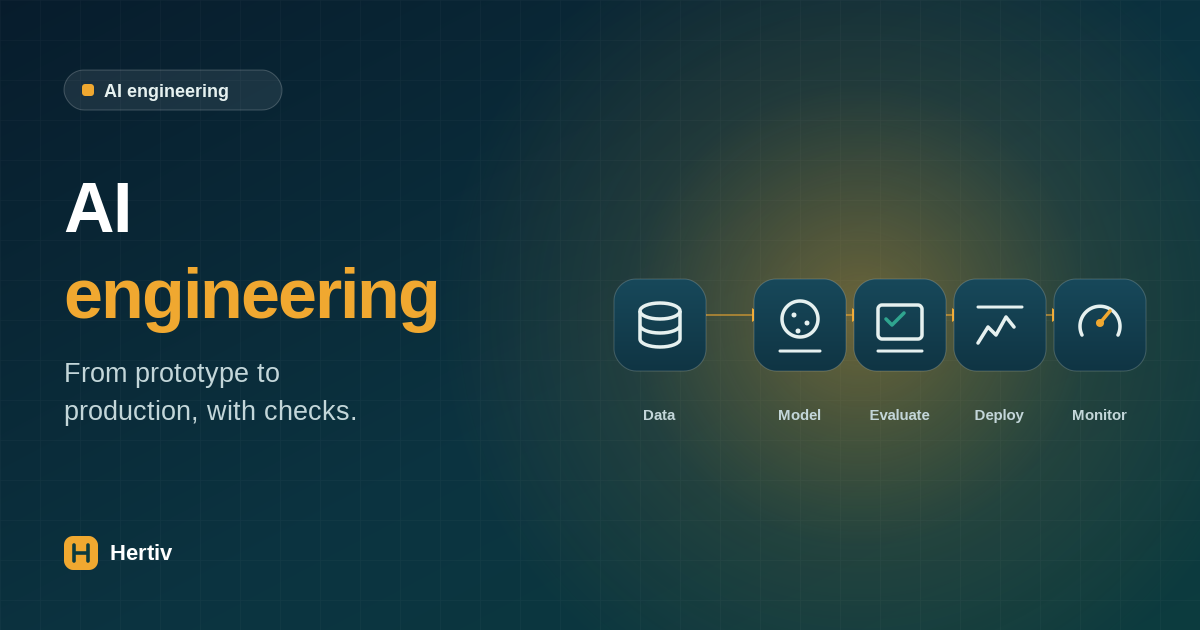
A typical AI engineering workflow runs in a loop, not a straight line. Each step feeds the next, and evaluation results send work back to earlier steps.
- Define the task and the success measure: what the system must do and how you will know it worked.
- Gather and prepare the data the system will actually see, including the awkward cases.
- Pick the simplest model or approach that could pass the evaluation.
- Build an evaluation set from real examples with known good answers.
- Connect the model to the product behind an API, with limits and fallbacks.
- Ship to a small group, watch quality and cost, then widen the rollout.
- Monitor live behaviour and feed failures back into the evaluation set.
Skipping the evaluation step is the most common shortcut, and the most expensive one. Without it, nobody can tell whether a change helped or hurt.
How do AI engineers evaluate a system?
AI engineers evaluate a system against a fixed set of real examples with known good answers. The set is built before the model is tuned, so that changes are measured against the same bar every time.
A good evaluation checks more than accuracy. It checks whether answers cite the right sources, whether the system refuses what it should refuse, how it handles edge cases, and how long it takes to answer. Each check is a separate score, not a single number.
Evaluations also cover cost and safety. A model that answers well but costs ten times more per request than the budget allows is not a working system. The same applies to a model that leaks private data or invents citations: the evaluation must catch it before users do.
What goes into a production AI stack?
A production AI stack has more parts than the model. The model is one layer; the rest is the plumbing that makes it usable, observable and safe.
| Layer | What it does | Example choices |
|---|---|---|
| Data layer | Stores and prepares training and retrieval data | Databases, vector stores |
| Model layer | Runs the model and manages prompts | Hosted APIs, self-hosted models |
| Application layer | Connects the model to the product | APIs, queues, caches |
| Evaluation layer | Scores outputs against test sets | Evaluation harnesses, labelled data |
| Operations layer | Watches quality, cost and incidents | Logs, alerts, dashboards |
Teams often start with hosted models and a thin application layer, then add evaluation and operations as usage grows. The stack grows with the product; building all five layers before the first user is usually wasted effort. The pipeline side is covered in how to build an MLOps pipeline.
What roles make up an AI engineering team?
A small AI engineering team usually has three roles, and one person may cover more than one. The AI engineer builds the system: prompts, retrieval, APIs and evaluation. The data engineer keeps the data clean, current and accessible. The product owner decides what the system should do and what good looks like.
Larger teams add specialists: a machine learning engineer for training and fine-tuning, a platform engineer for deployment and scaling, and a domain expert who can judge whether outputs are right. The domain expert is often the difference between a demo and a tool people trust.
Hiring for the team is its own problem. The brief matters more than the job title: a team that hires for model research when it needs production engineering will move slowly. The hiring guide for how to hire an AI developer covers the skills to test for.
Example (hypothetical): a support copilot goes live
Example (hypothetical): a software company handles 400 support tickets a day. The team builds a copilot that drafts replies from the help centre, and agents review every draft before it is sent.
In the first month the copilot drafts replies for 240 of the 400 tickets, which is 60%. Agents accept 180 drafts as written and edit 60, so 180 plus 60 is 240. The remaining 160 tickets are complex cases the copilot does not touch.
Each accepted draft saves about 4 minutes of typing, so 180 drafts save 720 minutes, or 12 hours, a day. The team spends the saved time on the 160 complex tickets instead of hiring more agents. The evaluation set grows with every edited draft, so the copilot improves from real corrections.
What are the common mistakes?
The most common AI engineering mistakes are shipping without an evaluation set, treating a demo as a product, and letting costs grow unnoticed.
- No evaluation set. Changes are judged by feel, so regressions go unnoticed.
- Demo as product. A notebook that works once is not a system that works at scale.
- No cost control. Per-request costs multiply with traffic and surprise the budget.
- Prompts as code, untested. Prompt changes ship without review or rollback.
- No fallback. When the model fails, users see an error instead of a safe default.
- Ignoring the data. Stale or duplicated source documents produce confident wrong answers.
Fix the evaluation set first. Once changes are measured, the other mistakes become visible and fixable in turn. For the operations view, LLMOps vs MLOps explains how the two practices differ.
Key takeaways
- AI engineering turns a model into a product that works in production
- An evaluation set built from real examples is the foundation of every change
- The stack has five layers: data, model, application, evaluation and operations
- Ship to a small group first, watch quality and cost, then widen the rollout
- Monitor live behaviour and feed failures back into the evaluation set
Frequently asked questions
What is the difference between AI engineering and data science?
Data science focuses on what a model can predict, using experiments and analysis. AI engineering focuses on the whole system in production: APIs, evaluation, deployment, monitoring and cost. The two overlap, and small teams often combine them, but the questions they answer are different.
Do I need MLOps to do AI engineering?
MLOps covers training, versioning and deployment pipelines, which matter once models are trained in-house. Many AI engineering teams start with hosted models and a thin application layer, then add MLOps practices as their own training and deployment needs grow.
What is an AI engineering evaluation set?
A fixed set of real examples with known good answers, built before the model is tuned. Every change is scored against the same set, so the team can tell whether quality improved or regressed. It should include edge cases and examples the model has handled badly before.
How much does AI engineering cost?
Cost depends on model choice, request volume and how much data must be stored and retrieved. Hosted models charge per request, so traffic growth multiplies cost directly. Track cost per request from the first rollout and set alerts before traffic grows.
What skills does an AI engineer need?
Software engineering, data handling, prompt and retrieval design, evaluation and basic statistics. The most useful skill is judgement about trade-offs: when a simpler model is enough, when to add a human check, and when a feature is not ready to ship.
When is a system ready for production?
When it passes its evaluation set, has a fallback for failures, is monitored for quality and cost, and has an owner who can roll it back. A demo that works once is not ready; a system that survives a small rollout with measured results is.