How to Hire an AI Developer: A Practical Guide
An AI developer builds and ships machine learning features, from data prep to a working product. Here is how to define the role, test skills and hire well.
On this page
Short answer
An AI developer is a software developer who builds features powered by machine learning: they prepare data, train or connect models, and ship the result as part of a working product. Hiring one means matching the role to a real product need, testing practical skills instead of paper credentials, and giving the new hire clean data and a clear first project.
What does an AI developer actually do?
An AI developer builds features that use machine learning. That work has three parts: preparing data, building or connecting a model, and putting the model into a product where real users can use it. Most of the time goes to the first and third parts, not to inventing new models.
The job varies by company. In a small team, one developer may do everything, from cleaning a spreadsheet to wiring a model into an app. In a larger team, the role splits: one person prepares data, another trains models, and a third handles deployment.
Before you write a job ad, decide which part matters most for your product. A team that needs a chatbot has a different hire in mind than a team that needs a demand forecast, even though both are called AI developers.
| Role focus | Main work | Key skill |
|---|---|---|
| Applied AI developer | Connects models to a product | APIs and product code |
| ML engineer | Trains and ships models | Python and model training |
| Data engineer | Builds data pipelines | SQL and pipelines |
| AI researcher | Tests new model ideas | Statistics and papers |
Most product teams need an applied AI developer or an ML engineer, not a researcher. Write the ad around the product problem, not around a list of model names.
Which skills should you test for?
The core skill is Python, since most AI work uses Python libraries for data and models. A good hire can also write SQL, work with APIs, and read model output with care instead of trusting it blindly.
Testing matters as much as building. An AI developer should know how to split data into training and test sets, measure whether a model is actually better, and spot when a model is guessing on data it has never seen. Read how to test AI models for the checks that matter most.
Look for product sense too. The best hires ask what the feature must do for the user, how often the model will be wrong, and what happens when it is wrong. Those questions matter more than knowing the newest model name.
Ask for a short work sample, such as a small project on a public dataset, and talk through the choices. You will learn more from that conversation than from a list of certificates. A candidate who can explain what machine learning is in plain words usually understands it well.
Where do you find AI developers?
Start with your own network and with developers who already know your product. A developer who understands your users and your data will often beat a stronger modeller who needs months to learn the domain.
Job boards and open source communities are the next step. Look for people who have shipped small projects, written clear notes about them, or answered questions in public. That public work is a better signal than a polished CV.
Agencies and hiring platforms can help when you need a hire fast, but they add cost. Hiring AI engineers through a specialist service can shorten the search, yet you still need your own interview to check fit.
Whatever channel you use, write the ad in plain words. Say what the product does, what the first project is, and what success looks like in three months. Vague ads attract vague applicants.
How do you interview an AI developer?
Use a practical interview, not a quiz. Give the candidate a small, realistic task, such as cleaning a messy dataset, choosing between two models, or reviewing a short piece of model code. Then talk through the choices together.
Ask how they would handle a model that works in testing but fails in production. Good answers mention data drift, bad inputs and monitoring, not just more training data.
Ask about a time a model was wrong and what they did about it. Every experienced developer has such a story. If a candidate has none, they may not have shipped real work yet.
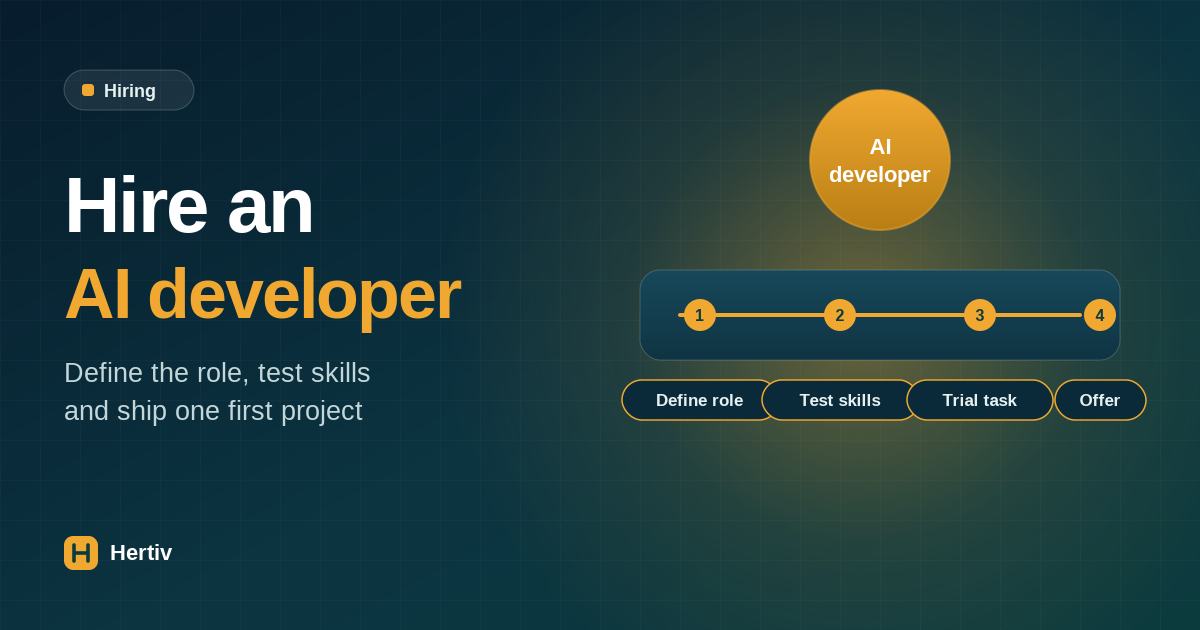
- Short screen: past work, product fit, and salary range.
- Practical task: a small dataset or a code review, done at home.
- Discussion: walk through the task and the trade-offs.
- Team round: how they explain a model to non-technical people.
- Offer: clear role, first project and start date.
Keep the process short. Strong candidates often have several offers, and a slow process loses them.
What should the first project look like?
Give the new hire a small, visible project with a clear result. A good first project is one feature, such as a search box that understands plain words, or a tool that drafts replies for the support team.
Make sure the data is ready. A new hire who spends the first month hunting for data will lose momentum. Prepare a sample dataset, access to the real data, and a named person who can answer data questions.
Set a review point after two weeks. Check what works, what is blocked, and whether the scope is right. Early course correction is cheaper than a three-month surprise.
Example (hypothetical): a support team gets 300 tickets a day, and each takes 5 minutes to read and route, which is 25 hours of work a day. An AI developer builds a router that sorts tickets in seconds, and a reviewer checks the 60 uncertain ones in 1 minute each, which is 1 hour a day. The team saves about 24 hours a day of reading time.
What does hiring an AI developer cost?
Cost depends on the market, the seniority and whether the hire is full-time, contract or through an agency. Salaries vary widely by country and city, so check current local listings rather than trusting a single figure.
Budget for more than salary. You need data access, model API fees or compute, and time from your own team to review the work. A hire with no reviewer and no data access will stall.
Agencies charge a fee, usually a share of the first-year salary, while freelance platforms charge by the hour or the project. See vendor sites for current rates, and compare the total cost, not just the headline number.
A cheaper hire with strong product sense often beats an expensive hire who needs constant direction. Judge the total value: speed, quality and how much of your time the hire needs.
Common mistakes
The most common mistake is hiring for a model instead of a product. A team that hires a researcher when it needs a product developer ends up with interesting experiments and no shipped feature.
Another mistake is skipping the practical test. A CV can list every library, but only a real task shows whether the candidate can clean messy data and explain a result.
A third mistake is giving the new hire no data and no reviewer. AI work needs feedback from someone who knows the product, or the model will solve the wrong problem well.
Finally, do not rush the offer. Check references, agree the first project in writing, and make sure the candidate knows what success looks like in the first three months.
Key takeaways
- Define the product problem first, then hire the developer who fits that problem.
- Most product teams need an applied AI developer or ML engineer, not a researcher.
- Test practical skills with a small real task, and talk through the trade-offs.
- Give the new hire clean data, a named data contact, and one visible first project.
- Check total cost, including data, compute and review time, not just salary.
Frequently asked questions
Do I need an AI developer or a data scientist?
They overlap, but the emphasis differs. A data scientist often focuses on analysis and insight, while an AI developer focuses on shipping a model inside a product. If you need a working feature, hire the developer; if you need to understand your data first, hire the analyst.
How long does it take to hire an AI developer?
Four to eight weeks is common for a careful process: one week to write the ad and shortlist, two weeks for tasks and interviews, and one to two weeks for the offer and notice period. Rushing usually costs more time later, when a poor hire needs replacing.
Can I hire a freelance AI developer instead?
Yes, for a single feature or a short project. Freelancers suit well-defined work with clean data. For ongoing model care and improvement, a full-time hire or a long-term contract works better, because the model needs an owner.
What should I ask in the interview?
Ask about a real project they shipped, a time a model was wrong, and how they test a model before release. Their answers show experience better than a quiz on model names. End by asking how they would explain the model to a non-technical colleague.
Do AI developers need a degree?
No. Many strong AI developers are self-taught or come from software engineering. A degree can help for research roles, but for product work, a portfolio of shipped projects and a good practical test matter more.
How do I keep an AI developer after hiring?
Give them real problems, clean data and time to improve models, not just to ship features. Developers leave when they spend all their time on data wrangling with no support, or when nobody reviews their work.


