LLMOps vs MLOps: What Is Different, and When to Use Each?
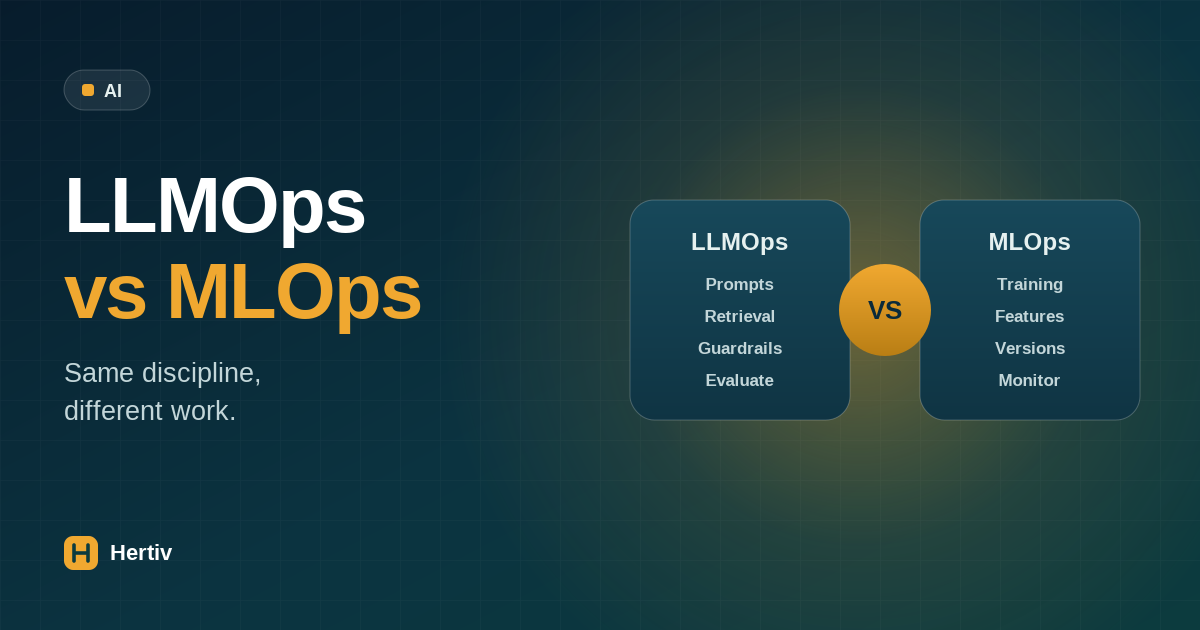
LLMOps runs language-model apps; MLOps covers machine learning models in general. They share pipelines, but differ on prompts, retrieval and evaluation.
On this page
Short answer
LLMOps is the set of practices for running applications built on large language models, while MLOps is the wider practice for running machine learning models of any kind. Both cover versioning, testing, deployment and monitoring, but LLMOps adds work that language models need and traditional models do not: prompts, retrieval, guardrails and human judgement of answers.
What is the difference between LLMOps and MLOps?
LLMOps is the operations practice for applications built on large language models, and MLOps is the operations practice for machine learning models in general. MLOps covers training, versioning, deployment and monitoring of models that learn from labelled data, such as a model that predicts churn or flags fraud. LLMOps covers the same ground for systems where the model is a language model and the work includes prompts, retrieved documents and generated text.
The key difference is what changes. In MLOps, the model itself changes: teams retrain it on new data and track which version is live. In LLMOps, the model often stays the same and the prompt, the retrieved documents and the guardrails change instead. That shifts the work from retraining to testing answers against a labelled set.
Teams that already run MLOps have a head start: pipelines, monitoring and versioning all carry over. What they need to add is the language-model layer: prompt management, retrieval quality checks, output evaluation and cost tracking per request.
What does MLOps cover?
MLOps covers the full life of a machine learning model, from data to production. It starts with data versioning and feature pipelines, moves through training, testing and packaging, and ends with deployment, monitoring and retraining. The goal is to make model changes safe, repeatable and easy to roll back.
| Area | MLOps | LLMOps |
|---|---|---|
| What changes | Model weights and features | Prompts, retrieval and guardrails |
| Main test | Accuracy on a test set | Answer quality judged by people or a checker |
| Data work | Labelled training data | Documents for retrieval |
| Key risk | Model drift over time | Wrong or unsafe generated text |
| Cost driver | Training and serving | Tokens per request |
| Rollback | Previous model version | Previous prompt and retrieval setup |
MLOps tools handle this well: experiment tracking, model registries, feature stores and serving infrastructure are mature. A team that runs a churn model or a fraud model already has most of the machinery, and the discipline of versioning everything carries straight over to language-model work. For the platform side, see the best MLOps platforms for startups.
What does LLMOps add?
LLMOps adds four things that MLOps does not cover well: prompts, retrieval, evaluation of generated text, and guardrails. Prompts are code: they need versions, tests and reviews, because a small wording change can change every answer. Retrieval needs its own checks, since the model can only answer well if it reads the right documents.
Evaluation is the hardest part. A language model does not give a right-or-wrong score on its own, so teams build labelled test sets of real questions with known good answers, and judge new versions against them. Some teams use a second model as a checker, but a person should still review a sample of answers each week.
Guardrails are the safety layer: rules that block unsafe content, stop the model from revealing private data, and send risky cases to a person. Cost tracking is also part of LLMOps, because every request costs tokens, and a small change in prompts or retrieval can double the bill. For how retrieval fits in, see what retrieval augmented generation is.
When should a team use each?
A team should use MLOps when it trains its own models on its own data: a churn model, a fraud model, a demand forecast. The practice fits any model that learns from labelled examples and needs retraining as data changes. If the model is trained in-house, MLOps is the right frame.
A team should use LLMOps when it builds on a hosted language model through an API: a support assistant, a document search tool, a drafting helper. The model is not trained by the team, so the work is prompts, retrieval, evaluation and guardrails, not training pipelines.
Many teams need both. A company might run a fraud model under MLOps and a support assistant under LLMOps, sharing the same monitoring, logging and incident process. The shared parts are deployment, monitoring, access control and cost tracking; the different parts are training on one side and prompts on the other. For how to build the pipeline side, see how to build an MLOps pipeline.
Example (hypothetical): a support-assistant pilot
Example (hypothetical): a team builds a support assistant that drafts replies from help articles. In the first month it handles 5,000 requests. Each request reads 2,000 input tokens and writes 500 output tokens, so the month uses 5,000 x 2,000 = 10,000,000 input tokens and 5,000 x 500 = 2,500,000 output tokens.
At $0.50 per million input tokens and $2 per million output tokens, the month costs 10 x $0.50 + 2.5 x $2 = $5 + $5 = $10.
That is cheap, but the team then adds a retrieval step that reads more documents, doubling input tokens to 20,000,000. The bill becomes 20 x $0.50 + 2.5 x $2 = $10 + $5 = $15 a month, still small, but the pattern matters: retrieval size drives the bill.
The team judges the pilot on 200 labelled questions. The first prompt gets 148 right, or 74%. After fixing the retrieval step, it gets 172 right, or 86%. That is 24 more good answers per 200 questions, and it came from retrieval, not from a new model.
That is the LLMOps lesson: test the prompt and the retrieval, not just the model. The team also checks 20 answers by hand each week, because the test set cannot cover every new kind of question that customers ask.
What are the common mistakes?
The most common mistake is treating LLMOps as MLOps with a new name. Teams that only track model versions miss the things that actually change: the prompt, the retrieved documents and the guardrails. Version all three, and test them together, or a small edit will break answers silently.
Another mistake is skipping the evaluation set. Without labelled questions and known good answers, teams argue about quality from a few examples. Build the test set before the first launch, and run it after every change.
Teams also forget cost tracking. Token costs are small per request but grow with volume and retrieval size, so track cost per task from the start. Finally, do not let the model answer risky questions alone: guardrails and a person in the loop are part of the system, not extras to add later.
Key takeaways
- LLMOps runs language-model apps; MLOps runs trained models.
- In LLMOps, prompts, retrieval and guardrails change most.
- Judge language models on a labelled test set, not by feel.
- Version prompts and retrieval like code.
- Track cost per request from the first week.
Frequently asked questions
Is LLMOps part of MLOps?
LLMOps grew out of MLOps and shares its discipline: versioning, testing, deployment and monitoring. It is usually treated as a separate practice because language models add prompts, retrieval, guardrails and answer evaluation that traditional models do not need.
Do we need LLMOps if we use a hosted model API?
Yes, if the app matters. The model is hosted, but the prompts, the retrieved documents, the guardrails and the evaluation are yours. Those are what decide whether the app gives good answers, and they need versions and tests.
What is the hardest part of LLMOps?
Evaluation is the hardest part. A language model does not give a simple right-or-wrong score, so teams build labelled test sets of real questions with known good answers and judge each version against them, with a person reviewing a sample.
Can one team run both MLOps and LLMOps?
Yes, and most teams that use both share deployment, monitoring, logging and access control. The different parts are training and feature pipelines on the MLOps side, and prompts, retrieval and guardrails on the LLMOps side.
How do you roll back a bad LLMOps change?
Roll back the prompt, the retrieval setup and the guardrails to the previous version, just as MLOps rolls back a model version. That only works if every change is versioned, so version prompts and retrieval configs like code.
When does a team need MLOps instead of LLMOps?
When it trains its own models on its own data, such as a churn model, a fraud model or a demand forecast. Those models need training pipelines, feature stores and retraining schedules, which is the core of MLOps.


