AI Data Pipelines: How Data Gets Ready for AI
An AI data pipeline prepares data for models: training examples, fresh features for live predictions, and indexed documents for AI answers.
On this page
Short answer
An AI data pipeline prepares data for AI models, delivering labelled training examples, fresh features for live predictions, or indexed documents for retrieval. It differs from a reporting pipeline because the data must be consistent enough to learn from and fresh enough to predict with.
What is an AI data pipeline?
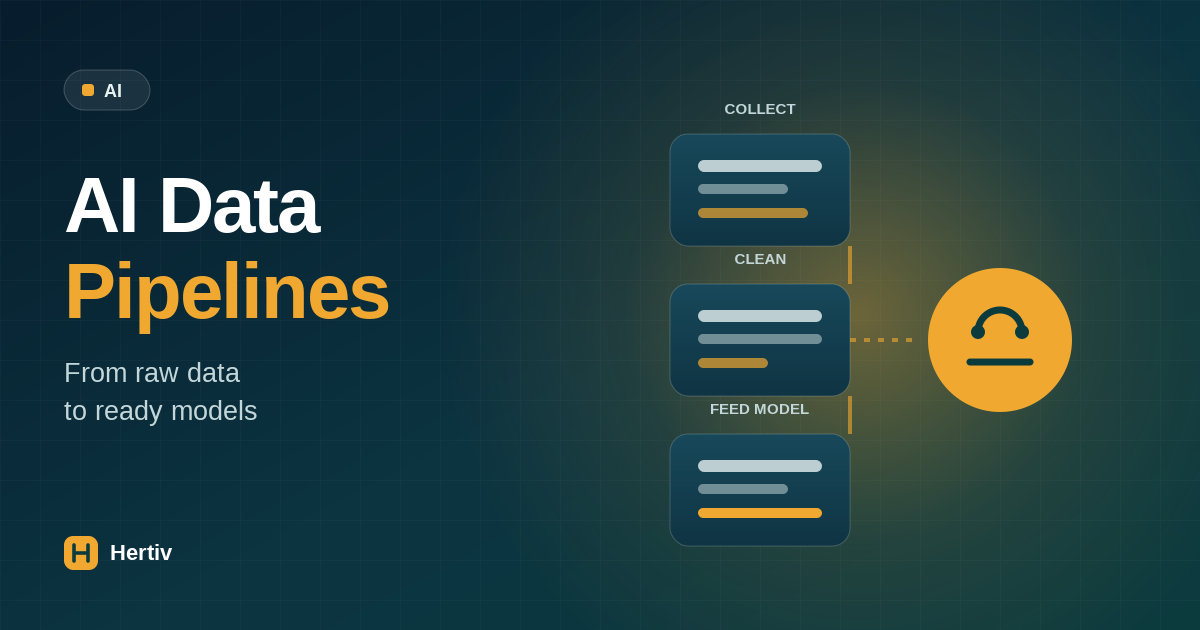
An AI data pipeline is a pipeline built to prepare data for AI models. It collects raw data from sources, cleans and labels it, and delivers it in the shape a model needs, whether that is training examples, features for a live prediction, or documents for a retrieval system.
A regular data pipeline moves data from one system to another, usually for reporting. An AI data pipeline has a different customer: a model that will learn from the data or answer questions with it. That changes what quality means. A report can tolerate a few bad rows; a training set cannot, because the model learns the errors as if they were truth.
There are three common kinds:
| Pipeline kind | What it delivers | Who uses it |
|---|---|---|
| Training data pipeline | Labelled examples for model training | Data scientists |
| Feature pipeline | Fresh features for live predictions | ML engineers |
| Retrieval pipeline | Indexed documents for AI answers | RAG and search teams |
All three share the same backbone: sources, cleaning, storage and monitoring. What differs is the output and the test that proves it works. For the plain definition of a pipeline, see what is a data pipeline.
How is an AI data pipeline different from a regular one?
An AI data pipeline differs from a regular one in what it must guarantee. A reporting pipeline must be accurate enough for a human to read; an AI pipeline must be consistent enough for a model to learn from, and fresh enough for a live prediction to be right.
Consistency matters because models amplify small errors. If a date field is sometimes a string and sometimes a number, a report shows a formatting glitch. A model trained on that field learns a meaningless pattern and its predictions quietly degrade. AI pipelines therefore need stricter validation rules and more tests on the data itself, not just on the code.
Freshness matters for feature pipelines, which feed live predictions. A fraud model that scores a transaction with features from last week is guessing. The pipeline has to deliver the same features in training and in production, or the model behaves differently live than it did in testing. That problem, known as training-serving skew, is one of the most common reasons a good model fails after launch.
Finally, AI pipelines need versioning. When a model changes, the team needs to know exactly which data trained it, so the result can be reproduced and audited. A reporting pipeline rarely needs that level of traceability.
What does a training data pipeline do?
A training data pipeline turns raw records into labelled examples a model can learn from. It collects the data, cleans it, applies labels, splits it into training and test sets, and stores the result so the training run can be repeated.
Cleaning is the largest part of the work. Duplicates, missing values, wrong formats and outdated records all have to be handled before training, because the model cannot tell a data error from a real pattern. The rules for cleaning should be written down and tested, so the same rules apply every time the pipeline runs.
Labelling is the step that most often decides quality. A model that classifies support tickets needs tickets labelled by category, and a model that detects defects needs images marked by a person who knows what a defect looks like. The labels do not have to be perfect, but the team has to measure their quality, for example by having two people label the same sample and comparing.
The split into training and test sets must be done carefully. If the test set leaks into training, the scores look good and the model fails in use. Splitting by time is usually the safest choice when the model will predict the future.
What is a feature pipeline?
A feature pipeline computes the inputs a model needs at prediction time and delivers them fresh. Features are the numbers and categories a model reads, such as a customer's purchase count in the last 30 days, or the average delivery time for a route.
The hard part is making training and live features identical. If the training data used a 30-day window and the live pipeline uses 7 days, the model sees different inputs and its predictions shift. The standard fix is to compute features in one place, a feature store, and use the same code for both training and serving.
Feature pipelines also have to handle timing. A feature that uses information from after the event it predicts is a leak, and it makes test scores look far better than real performance. Every feature needs a clear definition of what data it may use and when.
Freshness is a design choice, not a default. Some features can be computed nightly, others need to update within minutes. The right choice depends on how fast the underlying behaviour changes and what a stale feature costs the business.
How do RAG and vector pipelines work?
A retrieval pipeline prepares documents so an AI assistant can answer questions from them. It splits documents into chunks, turns each chunk into a vector embedding, and stores those vectors in an index the model can search at answer time.
Chunking is the first decision, and it matters more than most teams expect. Chunks that are too large mix several topics together, so the model retrieves irrelevant text. Chunks that are too small lose the context that makes an answer correct. A common starting point is a few hundred words per chunk, with overlap at the edges, then testing whether the answers improve.
The index has to be refreshed when the source documents change. A retrieval pipeline that only runs once will answer from stale policies and outdated prices, which is worse than not answering at all. The pipeline should track which version of each document it indexed, so a wrong answer can be traced back to its source.
Evaluation is the missing step in most retrieval pipelines. Before launch, test the pipeline on real questions with known good answers, and check whether the right documents were retrieved. Retrieval quality decides answer quality, and it can be measured directly.
How do you keep an AI data pipeline trustworthy?
An AI data pipeline is trustworthy when its data is tested, versioned and monitored. Testing means the pipeline checks the data on every run, not just the code, and stops or alerts when the data breaks its rules.
Data tests cover the basics: no missing values where the model needs them, values inside the expected range, no unexpected categories, and row counts that match the source. A pipeline that silently drops half its rows has failed, even if the code ran without an error.
Versioning means every dataset and every model can be traced back to its inputs. When a model behaves badly, the team needs to know which data trained it, which cleaning rules ran, and which labels were used. Without that trail, debugging is guesswork.
Monitoring means watching the live data, not just the pipeline's health. If the distribution of incoming data shifts, for example because a new product launched or a form changed, the model's answers will change too. Alerts on data drift give the team time to retrain before users notice. See generative AI for data engineering for where AI tools help with this work.
Example (hypothetical): a support team builds a retrieval pipeline for its help centre
Example (hypothetical): a support team has 800 help centre articles and wants an AI assistant to answer from them. The team builds a retrieval pipeline that splits the articles into chunks, embeds them and indexes the result.
The first run produces 6,400 chunks from the 800 articles, an average of 8 chunks per article. The team tests the pipeline on 50 real customer questions with known good answers. The right article is retrieved for 38 of the 50, and the assistant answers 35 of the 50 correctly.
The team then checks the 12 misses. Five come from articles that are out of date, four from chunks that split a procedure across two pieces, and three from questions the help centre does not cover at all. The team updates the five articles, changes the chunking so procedures stay together, and adds the three missing topics.
After the fix, the team re-runs the same 50 questions. The right article is now retrieved for 46 of the 50, and the assistant answers 43 correctly. The pipeline ships with a monthly re-test on the same 50 questions, so a future content change shows up as a falling score instead of a quiet decline.
What are the common mistakes?
The most common mistakes in AI data pipelines are skipping data tests, letting training and live features drift apart, and shipping a retrieval index nobody refreshes.
- No data tests. Code tests do not catch bad data. Test row counts, ranges, missing values and categories on every run.
- Training-serving skew. Features computed differently in training and production make a good model behave badly live. Compute them in one place.
- Leaky features. A feature that uses information from after the event it predicts inflates test scores and fails in use.
- Stale retrieval indexes. An index built once answers from outdated documents. Refresh it when sources change and version the result.
- No versioning. Without a trail from model to data, a bad result cannot be reproduced or explained.
- Skipping evaluation. A pipeline that is never tested on real questions will drift silently, and users will notice before the team does.
For the build sequence, how to implement a data pipeline covers the steps from sources to production monitoring.
Key takeaways
- An AI data pipeline prepares data for models, not for reports, so consistency and freshness matter more
- Training pipelines need clean, labelled examples and a test split that respects time
- Feature pipelines must compute identical features in training and in production
- Retrieval pipelines live or die by chunking, freshness and evaluation on real questions
- Test the data on every run, version every dataset, and monitor for drift
Frequently asked questions
What is an AI data pipeline?
An AI data pipeline is a pipeline built to prepare data for AI models. It collects raw data, cleans and labels it, and delivers training examples, features for live predictions, or indexed documents that an AI assistant can search when answering questions.
How is an AI data pipeline different from a normal data pipeline?
A normal pipeline moves data for reports, while an AI pipeline feeds a model. That means stricter data tests, identical features in training and production, and versioning so every model can be traced back to the data that trained it.
What is a feature pipeline?
A feature pipeline computes the inputs a model needs at prediction time, such as a customer's purchase count in the last 30 days. The same code should compute features for training and for live predictions, or the model behaves differently in production.
What is a RAG pipeline?
A RAG pipeline prepares documents for retrieval-augmented generation. It splits documents into chunks, turns each chunk into a vector embedding, and stores them in an index the AI searches at answer time. Chunk size, freshness and evaluation decide answer quality.
How do you test an AI data pipeline?
Test the data on every run: row counts, value ranges, missing values and unexpected categories. Then test the output against real cases, such as whether the right document is retrieved for a known question, and re-run the same test regularly.
What causes most AI data pipeline failures?
The most common causes are untested data, features that differ between training and production, leaky features that use future information, and retrieval indexes that are never refreshed when source documents change.