How Much Does a ZK Rollup Cost to Build and Run?
A ZK rollup's cost comes from building the prover and sequencer, paying for data availability and settling proofs on Ethereum. Here is what drives each part.
On this page
Short answer
A ZK rollup costs the team time to build and run its prover, sequencer and data pipeline, plus the fees for posting data and verifying proofs on Ethereum. The build is the larger share for a custom rollup, while running costs scale with transaction volume and how much data is posted on chain. Using a rollup framework or a rollup-as-a-service provider lowers the build cost but adds a service fee.
What is a ZK rollup?
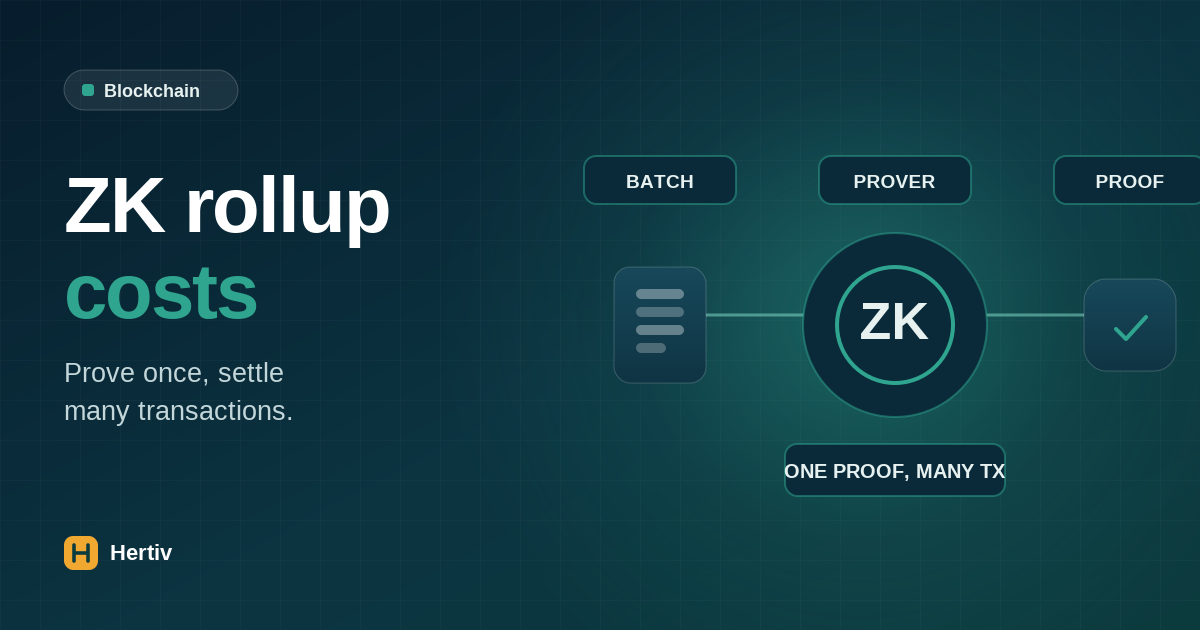
A ZK rollup is a scaling method that runs transactions off Ethereum and posts a short cryptographic proof to the main chain showing they were done correctly. The main chain checks the proof instead of re-running every transaction, so many transactions settle for the cost of one proof.
Three parts do the work. The sequencer orders transactions and builds batches. The prover turns each batch into a proof, which is the heavy computing step. A verifier contract on Ethereum checks the proof and updates the rollup's state, which is what makes the rollup inherit the security of the main chain.
Each part has its own cost. Building the rollup means paying for engineering time. Running it means paying for prover compute, data availability and the main-chain fees for each batch. If you are new to the idea, start with this explanation of what a ZK rollup is.
What drives the cost of a ZK rollup?
Six cost drivers decide most of a ZK rollup's budget, and they pull in different directions. A rollup built for payments cares most about cheap batches, while a rollup built for games cares most about fast proofs.
| Cost driver | What it is | What makes it grow |
|---|---|---|
| Prover compute | The machines that turn each batch into a proof | More transactions, heavier circuits, faster proof targets |
| Sequencer | The service that orders transactions and builds batches | Uptime needs, ordering rules, spam protection |
| Data availability | Where transaction data is published so anyone can check it | More data per batch, on-chain rather than off-chain storage |
| Main-chain settlement | The fee for verifying each proof on Ethereum | More batches per day, higher main-chain fees |
| Engineering team | The people who build, run and fix the rollup | Custom circuits, custom features, more integrations |
| Audits and monitoring | Security reviews and the tooling that watches the system | More code, more bridges, stricter uptime promises |
The key point is that running costs scale with use, while build costs are mostly fixed. A rollup with ten transactions a day and a rollup with ten thousand a day share most of the build cost, but their running costs look very different.
What does it cost to build a ZK rollup?
The build cost of a ZK rollup is mostly engineering time, and it depends on how much you build yourself. There are three common routes, and they trade control for speed and cost.
Building from scratch gives full control over the circuits, the prover and the settlement logic, but it is the slowest and most expensive route. It needs cryptographers and engineers who understand zero-knowledge circuits, and a project of this kind is measured in months of team time, not weeks.
Using a rollup framework is the middle route. Frameworks such as the ZK Stack, Polygon CDK and the Starknet stack provide the prover, the sequencer and the verifier contract, so the team configures and adapts them instead of writing them. This cuts the build to weeks of team time for a standard setup, though custom circuits still add work.
Rollup-as-a-service is the fastest route. A provider runs the sequencer and prover for you, and the team focuses on the application. The build cost drops to integration work, but the provider charges a service fee, so ask for pricing on the vendor's own site before budgeting. A security review of the circuits and contracts is still needed on every route, and it should be budgeted as its own line item.
What does it cost to run a ZK rollup?
Running a ZK rollup means paying for prover compute, data availability and main-chain settlement every day, plus the people who keep the system healthy. Each part scales differently, so the monthly bill depends on how the rollup is used.
Prover compute is usually the largest running cost. Proving a batch takes serious computing power, and the bill grows with the number of transactions and the complexity of the circuits. Batching more transactions into each proof spreads the cost, so teams tune batch size to balance proof cost against how fast users want finality.
Data availability is the second lever. Posting transaction data to Ethereum is the most secure option and the most expensive per byte. Posting to a dedicated data availability layer or keeping data off chain costs less, but it changes the trust assumptions, so the choice is a security decision as much as a cost decision.
Main-chain settlement is a fixed fee per batch, so fewer, larger batches cost less in settlement fees but make users wait longer for finality.
How do ZK rollup costs compare with optimistic rollups?
ZK rollups and optimistic rollups differ in where the money goes. A ZK rollup spends more on proving and less on waiting, while an optimistic rollup spends less on proving and more on the challenge window and the risk that a fraud proof is needed.
| Factor | ZK rollup | Optimistic rollup |
|---|---|---|
| Proof cost | Higher: every batch needs a proof computed | Lower: no proof unless someone challenges |
| Settlement speed | Fast: final once the proof is verified | Slow: a challenge window of about a week |
| Data cost | Similar: both post transaction data for checking | Similar: both post transaction data for checking |
| Build complexity | Higher: circuits and provers are specialist work | Lower: standard virtual machine execution |
| Best fit | Payments and apps that need fast finality | General apps where a wait for finality is fine |
The comparison is not only about the monthly bill. Fast finality has value of its own: users and exchanges can treat a transaction as settled at once, which matters for payments and trading. That is why the choice is usually made on the product need first, with cost second. For the full comparison, see this ZK rollup vs optimistic rollup guide.
Example (hypothetical): budgeting a payments rollup
Example (hypothetical): a payments app plans a ZK rollup that handles 10,000 transfers a day. The team posts one batch every hour, so there are 24 batches a day, each holding about 10,000 / 24 = 417 transfers.
The team assumes, for planning only, that verifying each batch on the main chain costs $25 in fees. That gives a daily settlement cost of 24 x $25 = $600, or $600 x 30 = $18,000 a month. Prover compute is assumed at $3,000 a month, and data availability at $2,000 a month, so the running total is $18,000 + $3,000 + $2,000 = $23,000 a month.
Per transfer, that is $23,000 / (10,000 x 30) = about $0.077. If volume doubles to 20,000 transfers a day with the same 24 batches, the settlement cost stays near $18,000 a month while the per-transfer cost roughly halves, which is why batching matters so much. These are planning figures, not quotes: real fees move with main-chain prices and with the size of each batch.
What are the common mistakes?
The most common ZK rollup cost mistakes are made before launch, when the budget is set from the wrong assumptions. The fixes are mostly about measuring early and choosing the data layer deliberately.
- Underestimating prover costs. Proving is the most expensive running part, and it grows with volume. Test the prover at real volume before promising a price per transaction.
- Posting too much data on chain. Every byte posted to Ethereum costs money. Compress batch data and choose the data availability layer on purpose, not by default.
- Ignoring finality costs. Fast finality needs frequent batches, and each batch pays a settlement fee. Decide how fast finality must be, then size batches to match.
- Skipping cost monitoring. Prover, data and settlement costs move independently. Track each one separately, or a spike in one hides inside the total.
- Choosing the wrong data layer. Off-chain data is cheaper but changes who can check the rollup. Make that choice with the security team, not the finance team alone.
- Forgetting the audit budget. Circuits and verifier contracts need a specialist review. Budget it from the start, because it is not a cost you can cut late.
Key takeaways
- A ZK rollup's cost splits into build cost, prover compute, data availability and main-chain settlement
- Prover compute is usually the largest running cost and grows with transaction volume
- Batching more transactions into each proof spreads the settlement cost across more users
- Rollup frameworks and rollup-as-a-service cut build time but add fees or reduce control
- ZK rollups cost more to prove than optimistic rollups but settle far faster
Frequently asked questions
What is the cheapest way to run a ZK rollup?
The cheapest route is usually a rollup-as-a-service provider or a standard framework setup with data posted to a low-cost data availability layer. Building custom circuits from scratch is the most expensive route, and it only makes sense when the product needs behaviour no framework offers.
Do ZK rollups pay gas fees on Ethereum?
Yes. Each batch pays a fee to verify its proof on Ethereum and to post its transaction data. The fee per batch is roughly fixed, so the cost per transaction falls as more transactions share each batch.
How much does a ZK rollup prover cost?
Prover cost depends on the circuit, the batch size and the hardware used. It is the largest running cost for most rollups, and it is best measured with a load test at real volume rather than estimated from a single batch.
Are ZK rollups cheaper than optimistic rollups?
It depends on volume and on how much fast finality matters. Optimistic rollups usually cost less to prove, while ZK rollups settle faster. At high volume the per-transaction costs are often close, so the decision usually turns on the product need.
What is the difference between a ZK rollup and a validium?
A ZK rollup posts its transaction data where anyone can check it, while a validium keeps data off chain and relies on a data availability committee. A validium is cheaper to run but asks users to trust the committee, so it suits apps where cost matters more than full on-chain checking.
Can a small team afford to build a ZK rollup?
Yes, if the team uses a framework or a rollup-as-a-service provider instead of building circuits from scratch. The build then becomes integration work, and the main ongoing cost is prover compute and data, which scale with the volume the app actually reaches.


