Why Build a Non-Custodial NFT Marketplace?
A non-custodial NFT marketplace lets buyers keep their own assets while they trade, so the platform never holds user funds. Here is when that trade-off pays off.
On this page
Short answer
A non-custodial NFT marketplace is a trading platform where buyers and sellers keep control of their own wallets and assets, and the marketplace only moves an NFT when a sale is agreed, signed and paid for.
What is a non-custodial NFT marketplace?
A non-custodial NFT marketplace is a trading platform where buyers and sellers keep control of their own wallets and assets, and the marketplace only moves an NFT when a sale is agreed and signed.
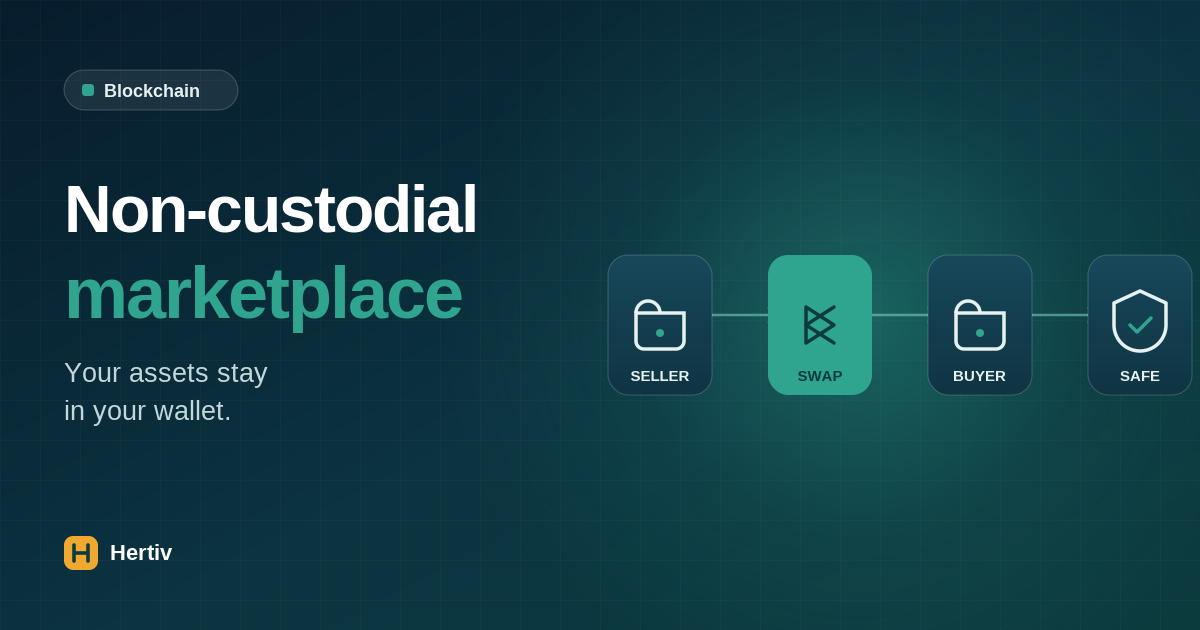
In a custodial marketplace, users deposit NFTs and funds into wallets the platform controls. In a non-custodial one, the asset stays in the seller's wallet until the buyer pays, and the smart contract swaps payment for the NFT in one step.
The difference matters most when things go wrong. If a custodial platform is hacked or stops operating, user assets can be trapped. In a non-custodial marketplace, the platform holds nothing to lose. If you are new to the format, start with what an NFT is.
| Feature | Custodial | Non-custodial |
|---|---|---|
| Who holds the NFT | The platform | The seller, until sale |
| Who holds the funds | The platform | The buyer, until sale |
| Withdrawal delay | Possible, set by the platform | None, assets never leave the wallet |
| Platform risk | High, assets are pooled | Lower, no pooled funds |
| User effort | Low, sign in and trade | Higher, manage your own wallet |
Why do buyers and sellers prefer non-custodial marketplaces?
Buyers and sellers prefer non-custodial marketplaces because they keep ownership of their assets at all times, and they do not have to trust the platform with their funds.
For sellers, the gain is control. A seller can list an NFT, change the price, or cancel the listing without asking the platform to release anything. The asset is in their wallet until the moment it sells.
For buyers, the gain is certainty. Payment leaves the wallet only when the NFT arrives, because the swap happens in one smart contract step. There is no waiting for a withdrawal to clear.
For creators, the gain is royalties that the contract can enforce on each sale. A custodial platform can promise royalties and later change the policy; a contract rule is harder to change quietly.
To see how the two wallet models differ in general, read custodial vs non-custodial wallets.
What does a non-custodial marketplace cost to run?
A non-custodial marketplace costs less to run than a custodial one, because it does not need the security, insurance and support work that comes with holding user funds.
The main costs are the smart contracts, the listing and search service, and the team that keeps them running. Gas fees are paid by buyers and sellers on each trade, not by the platform, which keeps the running costs predictable.
| Cost | Who pays | Planning range |
|---|---|---|
| Smart contract build | Platform | One-time, part of the build |
| Security audit | Platform | One-time, before launch |
| Hosting and indexing | Platform | Monthly, grows with listings |
| Gas per trade | Buyer or seller | Per trade, varies by chain |
| Platform fee per sale | Seller | Usually 1-3% of the sale price |
Revenue usually comes from the platform fee on each sale. A marketplace that charges 2.5% on $100,000 of monthly sales earns $2,500 that month, so volume matters more than the fee rate.
What do you need to build one?
You need five parts to build a non-custodial NFT marketplace: contracts that swap payment for NFTs, wallet connections, an index of listings, storage for media, and moderation for the listings.
The contracts are the core. They handle listing, bidding, sale and royalty payment, and they must be audited before launch, because a flaw can drain funds or lock assets.
- Smart contracts. Listing, sale, auction and royalty rules, written once and audited before launch.
- Wallet connection. Support for the wallets your buyers already use, with clear signing prompts.
- Listing index. A service that reads chain events and shows listings, prices and history fast.
- Media storage. Images and files stored off-chain, with the chain holding only a reference to them.
- Moderation. A way to flag copied art, spam and scams, and to hide listings that break the rules.
For the wider build picture, how NFT marketplaces work on Ethereum covers the same parts on the most common chain.
How to decide if non-custodial fits your marketplace
You decide by checking whether your users value control over convenience, and whether your team can support users who manage their own wallets.
- Know your users. Crypto-native collectors expect to hold their own assets. First-time buyers may prefer a custodial account that feels like a normal app.
- Check the asset type. Art, music and game items suit non-custodial trading. Tickets and memberships that need instant transfers may suit a custodial flow.
- Price the support load. Non-custodial users lose keys and sign the wrong transaction. Budget for guides and support that explain wallet safety.
- Pick the chain first. Fees, speed and wallet support differ by chain, and the chain shapes the whole user experience.
- Plan the audit. A non-custodial marketplace is only as safe as its contracts, so the audit belongs in the launch budget, not after it.
If your users are new to crypto, consider a hybrid: non-custodial trading for collectors, with a simple custodial option for first-time buyers who want help.
Example: a music NFT marketplace's first month
Example (hypothetical): a music NFT marketplace lists tracks from 20 artists. In its first month it records 500 sales at an average price of $40, so total sales are 500 x $40 = $20,000.
The platform charges a 2.5% fee, which is $20,000 x 0.025 = $500 for the month. Creators earn a 10% royalty on each sale, which is $20,000 x 0.10 = $2,000 paid out to the artists.
Buyers pay gas on each trade. At $2.40 per trade on average, 500 trades cost 500 x $2.40 = $1,200 in gas, paid by the buyers, not the platform.
The platform keeps its $500 fee and spends $300 on hosting and indexing that month, leaving $200 before staff costs. The team learns that volume must roughly triple before the marketplace pays for itself, so the next month focuses on bringing in more artists, not on raising the fee.
What are the common mistakes?
The most common non-custodial marketplace mistakes are skipping the audit, hiding the gas cost from buyers, and offering no help when a user loses access to a wallet.
- Skipping the audit. A contract flaw can lock assets or let a buyer take an NFT without paying. Audit before launch, and re-audit after any change.
- Hiding gas costs. Buyers who see a surprise fee at checkout abandon the sale. Show the estimated gas before they sign.
- No wallet recovery help. Users lose keys and seed phrases. Clear guides and a support path keep a lost wallet from becoming a lost customer.
- Weak moderation. Copied art and fake collections erode trust fast. Check listings before they go live.
- Listing on the wrong chain. High fees push small sales away, while a quiet chain may have too few buyers to matter.
Key takeaways
- A non-custodial marketplace keeps assets in the seller's wallet until the sale completes
- Buyers gain certainty because payment and the NFT swap in one contract step
- Running costs are lower than custodial, since the platform holds no user funds
- The contracts must be audited before launch, because a flaw can lock assets
- Volume matters more than the fee rate: a 2.5% fee needs real trading to pay the bills
Frequently asked questions
What happens if the marketplace shuts down?
Sellers keep their NFTs and buyers keep their funds, because neither was ever held by the platform. Listings disappear, but the assets stay in their owners' wallets. The only loss is the listing itself, which can be recreated on another marketplace that reads the same chain.
Can a non-custodial marketplace enforce creator royalties?
Yes, when the royalty rule is written into the sale contract. The royalty is paid as part of the same transaction as the sale, so it cannot be skipped by the buyer.
Is a non-custodial marketplace safer than a custodial one?
It removes the risk of the platform losing pooled funds, but it adds user risk: a lost key or a bad signature can still lose an asset. Both models need good security.
Do buyers pay gas on every trade?
Yes, on most chains. The buyer or seller pays the network fee for the transaction. Showing the estimate before they sign keeps the cost from surprising them. Fees vary with network demand, so a trade at a quiet hour can cost far less than the same trade at a busy hour.
Which chain should a non-custodial marketplace use?
Pick the chain where your buyers already hold wallets and funds. Low fees help small sales, but a chain with few buyers will not fill your listings. Check where your target collectors already trade, and test the fees and wallet support on that chain before you commit to it.
Can first-time buyers use a non-custodial marketplace?
Yes, but they need help. Clear guides, simple wallet choices and a support path for lost keys make the difference between a first sale and an abandoned checkout. A short getting-started page that walks through one purchase can turn a nervous first buyer into a returning one.


