NFT Marketplaces on Ethereum: How They Work
An NFT marketplace on Ethereum is a smart-contract app where people buy and sell ERC-721 and ERC-1155 tokens. Learn how listings, gas and royalties work.
On this page
Short answer
An NFT marketplace on Ethereum is a website or app that lists tokens held in smart contracts and lets buyers purchase them with ether. Sellers list a token, set a price or auction, and the marketplace contract moves the token and the payment in one transaction. Buyers pay the price plus a gas fee and a marketplace fee, and creators can receive a royalty on resales.
What is an NFT marketplace on Ethereum?
An NFT marketplace on Ethereum is a website or app where people buy and sell unique tokens that live on the Ethereum blockchain. The marketplace lists the tokens, shows the price and handles the transfer, while the token itself is held in a smart contract until it is sold.
Ethereum was the first chain with a widely used NFT standard, and most of the well-known marketplaces run on it. That history is why Ethereum marketplaces have the deepest liquidity: more buyers, more sellers and more collections than any other chain. A seller listing on Ethereum reaches the largest pool of buyers, while a buyer finds the widest choice of collections in one place.
The token at the centre of all this is an NFT. What an NFT is explains the token itself; this article explains the marketplaces where those tokens change hands.
Which token standards do Ethereum marketplaces use?
Ethereum marketplaces use two token standards. ERC-721 covers one-of-a-kind tokens, such as a single artwork, while ERC-1155 covers editions and game items, where many copies of one token exist. Knowing which standard a listing uses tells you what you are actually buying.
| Standard | What it covers | Typical use | Transfer |
|---|---|---|---|
| ERC-721 | One unique token | Art, collectibles, profile pictures | One token per transfer |
| ERC-1155 | Many copies of one token | Game items, editions, tickets | Batches in one transfer |
| ERC-20 | Fungible tokens | Payment, not NFTs | Any amount |
The marketplace contract checks the standard before a sale, so a buyer cannot accidentally pay for the wrong token type. That check is part of why buying through a marketplace is safer than a direct wallet-to-wallet deal.
Some collections use their own contract with extra rules, such as a fixed royalty or a limit on transfers. The marketplace reads those rules from the contract, so the listing shows what the token allows. A buyer who reads the listing terms avoids surprises, such as a token that cannot be transferred for a set period after minting.
How does buying an NFT on Ethereum work?
Buying an NFT on Ethereum follows the same steps on most marketplaces. The steps are simple, but each one has a cost or a check worth knowing before you confirm the transaction.
- Connect a wallet, such as MetaMask, to the marketplace and check the network is Ethereum mainnet.
- Find the listing and check the collection, the token ID and the seller's history.
- Confirm the price, the marketplace fee and the estimated gas fee before signing.
- Sign the transaction in the wallet and wait for the network to confirm it.
- Check the token appears in the wallet and the receipt shows the right token ID.
The sale is final once the network confirms it. There is no undo button, which is why the checks in step two matter more than the speed of the purchase.
What do gas and marketplace fees add to the price?
Gas is the fee paid to the Ethereum network for processing the transaction, and it changes with network demand. A purchase at a quiet hour costs less than the same purchase during a busy mint, so timing matters for expensive items.
The marketplace fee is separate and is usually a percentage of the sale price, often around 2.5% on the larger marketplaces. Some marketplaces charge less, and some charge the buyer instead of the seller, so the headline price is not always the full cost.
Fees vary by marketplace, so compare them before choosing where to buy. The best NFT marketplaces for startups compares the main options and their fee structures.
Gas can also be lowered by choosing when to buy. Marketplaces show an estimated gas fee before you sign, and waiting for a quiet hour can cut it sharply. For low-priced tokens, the gas fee can be larger than the token price, so checking the estimate is part of the purchase decision, not an afterthought.
How do royalties work on Ethereum marketplaces?
A royalty is a share of each resale that goes back to the creator. The creator sets the percentage when the token is minted, often between 5% and 10%, and the marketplace contract is meant to pay it automatically on every sale.
Royalties are not guaranteed on every marketplace. Some marketplaces made them optional, which means a buyer can choose to pay less or nothing. Creators who rely on royalties should check the marketplace's policy before listing, not after the first resale.
The royalty is written into the token's smart contract. How an NFT smart contract works explains the code that moves the token and splits the payment.
Some creators now build royalties into the token contract itself, so the payment happens even if the marketplace does not enforce it. That approach is newer and not universal, but it shows how the market is answering the royalty problem: by moving the rule from the marketplace into the token.
Example (hypothetical): selling one artwork on Ethereum
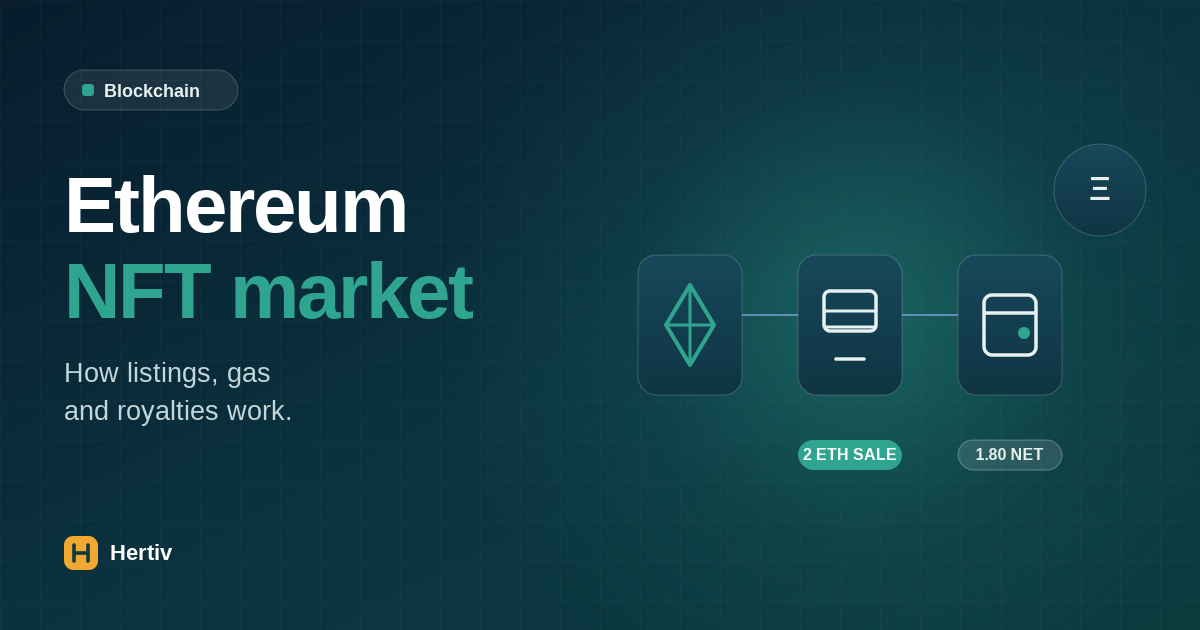
Example (hypothetical): an artist lists one artwork at 2 ETH on an Ethereum marketplace. The marketplace fee is 2.5% and the royalty is 7.5%.
The fee is 2 x 0.025 = 0.05 ETH and the royalty is 2 x 0.075 = 0.15 ETH. The seller receives 2 - 0.05 - 0.15 = 1.80 ETH.
The buyer pays the 2 ETH sale price plus the gas fee for the transaction. If gas is 0.004 ETH, the buyer's total is 2.004 ETH, and the seller's net is 1.80 ETH before any tax or conversion cost. The numbers show why fees matter: the seller keeps 90% of the price, and the rest goes to the marketplace and the creator.
What are the common mistakes?
The most common NFT marketplace mistakes on Ethereum are buying without checking the collection address, ignoring the gas fee and assuming royalties are always paid.
- Buying without checking the collection address, and paying for a copy of a real collection.
- Ignoring the gas fee, then being surprised by the total at checkout.
- Assuming royalties are paid on every marketplace, when some made them optional.
- Listing on the first marketplace found instead of comparing fees and buyers.
- Treating a listing as proof of value, when it only proves the token is for sale.
Key takeaways
- Ethereum marketplaces have the deepest liquidity because the standards started there
- ERC-721 covers unique tokens; ERC-1155 covers editions and game items
- The buyer pays the price plus gas and a marketplace fee
- Royalties are a creator's share of resales, but not every marketplace enforces them
- The sale is final once confirmed, so check the collection address first
Frequently asked questions
What is the best NFT marketplace on Ethereum?
There is no single best marketplace. The larger ones have more buyers and collections, while smaller ones may charge lower fees or focus on a niche. Compare the fee, the buyers for your kind of token and the royalty policy before choosing.
Do I need ether to buy an NFT on Ethereum?
Yes. Purchases on Ethereum marketplaces are paid in ether, plus a gas fee for the transaction. Some marketplaces accept cards through a payment partner, but the underlying sale still settles in ether on the chain.
What is the difference between ERC-721 and ERC-1155?
ERC-721 covers one unique token, such as a single artwork. ERC-1155 covers many copies of one token, such as game items or editions, and can move them in batches. The standard tells you what you are buying.
Are NFT royalties guaranteed on Ethereum?
No. The creator sets a royalty percentage when minting, but some marketplaces made royalty payment optional. Check the marketplace's royalty policy before listing if resale income matters to you.
Why is gas sometimes higher than the NFT price?
Gas depends on network demand, not on the item's price. During a busy mint, the network fee for a transaction can exceed the price of a cheap token, which is why timing and the item's value both matter.
Can I sell an NFT I bought on one marketplace on another?
Usually yes, if the other marketplace lists the same collection and standard. The token lives in your wallet, not in the marketplace, so you can list it wherever the collection is supported.


