White Label Tokenization Platform Architecture Explained
A white label tokenization platform gives you issuance, custody, compliance and trading under your own brand. Here is how the modules fit and what to check.
On this page
Short answer
A white label tokenization platform is a ready-made system that lets a company issue and manage tokenised assets under its own brand, without building the blockchain infrastructure itself. Its architecture splits into issuance, investor onboarding, custody, a token registry, compliance checks and secondary trading, with most rules enforced off-chain and ownership recorded on-chain.
What is a white label tokenization platform?
A white label tokenization platform is a ready-made software system that lets a company issue, manage and trade tokenised assets under its own brand, without building the blockchain infrastructure from scratch. The provider builds and runs the platform, and the client puts its own name, colours and domain on it.
Tokenisation turns an asset, such as a property, a fund share or a bond, into digital tokens on a blockchain. Each token represents a share of the asset, and ownership is recorded on-chain so transfers are fast and visible. The platform handles the parts around that record: who can buy, how payments settle, and what rules apply.
The 'white label' part matters because building all of this in-house takes a team, a licence strategy and months of work. A white label platform gives a smaller firm the same starting point, and the firm focuses on finding assets and investors instead of writing smart contracts. How to launch a white label tokenization platform covers the business steps that sit around the technology.
What are the core modules of the platform?
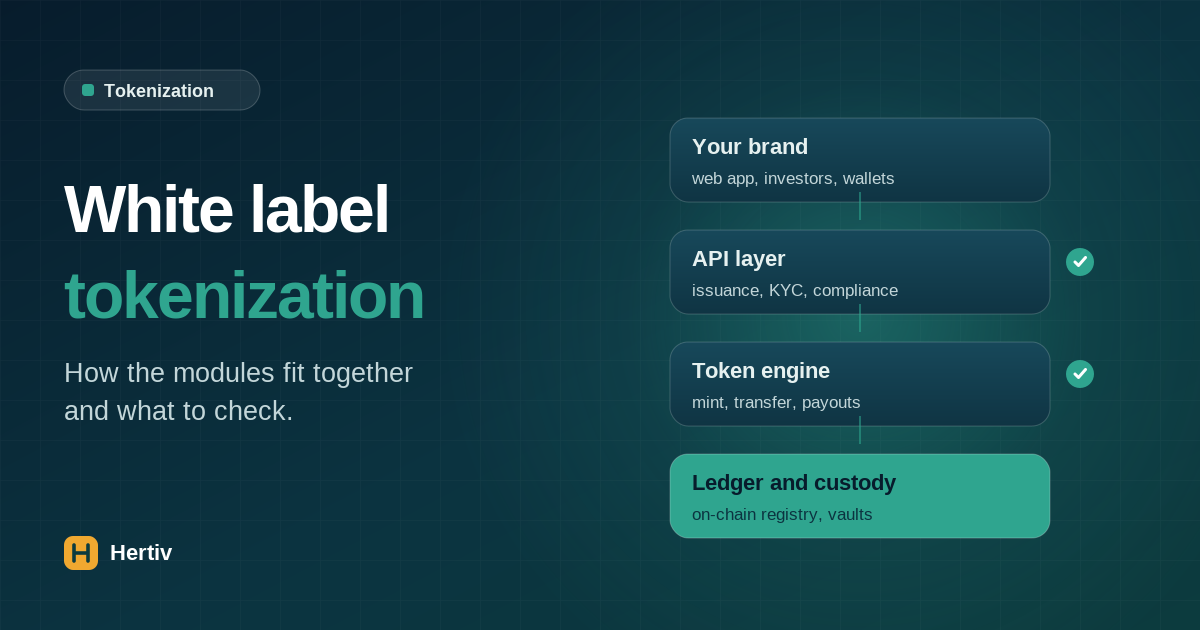
The core modules of a white label tokenization platform are issuance, investor onboarding, custody, a token registry, compliance checks, secondary trading and reporting. Each module does one job, and they share data through an API layer so a change in one place reaches the others.
| Module | What it does | Where it runs |
|---|---|---|
| Issuance engine | Creates tokens and sets their rules | On-chain smart contracts |
| Investor onboarding | Identity checks and wallet setup | Off-chain web app |
| Custody integration | Connects to wallets and custodians | Off-chain, with on-chain keys |
| Token registry | Records who owns which tokens | On-chain |
| Compliance engine | Enforces transfer rules and limits | Off-chain rules, on-chain checks |
| Secondary market | Lets investors buy and sell tokens | Off-chain order book |
| Reporting | Statements, tax records, audit trails | Off-chain database |
The split between on-chain and off-chain is the key design choice. Ownership and transfer rules live on-chain, where they are hard to change quietly. Identity documents, investor data and reporting live off-chain, where they can be updated, corrected and kept private.
How does the token lifecycle work?
The token lifecycle runs from asset onboarding to redemption, and the platform guides each step so nothing is issued before the legal and compliance checks are done.
- Asset onboarding. The asset is valued and its legal structure is set, so the token has a clear claim behind it.
- Token design. The team sets the token standard, the number of tokens, the minimum investment and the transfer rules.
- Investor onboarding. Investors pass identity checks and connect a wallet that the platform can whitelist.
- Minting and primary sale. Tokens are minted and sold to approved investors, with payment and token delivery linked.
- Secondary trading. Investors trade among themselves on the platform's market, subject to the same transfer rules.
- Payouts and redemption. Income such as rent or interest is paid to token holders, and tokens can be bought back or burned at the end.
Each step leaves a record. The on-chain record shows who holds what and when it moved, while the off-chain record shows who passed which check and when. Together they give an auditor a complete trail without exposing investor documents on a public chain.
How do custody and settlement fit in?
Custody and settlement decide where the tokens and the money actually sit, and they are the parts a buyer should examine first. Tokens can be held by a regulated custodian, in a multi-party computation wallet, or in a wallet the investor controls directly. Each option trades control for convenience.
Most white label platforms connect to a third-party custodian rather than holding assets themselves. That keeps the platform out of the custody business and gives investors a named institution to trust. The platform still needs to know, at all times, which custodian holds which tokens for which investor.
Settlement is the exchange of money for tokens. The cleanest design settles both sides at once, so the token moves only when the payment clears. If payment and token delivery happen separately, one side can be left waiting, and the platform needs a process for failed payments and refunds.
Where does compliance sit in the architecture?
Compliance sits in the middle of the architecture, between the investor and the token, so no transfer happens without a rule check. Identity checks run when an investor joins, and transfer rules run again every time a token moves, because an investor who was approved last year may no longer qualify.
The usual controls are a whitelist of approved wallets, limits on who can hold a token, holding periods, and jurisdiction rules that block transfers to places the offering cannot serve. These rules are written off-chain by the compliance team and enforced by the smart contract, so the contract rejects a transfer that breaks a rule.
Reporting closes the loop. The platform keeps an audit trail of every check, transfer and payout, and it can produce statements for investors and records for regulators. A platform that cannot show this trail is not ready for real investors, whatever its marketing says. For the service side, real-world asset tokenization covers how Hertiv structures these projects.
Example (hypothetical): a property fund launches on a white label platform
Example (hypothetical): a small property fund wants to tokenise one office building worth $4,000,000. It uses a white label platform instead of building its own, so the fund team spends its time on investors rather than on smart contracts.
The fund splits the building into 40,000 tokens at $100 each, since 40,000 x $100 = $4,000,000. The minimum investment is 10 tokens, or $1,000, and 200 investors join after passing identity checks. The platform whitelists their wallets and mints the tokens to them.
The building earns $200,000 a year in net rent. The platform pays that out to token holders, which is $200,000 / 40,000 = $5 per token per year. An investor holding 100 tokens receives $500 a year, minus the platform fee the fund disclosed up front.
After two years, one investor wants to sell 50 tokens. The platform checks that the buyer is whitelisted and that the holding period has passed, then settles the trade and updates the registry. The whole process runs through the same modules that handled the first sale.
What are the common mistakes?
The most common mistakes in white label tokenization platform architecture are treating the platform as the whole product, skipping the custody question, and writing transfer rules that nobody can change.
- Buying the platform before the legal structure. The token needs a clear legal claim behind it. Without that, the platform is a database with a blockchain label.
- Ignoring custody. If nobody can say clearly who holds the tokens and what happens if the custodian fails, investors will ask, and the answer matters.
- Hard-coding rules into contracts. Jurisdictions and limits change. Rules that cannot be updated without redeploying the contract become a problem within a year.
- No plan for failed payments. Primary sales fail, cards bounce and wires go missing. The platform needs a refund and retry flow, not just a success path.
- Weak reporting. Investors expect statements and tax records. If reporting is an afterthought, the support team pays for it every quarter.
Compare the platform options first with white label tokenization platforms before signing.
For the wider market, top asset tokenization platforms shows how the main providers compare on features and focus.
Key takeaways
- A white label platform gives you issuance, custody, compliance and trading under your own brand
- Ownership and transfer rules live on-chain; identity data and reporting stay off-chain
- Compliance checks run on every transfer, not just at onboarding
- Custody and settlement are the first things to examine in any provider
- Rules must be updatable without redeploying the whole contract
Frequently asked questions
What is a white label tokenization platform?
It is a ready-made system for issuing and managing tokenised assets, sold under your own brand. The provider builds and runs the software, while you bring the assets, the investors and the legal structure. You avoid building smart contracts, custody links and compliance tooling from scratch.
How is it different from building your own platform?
Building your own takes a team, months of work and a custody and compliance strategy. A white label platform gives you the same modules on day one, but you accept the provider's design choices and pay a licence or revenue share instead of owning the code.
Who holds the tokens in a white label setup?
Tokens are usually held by a regulated custodian, in a multi-party computation wallet, or in a wallet the investor controls. The platform should state clearly which option applies, who the custodian is, and what happens if the custodian fails.
Can transfer rules change after tokens are issued?
They should be able to. Jurisdictions, limits and investor status change over time, so the rules need an update path that does not force a full redeployment. Ask the provider how a rule change is tested and rolled out.
What does a white label tokenization platform cost?
Pricing varies by provider and by deal size, and most providers quote per project rather than publishing a fixed price. See the vendor site for current pricing, and ask what is included: custody links, compliance tooling, support and upgrades.
Is a white label platform right for a first tokenization project?
It usually is, because it removes the hardest technical work and lets the team test demand with real investors. The trade-off is less control over the design, so it suits teams that want to launch fast more than teams with unusual requirements.


