Top 10 Asset Tokenization Platforms to Compare
Ten asset tokenization platforms worth shortlisting, from real estate and funds to bonds and equity. Compare what each one fits before you choose.
On this page
Short answer
Asset tokenization platforms turn real-world assets into digital tokens, and the choice of platform decides which assets you can tokenize, which investors you can reach, and how much compliance work the platform handles for you. This list compares ten platforms that operate today, so you can shortlist the ones that fit your asset type, your investors and your budget. Prices change often, so check the vendor site for current plans.
Which asset tokenization platforms should you compare?
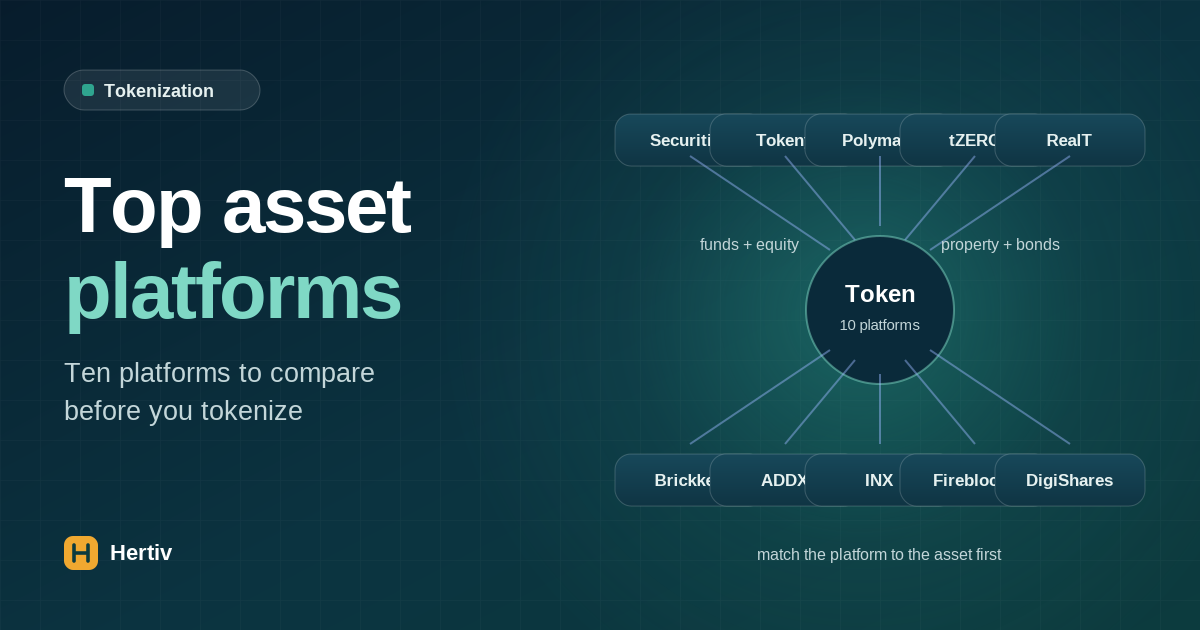
An asset tokenization platform is software that creates digital tokens for a real asset, manages who may hold them, and handles the rules for buying, selling and paying out. The ten platforms below cover real estate, funds, bonds, equity and art, and each one fits a different kind of issuer.
| Platform | Assets it fits | Key strength |
|---|---|---|
| Securitize | Funds, equity, bonds | Regulated issuance and investor onboarding |
| Tokeny | Funds, equity, real estate | Identity and compliance built into the token |
| Polymath | Security tokens | Specialist tools for token creation |
| tZERO | Equity and funds | Issuance plus a trading venue |
| RealT | Rental property | Fractional property with rental payouts |
| Brickken | Real estate, equity, funds | Simple setup for smaller issuers |
| ADDX | Funds, bonds, pre-IPO shares | Access to private market assets |
| INX | Security tokens, crypto | Regulated trading of tokenized assets |
| Fireblocks | Many asset types | Custody and secure token operations |
| DigiShares | Real estate, funds | White-label platform for issuers |
Before shortlisting, decide your asset type and your investors. A guide to fund tokenization explains how funds are structured as tokens.
For property, a guide to real estate tokenization covers the property side, which is where most first-time issuers start.
Securitize and Tokeny
1. Securitize: best for regulated fund issuance
Securitize is a platform for issuing security tokens for funds, equity and bonds, with investor onboarding, compliance checks and transfer rules built in. It suits issuers who need a regulated path from the first token to the first investor.
Its strength is the compliance work it handles: identity checks, accreditation checks and transfer limits are part of the platform, not add-ons the issuer must build. That matters most for funds and bonds, where the rules are strictest.
Pros: regulated issuance, full investor onboarding, transfer rules built in.
Cons: setup takes longer than a simple token tool, and it fits larger issuers better than small ones.
2. Tokeny: best for compliance built into the token
Tokeny builds identity and compliance rules into the token itself, so a token can only move between investors who pass the checks. It suits funds, equity and real estate where the issuer must control who may hold the asset.
Its strength is that the rules travel with the token. Even if the token changes hands on another system, the compliance checks still apply, which gives issuers and regulators a clear audit trail.
Pros: rules travel with the token, strong identity checks, clear audit trail.
Cons: issuers must define every rule up front, which takes legal and technical time.
Polymath and tZERO
3. Polymath: best for specialist security token creation
Polymath offers specialist tools for creating security tokens, with templates for the token rules, the offering and the investor records. It suits teams that want a focused token-creation tool rather than a full marketplace.
Its strength is depth in one job: token creation. Teams that already have investors and a trading plan can use it to build the token layer and keep the rest of their process as it is.
Pros: focused token tools, clear templates, fits teams with their own investors.
Cons: issuers must arrange onboarding and trading separately.
4. tZERO: best for issuance plus trading
tZERO pairs token issuance with a trading venue, so investors can buy and later trade the tokens in one place. It suits equity and fund issuers who want liquidity for their investors, not just a one-time sale.
Its strength is the second market. Many platforms issue tokens well but leave trading to others, while tZERO keeps issuance and trading under one roof, which makes the investor journey simpler.
Pros: issuance and trading in one place, clearer path to liquidity.
Cons: trading rules and availability depend on the investor's location.
RealT and Brickken
5. RealT: best for fractional rental property
RealT tokenizes rental property into fractions that investors can buy, and pays out rental income to token holders. It suits investors who want a small share of a property and a regular payout, rather than a whole building.
Its strength is the payout habit: rent is collected, costs are taken out, and the rest is shared among token holders. That makes the return easy to follow, even for first-time property investors.
Pros: small fractions, regular rental payouts, simple investor story.
Cons: limited to property, and returns depend on the local rental market.
6. Brickken: best for smaller issuers
Brickken offers tokenization for real estate, equity and funds with a setup aimed at smaller issuers. It suits teams that want to tokenize one asset without hiring a large technical team first.
Its strength is the short path from idea to issued token. The platform handles the token, the investor records and the payout logic, so a small team can launch and learn before scaling up.
Pros: fast setup, fits small teams, covers several asset types.
Cons: larger or more complex deals may need extra legal and technical work.
ADDX and INX
7. ADDX: best for private market assets
ADDX gives investors access to private market assets such as funds, bonds and pre-IPO shares, tokenized into smaller pieces. It suits investors who want assets that are usually open only to large institutions.
Its strength is the asset range. By tokenizing private market products, it lets smaller investors take part in deals they could not reach before, with the platform handling the onboarding and the rules.
Pros: wide private market range, smaller minimums, full onboarding.
Cons: availability depends on the investor's location and status.
8. INX: best for regulated token trading
INX runs a regulated venue for trading security tokens and crypto, and it also supports token issuance. It suits issuers and investors who want trading on a regulated market rather than an informal one.
Its strength is the market structure: trading, settlement and compliance sit together, which gives both sides a clear record of each trade. That matters for investors who must report their holdings.
Pros: regulated trading venue, clear settlement, issuance support.
Cons: the asset list is narrower than on a general exchange.
Fireblocks and DigiShares
9. Fireblocks: best for custody and secure operations
Fireblocks is a platform for holding and moving digital assets safely, and it supports tokenization work for many asset types. It suits issuers and funds that need strong custody, key management and secure transfers above all else.
Its strength is security operations: keys, approvals and transfer rules are managed in one place, with an audit trail for every move. Teams that handle large sums usually start here and add issuance tools around it.
Pros: strong custody, key management, full audit trail.
Cons: it is an operations platform, so issuers may need a separate issuance tool.
10. DigiShares: best for white-label issuance
DigiShares offers a white-label platform that issuers can brand as their own, covering real estate and funds. It suits teams that want their investors to see their own brand, not a third-party marketplace.
Its strength is the branded experience: the issuer's name, colours and domain sit on top of the platform, while DigiShares handles the token, the investor records and the payouts behind the scenes.
Pros: full white-label branding, covers real estate and funds, payout handling.
Cons: the issuer still owns the legal and marketing work.
How to choose in five steps
Choosing a platform starts from the asset and the investor, not from the feature list. A platform that fits real estate may be a poor fit for a fund, and a platform built for institutions may be too heavy for a single property.
- Write down the asset type, the investors you want, and the countries they live in.
- Check which platforms support that asset and those investors.
- Ask each one who handles onboarding, custody, trading and payouts.
- Compare the fees and the setup time, and check the vendor site for current plans.
- Run a small pilot with one asset before committing to a full launch.
Ask for a demo with your own asset, not a generic one. A practical guide to RWA tokenization covers the issuer-side steps, from structuring the asset to the first sale, and it is worth reading before the demo.
Common mistakes
The first mistake is choosing a platform before choosing the asset. Teams fall in love with a feature list, then discover the platform does not support their asset type or their investors' countries. The asset and the investor list come first, always.
The second mistake is ignoring the secondary market. Tokens that cannot be traded leave investors stuck, and stuck investors do not come back for the next offering. Ask how trading works before the first sale, not after it.
The third mistake is underestimating the legal work. Tokenization does not remove the need for lawyers, offering documents and investor checks. Budget for legal advice from the start, and keep it separate from the platform fee.
Key takeaways
- Match the platform to your asset type and your investors first.
- Securitize and Tokeny suit regulated funds and equity; RealT and Brickken suit property.
- tZERO and INX add trading, which gives investors a way out.
- Fireblocks suits teams that need custody and secure operations most.
- Always pilot one asset before a full launch.
Frequently asked questions
What is an asset tokenization platform?
It is software that creates digital tokens for a real asset, such as property, a fund or a bond, and manages who may hold them. It usually handles investor onboarding, compliance checks, payouts and the rules for buying and selling.
Which assets can be tokenized?
Real estate, funds, bonds, equity, art and commodities are the most common. The platform must support the asset type, and the legal structure must fit the country where the asset and the investors sit.
Do investors need to be accredited?
It depends on the asset and the country. Many platforms check accreditation during onboarding, and some assets are open only to accredited investors. The platform usually runs these checks as part of sign-up.
Can token holders sell their tokens?
It depends on the platform. Some offer a trading venue, while others leave trading to third parties or lock the tokens for a period. Ask about the secondary market before the first sale.
How much does a tokenization platform cost?
Fees vary by platform, asset type and deal size, and they change often. Most charge setup fees, a share of the raise or a monthly fee, so check the vendor site for current plans and compare like with like.
What is the first step to tokenize an asset?
Decide the asset, the investors and the legal structure, then shortlist platforms that support all three. A small pilot with one asset shows the real cost and effort before a full launch.


