What Is Fund Tokenization, and How Does It Work?
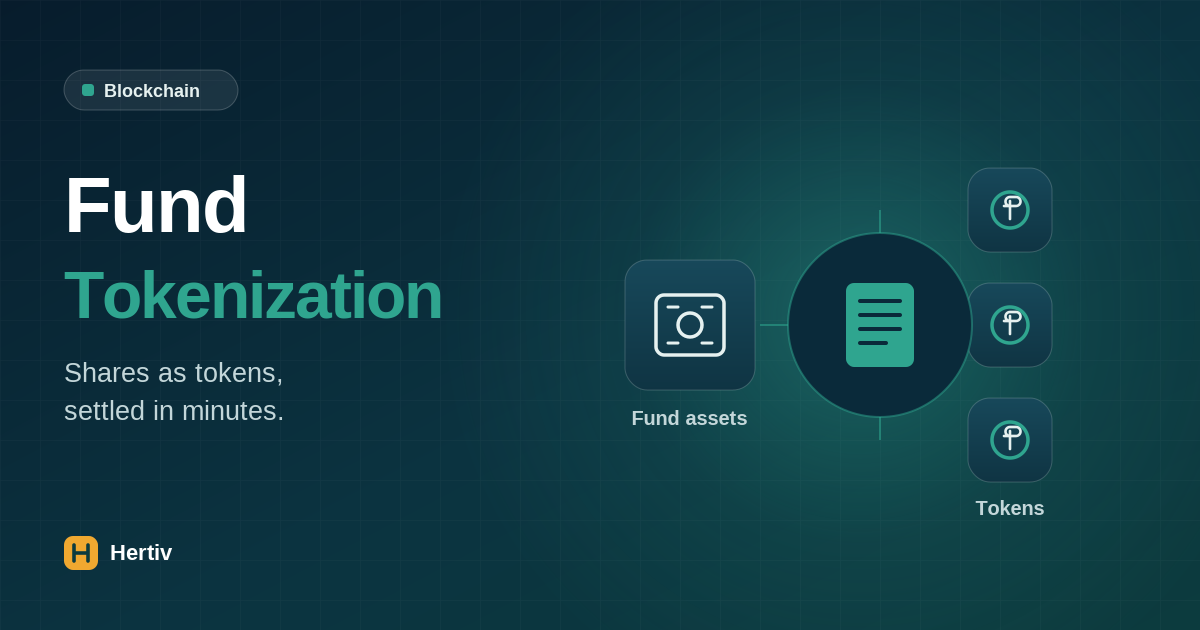
Fund tokenization records shares in an investment fund as digital tokens on a blockchain, so transfers settle in minutes and the register stays current.
On this page
Short answer
Fund tokenization records shares in an investment fund as digital tokens on a blockchain, so ownership, transfers and settlement are handled by a shared ledger instead of paper records and intermediaries. Each token stands for a share in the fund, the fund still holds the same underlying assets, and the legal rights stay the same while the record-keeping changes.
What is fund tokenization?
Fund tokenization is the process of recording shares in an investment fund as digital tokens on a blockchain, so that ownership, transfers and settlement are handled by a shared ledger instead of by paper records and a chain of intermediaries. Each token stands for a share in the fund, and the fund itself still holds the underlying assets.
The fund does not change its strategy. A tokenized money-market fund still holds the same short-term assets, and a tokenized real-estate fund still holds the same properties. What changes is how ownership is recorded and moved: a transfer that used to take days of paperwork can settle in minutes, and the register is visible to everyone with permission to see it.
Tokenization is often confused with creating a new asset. It is not. It is a new way of recording and moving an existing fund share, in the same way that a share certificate became an electronic entry. The legal rights stay the same; the record-keeping changes.
Which funds can be tokenized?
Almost any fund with a clear register of investors can be tokenized, but the funds that gain most are the ones where transfers are slow, the investor base is large, or settlement takes days. The table shows the common cases.
| Fund type | What gets tokenized | Why it helps |
|---|---|---|
| Money-market fund | Shares in a cash-like fund | Faster settlement and use as collateral |
| Real-estate fund | Shares in a property fund | Smaller minimums and easier transfers |
| Private equity fund | Interests in a private fund | A record that secondary buyers can check |
| Bond fund | Shares in a fund of bonds | Faster settlement and fewer reconciliations |
| Venture fund | Interests in a startup fund | Clearer ownership over a long fund life |
| Commodities fund | Shares in a fund of commodities | Simpler transfers between investors |
Money-market funds were among the first to be tokenized because their assets are simple and their investors value speed. Private funds gain a different benefit: a shared register makes it easier to prove who owns what when an interest changes hands, which is the slowest part of a private-fund transfer today.
How does fund tokenization work?
Fund tokenization works by creating a token contract that mirrors the fund register. The fund manager, a custodian and a transfer agent agree the rules, and the token contract enforces them: who can hold a token, how many exist, and what happens when one is transferred.
- The fund is set up or adapted so its shares can be represented as tokens, with the legal documents updated to match.
- A custodian holds the underlying assets, and the token supply is issued to match the shares outstanding.
- Investors pass checks and receive tokens in a wallet the fund recognises.
- Transfers move tokens between wallets, and the contract checks the rules before the transfer settles.
- Distributions, such as income, are paid to token holders according to the register at a set time.
Settlement is the part that changes most. In a traditional fund, a transfer passes through a transfer agent, a custodian and a bank, and each one reconciles its own records. With tokens, the ledger is the register, so the transfer and the record update happen in the same step.
What are the benefits of tokenized funds?
The main benefit of a tokenized fund is speed: transfers settle in minutes rather than days, and the register is always current. That matters for investors who want to move quickly, and for funds that want to use shares as collateral without waiting for a paper process.
Smaller minimums are a second benefit. Splitting a fund share into tokens makes it possible to offer a smaller slice to more investors, which can widen the investor base. That does not make the fund safer or the assets more liquid on its own; it only makes the slices smaller.
Transparency is a third benefit, with a limit. Anyone with permission can check the register and the token supply, which cuts down on reconciliation disputes. But the underlying assets still need auditing and reporting, and a token does not make a bad fund good. Real-world asset tokenization shows the same pattern: real-world asset tokenization use cases start with the asset, not the token.
What are the risks and limits of fund tokenization?
The biggest risk in fund tokenization is legal, not technical. A token is only as good as the legal link between the token and the fund share, and that link depends on the rules in each country. A fund that is tokenized in one place may not be recognised as a fund share in another, which limits who can buy it.
Liquidity is often overstated. A token can be transferred quickly, but that only helps if someone wants to buy it. A tokenized share in a fund that holds illiquid assets is still an illiquid investment, and the token does not create buyers. Investors who expect to sell at any moment will be disappointed.
Technology risk is real too. A bug in the token contract, a lost wallet key or a compromised custodian can lock up shares or move them wrongly. That is why tokenized funds use audited contracts, regulated custodians and recovery processes, and why the manager still matters more than the token. The comparison with traditional structures is covered in tokenization vs securitization, which sets out where the two overlap and where they differ.
Example: a fund tokenizes its shares
Example (hypothetical): a fund holds 10 million dollars of assets and has 10,000 shares outstanding. Each share is worth 1,000 dollars. The manager tokenizes the fund, issuing 10,000 tokens, one per share.
An investor buys 50 tokens for 50,000 dollars, which is 0.5 percent of the fund. The fund earns 8 percent in a year, so the investor share of the gain is 4,000 dollars, and the token value rises from 1,000 to 1,080 dollars each.
Later the investor sells 20 tokens to another checked investor for 21,600 dollars. The transfer settles in minutes, the register updates in the same step, and the remaining 30 tokens stay in the first investor wallet, worth 32,400 dollars. The fund itself never sold an asset; only the ownership record changed.
What are the common mistakes?
The most common fund tokenization mistakes are treating the token as the product, promising liquidity the assets cannot support, and starting before the legal link between token and share is clear.
- Tokenizing a fund before the legal documents recognise the token as a share
- Promising fast exits when the underlying assets take months to sell
- Choosing a token standard that the fund custodian cannot support
- Skipping investor checks because the transfer is fast
- Assuming a token makes the fund transparent without audits and reporting
- Forgetting a recovery process for lost wallet keys
Start with the fund, not the token. A fund with clear assets, a regulated custodian and a simple register is a good candidate; a fund with unclear assets is not fixed by tokenizing it. Property funds face the same test, as real estate tokenization shows with its own legal and valuation checks.
Key takeaways
- Fund tokenization records fund shares as tokens; it does not create a new asset or change the fund strategy.
- Transfers settle in minutes because the ledger is the register, so the transfer and the record update happen together.
- Smaller token slices can widen the investor base, but they do not make illiquid assets liquid.
- The legal link between token and share matters more than the technology, and it varies by country.
- Start with a fund that has clear assets and a regulated custodian; a token does not fix an unclear fund.
Frequently asked questions
Is a tokenized fund the same as a cryptocurrency?
No. A tokenized fund is a share in a fund that happens to be recorded as a token, and its value follows the fund assets. A cryptocurrency is a digital asset in its own right, with no fund or underlying portfolio behind it. The token in a fund is a record of ownership, not a separate investment.
Can anyone buy a tokenized fund?
No. Tokenized funds still have investor checks, and many are limited to investors who pass suitability and identity checks. The token makes the transfer faster, but it does not remove the rules about who can hold the fund. The fund documents state who is eligible.
Does tokenization make a fund more liquid?
Only partly. A token can be transferred quickly, but liquidity needs buyers, and a fund holding illiquid assets still takes time to sell those assets. Tokenization helps with transfers and settlement, but it does not create a market where none exists.
Who holds the assets in a tokenized fund?
A regulated custodian holds the underlying assets, just as in a traditional fund. The token contract records who owns which shares, and the custodian records what the fund owns. Both records must agree, and audits check that they do.
What happens if I lose my wallet key?
It depends on the fund setup. Most tokenized funds use a recovery process run by the transfer agent or custodian, so a lost key does not mean a lost investment. Check the fund documents before investing: a fund with no recovery process is a risk worth avoiding.
Is fund tokenization legal everywhere?
No. The rules differ by country, and a token recognized as a fund share in one place may not be recognized in another. Funds usually start in one jurisdiction with clear rules and expand slowly. Ask the manager which rules apply before investing.


