What Is Real Estate Tokenization, and How Does It Work?
Real estate tokenization turns a building into digital tokens on a blockchain, so many investors can own small shares. How it works, what holders get, and the risks.
On this page
Short answer
Real estate tokenization is the process of recording ownership of a property, or a share in it, as digital tokens on a blockchain. Each token stands for a fraction of the asset, and holders receive rent or sale proceeds in proportion to what they own. It can open property investment to smaller buyers, but it does not remove the legal, market and liquidity risks of the property itself.
What is real estate tokenization?
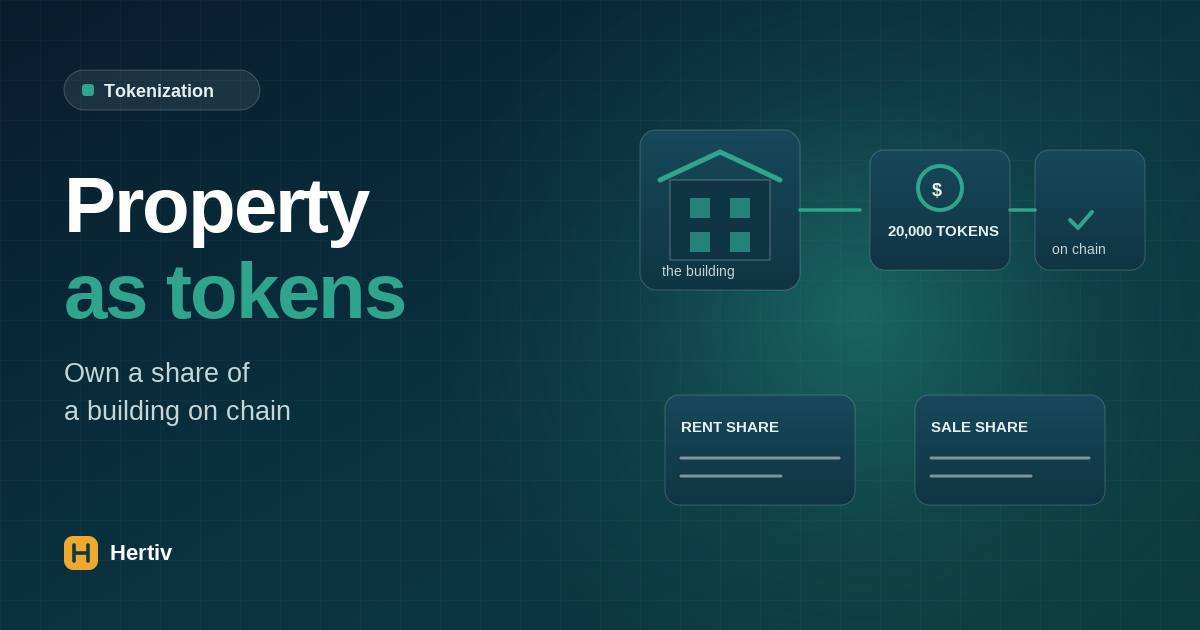
Real estate tokenization is the process of recording ownership of a property, or a share in it, as digital tokens on a blockchain. Each token stands for a fraction of the asset, and holders can receive rent or sale proceeds in proportion to what they own.
The property itself does not move onto the blockchain. A legal structure, usually a company or a fund, holds the building, and the tokens stand for shares in that structure. The blockchain records who owns which tokens, and the law decides what those tokens mean.
| Step | What happens |
|---|---|
| Value the asset | An appraiser sets the property value |
| Create the structure | A company or fund holds the property |
| Issue the tokens | Tokens are minted, each worth a share |
| Sell the tokens | Investors buy tokens, often in small amounts |
| Manage and pay out | Rent is collected and shared by token |
Tokenization does not change the building. It changes who can own a piece of it and how easily that piece can change hands. To see the wider idea first, read how tokenization works for other asset types.
What kinds of property get tokenized?
The most common candidates are income-producing buildings: offices, shops, warehouses and rental flats. They suit tokenization because they produce regular rent, and that rent gives token holders a reason to hold.
Development projects are tokenized too, so many small investors can fund a build and share the sale proceeds. Funds that hold several properties are another common case, because one token can stand for a share of a whole portfolio rather than a single building.
A single family home is a poor fit. The legal and setup costs are the same whether the property is worth $200,000 or $20,000,000, so small properties rarely justify the work.
Hotels and student housing sit in the middle. They earn rent like offices, but their income moves with seasons and bookings, so token holders should expect payouts that rise and fall through the year.
How does a token sale work?
A token sale follows the same shape as a small securities offering, because in most countries the tokens are regulated as securities. The steps are legal first and technical second.
- Value and structure the asset. An appraiser values the property and lawyers set up the holding company or fund.
- Draft the offering documents. These state what holders get, what they do not get, and who can buy.
- Mint the tokens. The tokens are created on a blockchain, usually with rules that limit who can hold them.
- Sell to investors. Buyers pass identity checks, pay, and receive tokens in a wallet or a custodial account.
- List for trading. Some tokens trade on a licensed secondary market; many do not, and holders should assume they cannot sell quickly.
The identity checks are not optional. Most regulators require the issuer to know who holds the tokens, which is why token sales look more like a share offering than a crypto launch. A step-by-step account of the same process is in how to tokenize real estate, which covers the same stages from the owner side.
What do token holders get?
Holders usually get a share of the rent, paid in proportion to the tokens they own, and a share of any sale proceeds if the property is sold. Some tokens also give voting rights on big decisions, such as selling the building or taking on debt.
What holders do not get matters just as much. They do not own the building directly, they cannot live in it, and they cannot force a sale on their own. The rights are whatever the offering documents say, and those documents, not the token, are what a court will read.
Income is the main attraction, and it is also the main source of disappointment. Rent can fall, a tenant can leave, and maintenance can eat the payout. A token does not fix any of that.
Example: a small office building is tokenized
Example (hypothetical): a small office building is valued at $2,000,000. The owner creates 20,000 tokens at $100 each, and 400 investors buy them, 50 tokens each on average.
The building earns $10,000 a month in rent after costs. That is $10,000 divided by 20,000 = $0.50 per token per month, so an investor holding 50 tokens receives $25 a month, or $300 over a year.
If the building is later sold for $2,200,000, each token is worth $110, and the same investor's 50 tokens are worth $5,500. The gain is real, but it took years, and the investor could not sell the tokens quickly while waiting.
What are the risks and limits?
The biggest risk is liquidity. Many tokens have no active secondary market, so a holder who needs cash may wait months or accept a low price. A token that cannot be sold is not much better than a direct share in a private company.
Regulation is the second risk. Rules differ by country, and a token that is legal in one market may be restricted in another. Issuers must also keep records, file reports and run identity checks, and those duties cost money every year.
The property risk does not go away either. A tokenized building can lose tenants, need repairs or fall in value, and the token holder shares those losses. Anyone comparing tokenized property with other tokenized assets should also read real-world asset tokenization use cases to see the wider pattern.
Currency adds another layer for cross-border buyers. A token priced in dollars pays rent in dollars, and an investor who spends in another currency takes the exchange risk on every payout.
What are the common mistakes?
The most common mistakes are assuming tokens mean easy selling, skipping the legal documents, and trusting the technology more than the property.
- Assuming instant liquidity. Most tokens trade rarely, if at all, and a quick exit is the exception.
- Skipping the offering documents. The token is only as good as the legal rights behind it.
- Ignoring costs. Valuation, legal work, custody and reporting all take a share of the returns.
- Trusting the building's past rent. A full building today can be half empty next year.
- Buying without a plan. A token that pays $25 a month is a poor fit for someone who needs the money back in six months.
Key takeaways
- Real estate tokenization records shares of a property as digital tokens on a blockchain
- The building stays in a legal structure; the tokens stand for shares in it
- Holders usually get rent and sale proceeds in proportion to what they own
- Liquidity is the biggest risk: many tokens have no active market to sell into
- The offering documents, not the token, state what a holder can actually claim
Frequently asked questions
Do I own the building if I buy a token?
No. You own a token that stands for a share in the company or fund that holds the building. Your rights are whatever the offering documents say, and they usually cover income and sale proceeds, not direct ownership or use of the property.
How much money do I need to start?
It depends on the offering. Some tokens are priced at $100 or less, which is the point of tokenization: smaller investors can buy in. The minimum is set by the issuer and the rules of the market where the tokens are sold.
Can I sell my tokens whenever I want?
Usually not. Many tokens have no active secondary market, so selling can take months or mean accepting a low price. Before buying, check whether a licensed market lists the token and how often it actually trades.
Is real estate tokenization legal?
It depends on the country. In most markets the tokens count as securities, so the issuer must follow securities rules, run identity checks and file reports. Rules differ by country, and a token legal in one market may be restricted in another.
What happens if the property loses value?
The tokens fall with it. Tokenization does not protect against empty units, repair costs or a falling market. The holder shares the losses in proportion to the tokens owned, just as a direct shareholder would.
How is this different from a real estate fund?
A fund pools money from many investors and buys property, and tokenization does the same thing with tokens as the ownership record. The difference is the record-keeping and the chance of trading tokens, not the property itself.


