What Is a Zero-Knowledge Proof in Blockchain?
A zero-knowledge proof lets you prove a statement is true without revealing the facts behind it. Here is how it works on a blockchain and where teams use it.
On this page
Short answer
A zero-knowledge proof is a cryptographic method that lets one party prove a statement is true without revealing the information that makes it true. On a blockchain, it lets a user prove they own enough funds, are over a certain age or ran a computation correctly, while keeping the underlying data private. The network checks the proof instead of the data, so privacy and verification work together.
What is a zero-knowledge proof?
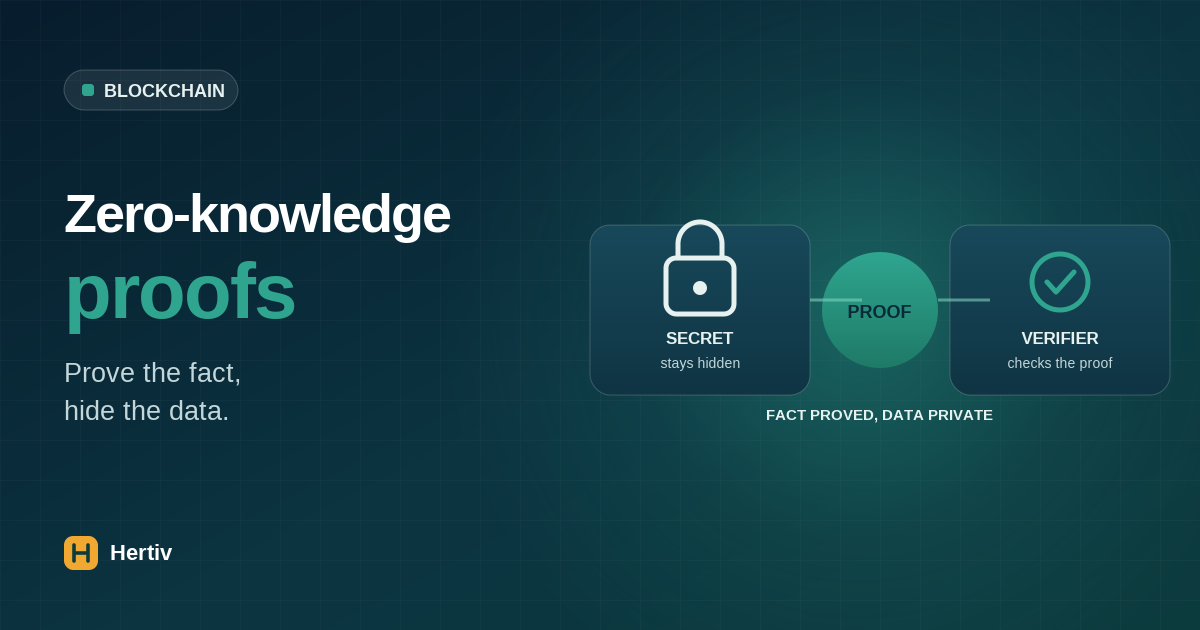
A zero-knowledge proof is a cryptographic method that lets one party prove a statement is true without revealing the information that makes it true. The prover shows the statement holds, and the verifier checks the proof, but the underlying facts stay private.
The name describes the deal: the verifier learns zero knowledge about the secret itself, only that the statement is true. A classic example is proving you are over 18 without showing your birth date, or proving a wallet holds enough funds without showing the balance.
On a blockchain, this matters because chains are public by default. A zero-knowledge proof lets a user act on chain while keeping the details off it. For the use cases, see zero-knowledge proof use cases.
How does a zero-knowledge proof work?
A zero-knowledge proof works by turning a statement into a mathematical check that only passes when the statement is true. The prover runs the check with their private data and hands the verifier a short proof, which the verifier can check quickly without seeing the data.
- State the claim. The prover states what must be true, such as 'my balance is at least 100 tokens'.
- Build the proof. The prover runs a program that takes the private data and produces a short proof that the claim holds.
- Send the proof. The prover gives the proof to the verifier, or posts it on chain for a smart contract to check.
- Check the proof. The verifier runs a fast check on the proof. If it passes, the claim is true; if it fails, it is not.
- Act on the result. The contract or the app proceeds on the strength of the proof, without ever seeing the private data.
The proof is short and fast to check, even when the computation behind it is large. That is why the method works on chain: the network checks a small proof instead of re-running the whole computation.
What can you prove without revealing?
A zero-knowledge proof can cover any statement that can be written as a computation. The table below shows the statements teams prove most often and what stays hidden in each case.
| Statement | What is proved | What stays hidden |
|---|---|---|
| Balance is enough | Wallet holds at least X tokens | The exact balance |
| Age is over a limit | Person is over 18 | Birth date |
| Identity is valid | Credential was issued to this person | Name and details |
| Computation is correct | Program ran as written | Inputs to the program |
| Membership is real | Person belongs to a group | Which member they are |
| Vote was counted | Vote was valid and counted once | Who voted for what |
The pattern is the same in each case: the verifier learns that a rule was followed, and nothing else. That is what makes the method useful for privacy, compliance and voting, where the fact matters and the details do not.
Where are zero-knowledge proofs used in blockchain?
Zero-knowledge proofs are used in blockchain wherever privacy and public verification meet. Rollups use them to prove that many transactions were processed correctly without posting every detail on chain. Identity systems use them to prove a credential without sharing personal data.
They also appear in private payments, where the sender proves they own the funds without showing the amount, and in voting, where a voter proves their vote was counted without showing how they voted. For the contract side, see zero-knowledge proof smart contracts.
The common thread is a public chain that must check something it cannot be allowed to see. If the data can be public, a plain signature is simpler and cheaper, so teams use zero-knowledge proofs only where privacy is a real requirement.
Example (hypothetical): a private payment on chain
Example (hypothetical): a wallet holds 250 tokens, and the owner wants to pay 100 tokens without showing the balance. The wallet builds a proof that the balance is at least 100, and posts the proof with the payment. The network checks the proof and accepts the payment.
After the payment, the wallet holds 250 - 100 = 150 tokens. Nobody watching the chain learns the starting balance of 250 or the remaining balance of 150; they learn only that the payment was covered. The same proof pattern works for any amount, as long as the balance covers it.
If the wallet held only 80 tokens, the proof could not be built, and the payment would fail before it reached the chain. That is the point: the check happens in the proof, so an invalid payment never gets posted.
What are the common mistakes?
The most common zero-knowledge proof mistakes are using them where a simpler method would do, hiding the wrong thing, and trusting a setup nobody checked.
- Using proofs for public data. If the data can be public, a signature is simpler, cheaper and easier to audit. Use a proof only when privacy is a real requirement.
- Proving the wrong statement. A proof that checks the wrong rule proves nothing useful. Write the statement in plain words first, then turn it into a circuit.
- Trusting an unchecked setup. Some proof systems need a trusted setup, and a bad setup can break the whole scheme. Use a setup ceremony with many participants, or a system that needs none.
- Ignoring the cost. Building a proof takes time and computing power, and on-chain checks cost gas. Measure both before promising users instant private payments.
- No fallback. If the prover fails, the user should still be able to act, for example by revealing the data or using a slower public path.
How should a team start using zero-knowledge proofs?
A team should start with one statement, one use case and a tested library, and only build custom circuits once the first proof works end to end.
- Pick the statement. Write it in one plain sentence, such as 'the balance covers the payment'.
- Choose a tested library. Use a well-known proving system and a standard circuit, not a custom build, for the first version.
- Build a small demo. Prove the statement off chain first, and check the proof verifies quickly.
- Put the check on chain. Move the verification into a smart contract, and measure the gas cost per proof.
- Test the failure paths. Try a false statement, a broken proof and a missing prover, and check each one fails safely.
For the building blocks, see smart contract development.
For scaling, see what a ZK rollup is.
Key takeaways
- A zero-knowledge proof proves a statement is true without revealing the facts behind it
- The verifier checks a short proof instead of the private data itself
- Use proofs where privacy is a real requirement, not where the data can be public
- Write the statement in one plain sentence before building the proof
- Start with a tested library and one use case, then move the check on chain
Frequently asked questions
Are zero-knowledge proofs the same as encryption?
No. Encryption hides data so nobody can read it, while a zero-knowledge proof shows that a statement about the data is true. The two are often used together: encryption keeps the data private, and the proof lets someone check a fact about it without seeing it.
Can a zero-knowledge proof be faked?
A correct proof cannot be faked without breaking the cryptography behind it, which is the whole point of the method. The risk is not a fake proof but a wrong statement: a proof that checks the wrong rule proves nothing useful. That is why the statement must be written in plain words first.
Why are zero-knowledge proofs used in rollups?
A rollup processes many transactions off chain and posts one proof on chain that they were all handled correctly. The main chain checks the short proof instead of re-running every transaction, which saves time and cost while keeping the results checkable by anyone.
Do zero-knowledge proofs hide everything?
No. They hide the private inputs, but the statement itself and the fact that a proof was posted are public. A private payment still shows that a payment happened; it hides the amount and the balance. Teams must decide what the proof reveals before they build it.
What is a trusted setup?
Some proof systems need a one-time setup that creates secret parameters, and the system is only safe if those secrets are destroyed. A setup ceremony with many independent participants makes it very unlikely that all of them kept the secret. Newer systems avoid the setup entirely.
Are zero-knowledge proofs slow?
Building a proof takes real computing power, often seconds for a simple statement, while checking one is fast. That trade-off fits most uses, because the prover runs once and many verifiers check the result. Measure both sides before promising users instant private transactions.


