Zero-Knowledge Proof Use Cases in Blockchain: 10 to Know
Zero-knowledge proofs let you prove something is true without revealing the details. Here are ten blockchain use cases, from private payments to voting.
On this page
Short answer
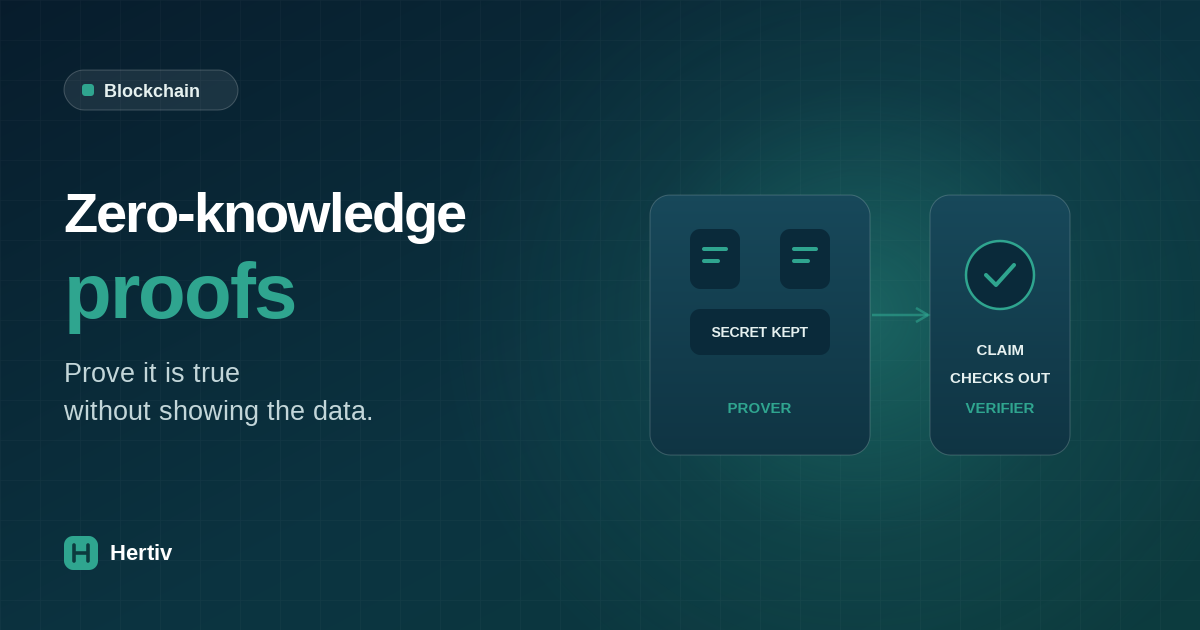
Zero-knowledge proofs let one party prove a statement is true without revealing the facts behind it. On blockchains, that trick powers private payments, identity checks, voting, compliance and scaling — ten use cases that show where the technology actually earns its keep.
What are zero-knowledge proofs used for on blockchains?
Zero-knowledge proofs let someone prove a claim — I am over 18, this payment is valid, I own this asset — without showing the evidence behind it. On a public blockchain, where every transaction is visible, that privacy is the point.
| Use case | What is proven | What stays hidden |
|---|---|---|
| Private payments | The payment is valid | Sender, receiver, amount |
| Identity checks | The person qualifies | Personal details |
| Private voting | The vote is valid | Who voted for what |
| Compliance checks | The user passed screening | Full identity documents |
| Private DeFi | The trade is solvent | Positions and balances |
| Supply chain | Goods are genuine | Supplier prices |
| Credentials | The holder is qualified | Grades and records |
| Gaming and NFTs | Ownership is real | Wallet history |
| Cross-chain bridges | The transfer is valid | Bridge internals |
| Health records | The record is genuine | Patient data |
Each use case below proves something different, but the pattern is the same: prove the claim, hide the data. For the scaling side of this technology, see our guide to what a ZK rollup is.
<h3>1. Private payments: best for hiding who paid whom</h3>
Private payments use zero-knowledge proofs to show a transaction follows the rules without revealing the sender, the receiver or the amount. The network can check the payment is valid and still learn nothing about the people behind it.
This matters for businesses that cannot put supplier payments on a public ledger, and for people who simply want financial privacy. The trade-off is complexity: private payments are harder to build and audit than plain transfers.
Pros
- Payment details stay private on a public chain
- The network still checks every payment is valid
Cons
- Harder to audit and to explain to regulators
- Heavier to compute than a plain transfer
2. Identity checks: best for proving you qualify
Identity checks let a person prove they meet a rule — over 18, a resident, a licensed professional — without handing over the document that proves it. The proof confirms the claim; the document stays with the owner.
This is the use case most people will meet first. A wallet can hold a proof of age or a proof of licence, and a service can check it without storing a copy of a passport or a licence.
Pros
- No personal documents stored by services
- One proof can be reused across services
Cons
- Someone must still issue the original credential
- Standards are still settling
<h3>3. Private voting: best for votes nobody can trace</h3>
Private voting uses zero-knowledge proofs to show each vote is valid and counted once, without linking any vote to a voter. The result is public and checkable; the individual choices are not.
Community treasuries and decentralised organisations use this for decisions where people should vote freely. The risk is the setup: if the voter list or the counting code is wrong, the proof cannot save the result.
Pros
- Results are checkable without revealing votes
- Voters cannot be pressured over their choice
Cons
- Setup and voter lists need care
- Complex to explain to non-technical voters
4. Compliance checks: best for screening without exposure
Compliance checks let a user prove they passed screening — sanctions lists, for example — without handing over full identity documents to every service they use. The screening result is proven; the documents stay private.
This is useful for exchanges and fintech apps that must screen users but do not want to hold copies of everyone's documents. It also gives users a reason to complete screening once and reuse the proof.
Pros
- Services screen users without holding documents
- Users complete screening once and reuse it
Cons
- Regulators still want to see the screening process
- Needs trusted issuers of screening results
<h3>5. Private DeFi: best for trades without showing your hand</h3>
Private DeFi uses zero-knowledge proofs to show a trade or a loan is properly funded without revealing positions and balances. Traders can act without front-runners watching their orders, and lenders can check solvency without seeing the whole book.
This is still early. Private DeFi is harder to build than open DeFi, and it is harder for users to check what a protocol is doing. But for large trades, the privacy is worth the complexity.
Pros
- Large trades do not leak strategy
- Solvency can be proven without full disclosure
Cons
- Early and complex to build
- Harder for users to audit
6. Supply chain: best for proving origin without sharing prices
Supply chain proofs let a company show goods are genuine and came from a certified source, without revealing what it paid or who else it buys from. Each step in the chain adds a proof instead of a public record.
This suits goods where provenance matters — food, medicine, luxury items — and where prices are commercially sensitive. The hard part is getting every supplier to record their step honestly.
Pros
- Provenance without exposing commercial terms
- Buyers can check goods before paying
Cons
- Only as honest as the data entered
- Needs suppliers to take part
<h3>7. Credentials: best for proving qualifications privately</h3>
Credential proofs let a person show they hold a degree, a licence or a certificate without sharing the full record. An employer can check the claim is genuine and issued by a real institution, and learn nothing else.
This cuts the document shuffle in hiring and licensing. The catch is adoption: a proof is only useful if employers and institutions accept it, and that takes time.
Pros
- Qualifications checked without sharing records
- Harder to fake than a paper certificate
Cons
- Needs issuers and employers to adopt it
- Revocation needs a clear process
8. Gaming and NFTs: best for ownership without wallet history
Gaming and NFT proofs let a player show they own an item or reached a level without revealing their whole wallet history. A game can check ownership and grant access; it does not need to see everything else the player owns.
This matters as wallets hold more of a person's digital life. A game that asks for full wallet access is asking too much, and proofs are the way to ask for less.
Pros
- Ownership proven without exposing the wallet
- Games can gate content on real achievements
Cons
- Games must build proof support in
- Players need wallets that can make proofs
<h3>9. Cross-chain bridges: best for safe transfers between chains</h3>
Cross-chain bridges use zero-knowledge proofs to show a transfer on one chain is valid before releasing funds on another. The proof replaces the committee or multisig that many bridges rely on today, which removes a common point of failure.
Bridges have been a frequent target for attacks, so a proof-based bridge is a real improvement when it is built well. The challenge is the cost and complexity of generating proofs for every transfer.
Pros
- No committee holding the bridge funds
- Transfers checked by maths, not trust
Cons
- Proof generation adds cost and delay
- Still a young technology
10. Health records: best for proving a record is genuine
Health record proofs let a patient or a provider show a record is genuine — a vaccination, a prescription, a test result — without sharing the full medical history behind it. The proof confirms the fact; the rest of the record stays private.
This is the most sensitive use case here, and the one with the highest bar for trust. Health data rules are strict, and a proof system must meet them before anyone will use it at scale.
Pros
- Medical facts proven without sharing history
- Patients keep control of their data
Cons
- Strict health data rules to meet
- Needs trusted issuers of records
How to choose a zero-knowledge use case
The right use case starts from the privacy problem, not the technology. If nothing needs to stay hidden, a plain blockchain record is simpler and cheaper. Zero-knowledge proofs earn their cost when revealing the data would cause real harm.
- Write down what must be proven and what must stay hidden.
- Check whether a simpler method — encryption, a private database, a permissioned chain — does the job.
- Pick the use case where the proof removes a real blocker, such as regulation or commercial secrecy.
- Prototype one proof end to end before committing to a full system.
- Plan for the trusted setup: who issues credentials and how proofs are checked.
Most teams should prototype first. A single working proof, checked by a real user, teaches more than a month of reading. For the contract side, see our guide to smart contract development.
What are the common mistakes?
The most common mistake is using zero-knowledge proofs where a simpler tool would do. If the data can stay in a private database, it should. Proofs are for cases where a public record and private data must coexist.
A second mistake is forgetting the trusted setup. Proofs are only as trustworthy as the issuer of the original credential. If anyone can issue a proof of age, the proof means nothing.
A third mistake is ignoring the cost. Generating proofs takes computing power, and on some chains that cost is real money. Budget for it before promising a feature, and measure it in the prototype.
Key takeaways
- Zero-knowledge proofs prove a claim without revealing the data behind it.
- Private payments, identity, voting and compliance are the most mature use cases.
- DeFi, supply chain, credentials, gaming, bridges and health records are growing fast.
- Use proofs where revealing the data would cause real harm — not everywhere.
- Prototype one proof end to end and budget for proof generation cost.
Frequently asked questions
What is a zero-knowledge proof in simple terms?
A zero-knowledge proof is a way to prove a statement is true without revealing why it is true. You can prove you are over 18 without showing your birth date, or prove a payment is valid without showing the amount.
Are zero-knowledge proofs the same as encryption?
No. Encryption hides data so nobody can read it. A zero-knowledge proof shows a claim is true while keeping the data hidden. Encryption protects stored data; proofs let you use data without revealing it.
Why do blockchains need zero-knowledge proofs?
Public blockchains show every transaction to everyone. That is good for checking, but bad for privacy. Zero-knowledge proofs let a chain check a transaction is valid without publishing the private details behind it.
What is the difference between ZK rollups and zero-knowledge proofs?
A ZK rollup is one application of zero-knowledge proofs: it bundles many transactions off-chain and proves them on-chain in one proof. Zero-knowledge proofs are the general technique; rollups use them to scale a chain.
Are zero-knowledge proofs expensive to use?
Generating a proof takes computing power, which costs time and money. Costs vary by use case and by chain, and they are falling as the tooling improves. Prototype first and measure the cost before committing.
Can zero-knowledge proofs be used without a blockchain?
Yes. They work anywhere a claim must be proven without revealing data, such as login systems and identity checks. Blockchains made them famous, but the technique stands on its own.


