What Is the TRON Ecosystem? A Plain Guide
The TRON ecosystem is the set of apps, tokens, wallets and services built on the TRON blockchain. Here is how its parts fit together and what you can do with them.
On this page
Short answer
The TRON ecosystem is everything built on the TRON blockchain: its TRX coin, TRC-20 tokens, wallets, decentralised apps, stablecoin transfers and staking. It runs on delegated proof of stake, which keeps fees low and blocks fast, so it is mainly used for payments, token transfers and consumer apps.
What is the TRON ecosystem?
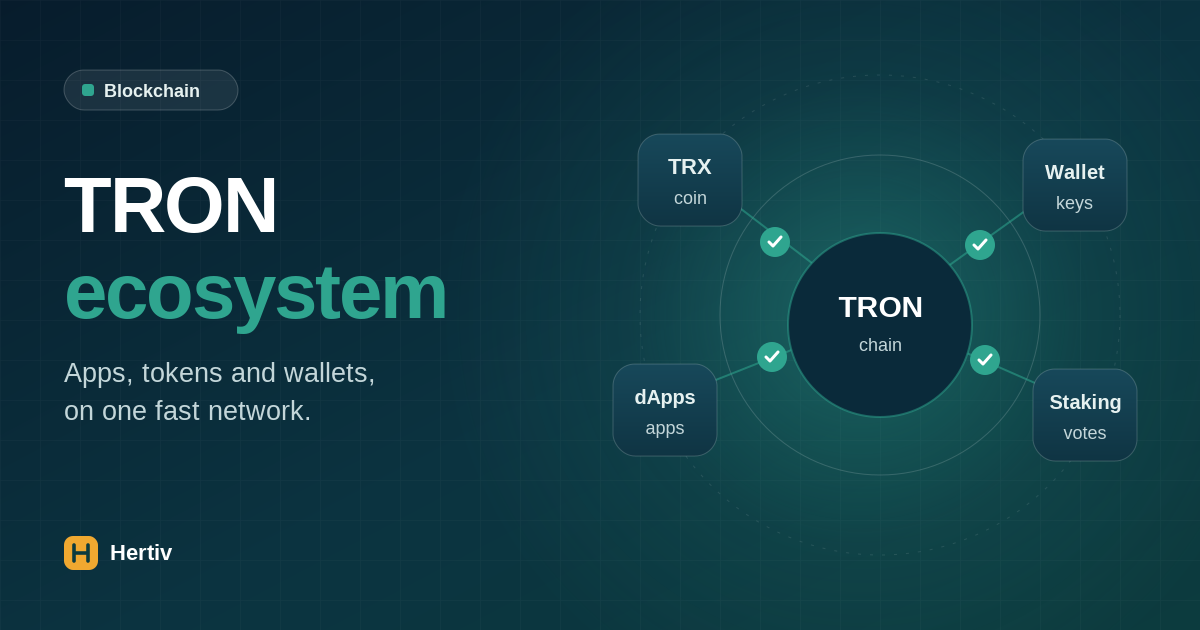
The TRON ecosystem is the collection of apps, tokens, wallets and services that run on the TRON blockchain. At its centre is TRX, the network's own coin, and around it sit token standards, wallets, exchanges, games and payment tools that all share the same chain.
Think of it as a city built on one road network. The chain is the road, TRX is the fuel that pays for travel, and each app is a building that uses the road to reach users. A wallet, a token and a game can all talk to each other because they follow the same rules.
| Part | What it does | Who uses it |
|---|---|---|
| TRX | The native coin; pays fees and powers staking | Everyone on the network |
| TRC-20 tokens | Tokens built on TRON, including stablecoins | Projects and payment apps |
| Wallets | Hold TRX and tokens, sign transactions | Users and teams |
| dApps | Apps that run on the chain | Developers and players |
| Staking and voting | Locks TRX to vote for block producers | TRX holders |
| Energy and bandwidth | Resources that pay for transactions | Anyone sending a transaction |
The parts work together. A user holds TRX in a wallet, uses it to pay a small fee, and opens a dApp that moves a TRC-20 token. None of the parts needs a bank or a central server to settle the transfer.
How does TRON work?
TRON runs on delegated proof of stake. TRX holders vote for 27 Super Representatives, and those representatives take turns producing blocks about every three seconds. Voters can change their votes, so a representative that performs badly can be replaced.
Transactions on TRON use two resources instead of only a fee. Bandwidth covers ordinary transfers, and energy covers smart contract calls. Users get a daily allowance of both, and they can freeze TRX to get more. Freezing means locking coins for a time, not spending them.
When the allowance runs out, the network burns a small amount of TRX as a fee. That keeps spam expensive while keeping normal use cheap. For a team, the practical result is that sending tokens and running simple contracts costs far less than on many older chains.
TRON also runs a virtual machine that is close to Ethereum's, so developers can move a contract written for Ethereum to TRON with modest changes. That is one reason many stablecoin and payment projects picked TRON as their home.
What can you build on TRON?
You can build wallets, payment apps, token projects, games and decentralised finance tools on TRON. The most active uses are stablecoin transfers, token sales and simple consumer apps, because the chain is fast and the fees are low.
Stablecoin transfers are the busiest use. A payment app can move a dollar-pegged token from one wallet to another in seconds, and the fee is a small fraction of the amount. That suits remittances, payroll for remote teams and settlement between businesses.
Games and content apps use TRON tokens for in-app items and rewards. A game can give players a token for an achievement, and the player can trade that token with others without asking the game studio for permission.
Developers can also launch their own TRC-20 token. The standard defines how the token moves, how balances are read and how approvals work, so wallets and exchanges can support a new token without custom code. TRON smart contract use cases show the same pattern across payments, gaming and token projects.
Wallets and accounts on TRON
A TRON wallet is an app or device that holds your private keys and signs transactions. The address is a string that starts with T, and anyone can send TRX or TRC-20 tokens to it. The wallet never holds the coins itself; the coins live on the chain, and the wallet only holds the keys.
Most teams start with a software wallet for daily use and a hardware wallet for larger sums. A software wallet is quick to open and easy to connect to a dApp, while a hardware wallet keeps keys off an internet-connected computer. Both use the same addresses and the same tokens.
Before a wallet can receive tokens, it must be activated with a small amount of TRX. After that, it can hold any TRC-20 token. If you send a token to an address that has never been activated, the transfer can fail, so check the address first with a small test amount. See how to build a TRON wallet for the build choices behind a wallet app.
Keep the recovery phrase on paper, in a safe place, and never type it into a website or share it in a message. Anyone with the phrase can move every coin in the wallet, and no support team can reverse that.
Staking, voting and rewards
Staking on TRON means freezing TRX to gain voting power and resources. Frozen TRX gives you energy and bandwidth, and it gives you votes that you cast for Super Representatives. You can unfreeze the coins later, after a short waiting period.
Voting matters because the representatives you vote for produce the blocks. A good representative runs reliable servers, publishes its work and shares part of its block rewards with voters. A poor one can miss blocks and earn less for everyone who voted for it.
Rewards come from block production, not from a fixed interest rate. The amount a voter receives depends on how many votes the representative gets in total and how much of its reward it shares. Treat any reward figure as a moving number, and check it on the network itself before you plan around it.
Staking is not risk-free. Frozen coins cannot be spent until they are unfrozen, and a representative you voted for can change its sharing policy. Freeze only coins you do not need for the next few weeks, and spread votes across more than one representative.
Example (hypothetical): a creator token launch
A small music collective wants to sell a fan token on TRON. It mints 1,000,000 tokens and offers 400,000 of them at $0.05 each. The sale brings in 400,000 x $0.05, which is $20,000, and the collective keeps the other 600,000 tokens for future rewards and the team.
The launch platform takes a 5% fee on the sale. Five percent of $20,000 is $1,000, so the collective keeps $19,000 after the fee. It sets aside $4,000 of that for the first year of wallet support and listing costs, leaving $15,000 for recording and marketing.
Each buyer needs a TRON wallet with a little TRX for fees. The collective tells buyers to keep about 10 TRX in the wallet for activation and transfers, and to test with one small transfer before sending the full amount. That test costs almost nothing and catches a wrong address before real money moves.
The numbers above are made up to show the arithmetic. A real launch would need a legal review, a clear token purpose and a plan for what holders actually get. A token with no use is a souvenir, and souvenirs do not hold value.
Common mistakes
The most common mistake is sending tokens to the wrong network. TRX and TRC-20 tokens live on TRON, and sending them to an Ethereum or exchange address that does not support TRON can lose them. Always check the network name before you confirm a transfer.
- Skipping the test transfer. Send a tiny amount first, confirm it arrives, then send the rest.
- Freezing all your TRX. Frozen coins cannot pay fees, so keep some TRX free for transfers.
- Sharing the recovery phrase. No real support team will ever ask for it.
- Trusting a token because it is cheap. A low price per token says nothing about the project behind it.
- Ignoring the energy cost. A contract call without frozen energy burns TRX, so check the cost before you run it.
Start small, learn the wallet and the resources, and only then move larger sums. TRON is forgiving on fees, but a lost key or a wrong address is still final. How tokenization works explains the token side of the same idea in more detail.
Key takeaways
- TRON is a blockchain plus the apps, tokens and wallets built on it.
- TRX pays fees, TRC-20 is the token standard, and wallets hold the keys.
- Delegated proof of stake uses 27 voted Super Representatives to make blocks.
- Energy and bandwidth pay for transactions; freezing TRX buys more of both.
- Stablecoin transfers, games and token projects are the busiest uses.
- Test with a small transfer and guard the recovery phrase.
Frequently asked questions
What is TRON?
TRON is a public blockchain built for fast, low-cost transfers and apps. Its native coin is TRX, and it supports tokens, smart contracts and decentralised apps. It is mainly used for payments, stablecoin transfers and consumer apps.
What is TRX used for?
TRX pays transaction fees, activates wallets and is frozen for staking and voting. Freezing TRX gives energy and bandwidth for transactions and votes for Super Representatives. It is also traded as a coin in its own right.
What is a TRC-20 token?
TRC-20 is the token standard on TRON. Tokens built to this standard move, display and trade the same way in wallets and exchanges, which is why most TRON tokens, including many stablecoins, use it.
How fast is TRON?
TRON produces a block about every three seconds, so a transfer usually confirms in seconds. The exact time depends on network load and on whether the wallet waits for extra confirmations.
Is TRON free to use?
No. Ordinary transfers use bandwidth and contract calls use energy, and both are limited. Users get a daily allowance and can freeze TRX for more, or pay a small TRX fee when the allowance runs out.
How do I start using TRON?
Install a TRON wallet, write down the recovery phrase, and add a small amount of TRX. Try one small transfer first, then explore tokens and apps once the wallet works as expected.


