TRON Smart Contracts: Real-World Use Cases That Work
TRON smart contracts run payments, lending, games and content rewards on a fast, low-fee network. Here are the use cases that work, and the limits.
On this page
Short answer
A TRON smart contract is a program that runs on the TRON blockchain and carries out agreed rules automatically, such as moving tokens when a payment arrives or paying a reward when a task is done. It works in the real world where a fast, low-fee transfer or an automatic payout matters more than a complex calculation.
What is a TRON smart contract?
A TRON smart contract is a program stored on the TRON blockchain that runs automatically when its conditions are met. It is written in Solidity, the same language used on Ethereum, and it runs on the TRON Virtual Machine, which executes the code on every node in the network.
Once deployed, the contract cannot be changed, so the rules it enforces are the same for everyone who uses it. It can hold tokens, send them to a wallet, record a vote, or issue a receipt, all without a middleman. The network charges for the work in energy and bandwidth, two resources that replace the gas model used elsewhere.
TRON is built for high throughput and low fees, which shapes what its contracts are good at. They suit simple, frequent actions such as payments and payouts, rather than heavy computation. For the basics of how such programs work, what smart contract development involves explains the general pattern.
How do TRON smart contracts work in practice?
TRON smart contracts work by taking an action when a transaction calls them, using the network's energy and bandwidth resources to pay for the work.
A user or an app sends a transaction to the contract's address. The network checks that the caller has enough energy and bandwidth, runs the code, and records the result on the chain. Energy is used for running the code, and bandwidth is used for the size of the transaction. Users can freeze TRX to gain both, which keeps the cost of frequent actions low.
The contract itself is a set of rules: who can call it, what it checks, and what it does with the tokens it holds. Common patterns include holding funds until a condition is met, splitting a payment between several wallets, and issuing a token when a user completes a task. The rules are public, so anyone can read them before using the contract.
What are the real-world use cases of TRON smart contracts?
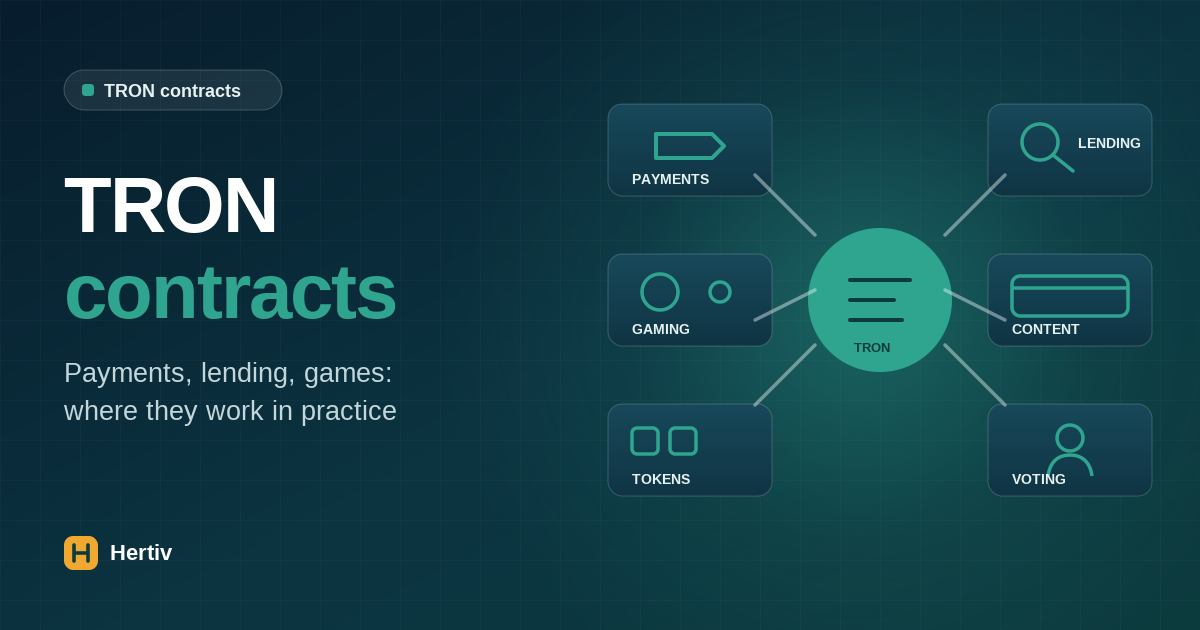
TRON smart contracts are used in the real world for payments, lending, gaming, content rewards and tokenised assets, wherever a fast transfer or an automatic payout matters.
| Use case | What the contract does | Why TRON fits |
|---|---|---|
| Stablecoin payments | Moves stablecoins between wallets on agreed terms | Low fees suit small, frequent payments |
| Lending and borrowing | Locks collateral and releases a loan automatically | Fast settlement keeps rates current |
| Gaming and NFTs | Issues items, runs draws and pays winners | Cheap transactions suit many small actions |
| Content rewards | Pays creators when content is viewed or tipped | Direct payouts without a middleman |
| Tokenised assets | Issues tokens that stand for a real asset | Simple issuance and transfer rules |
| DAOs and voting | Records votes and releases funds on a result | Transparent rules anyone can check |
The strongest use cases are the simplest ones. A payment contract that moves a stablecoin from a buyer to a seller needs few rules and runs often, which is exactly where TRON's low fees pay off. For the stablecoins themselves, what a stablecoin is explains how they hold their value.
How are TRON smart contracts used for payments?
TRON smart contracts are used for payments by moving stablecoins between wallets on agreed terms, with the contract acting as the escrow, the splitter or the payout rule.
A common pattern is escrow: a buyer sends a stablecoin to the contract, the seller delivers the service, and the contract releases the payment when the buyer confirms. Another is splitting: a single payment is divided between a seller, a marketplace and a referrer, all in one transaction, so nobody has to chase the others.
Merchants use these contracts because the transfer is fast and the fee is small, which matters for small payments that would be eaten by card fees. The contract also gives both sides a shared record of what was paid and when, which settles disputes without a third party. The limits are the same as for any payment contract: the stablecoin must hold its value, and the contract must be checked before it holds real money.
How are TRON smart contracts used in DeFi and gaming?
TRON smart contracts are used in DeFi to lock collateral and release loans automatically, and in gaming to issue items, run draws and pay winners without a central server.
In lending, a user locks tokens as collateral and the contract releases a loan in a stablecoin. If the collateral falls below an agreed level, the contract can sell part of it to protect the lender. The rules are public, so both sides know exactly when a loan is safe and when it is not.
In gaming, contracts issue in-game items as tokens, so a player owns the item and can trade it. They also run draws and pay winners automatically, which removes the need to trust the game operator. The same pattern works for content: a contract can pay a creator each time a video is viewed or a tip is sent, with the split written into the code.
Example (hypothetical): a marketplace pays creators automatically
Example (hypothetical): a small marketplace sells digital art and pays creators in a stablecoin on TRON. Each sale is 100 stablecoins, and the contract splits it three ways: 85 to the creator, 10 to the marketplace, and 5 to the artist who referred the buyer.
In one month the marketplace makes 200 sales. That is 20,000 stablecoins in total. The contract pays 17,000 to creators, 2,000 to the marketplace, and 1,000 to referrers. The split happens in the same transaction as each sale, so nobody waits for a monthly payout and nobody has to chase a missing payment.
The marketplace also holds a reserve of 1,000 stablecoins in the contract for refunds. If a buyer asks for a refund within 7 days, the contract returns 100 stablecoins from the reserve and the creator keeps nothing from that sale. The reserve is refilled from the next sales, so the contract never needs a human to move money.
What are the common mistakes?
The most common mistakes with TRON smart contracts are deploying without an audit, trusting a contract you have not read, and forgetting that the rules cannot be changed after deployment.
- Skipping the audit. A small bug in a contract that holds money can drain it. Get the code reviewed before it holds real value.
- Not reading the contract. The rules are public, so read them. A contract that gives one wallet the power to change the rules is not the same as a fixed contract.
- Forgetting the fees. Energy and bandwidth are cheap but not free. A contract that runs many times a day still needs a plan for who pays for the resources.
- Assuming the price is stable. A payment in a volatile token can change value between the sale and the payout. Use a stablecoin for payments that must hold their value.
- No pause or upgrade path. A contract with no way to stop it cannot be fixed if a bug is found. Decide the upgrade plan before deployment.
Teams building on TRON can start from how to create a cryptocurrency, which covers the token side of the same work.
Key takeaways
- A TRON smart contract is a program on the TRON blockchain that carries out agreed rules automatically
- Energy and bandwidth pay for the work, which keeps frequent, simple actions cheap
- The strongest use cases are payments, lending, gaming, content rewards and tokenised assets
- A contract cannot be changed after deployment, so audit it and read it before it holds real money
- Use a stablecoin for payments that must hold their value
Frequently asked questions
What language are TRON smart contracts written in?
They are written in Solidity, the same language used on Ethereum, and they run on the TRON Virtual Machine. A developer who knows Solidity can usually work on TRON without learning a new language.
What are energy and bandwidth on TRON?
Energy is the resource used to run smart contract code, and bandwidth is the resource used for the size of a transaction. Users can freeze TRX to gain both, which keeps the cost of frequent actions low.
Are TRON smart contracts the same as Ethereum contracts?
They are similar in language and structure, but they run on different networks with different fees and resources. A contract written for Ethereum often needs changes to work well on TRON.
Can TRON smart contracts hold real money?
Yes, they can hold tokens and stablecoins, and many payment and lending contracts do. That is why the code should be audited before it holds real value, and why the rules should be read first.
What happens if a TRON smart contract has a bug?
The contract keeps running with the bug unless it has a pause or upgrade path built in. This is why the audit and the upgrade plan matter before deployment, not after.
Do I need TRON to use a TRON smart contract?
You need a TRON wallet and enough resources to pay for the transaction. Most users interact with contracts through an app or a wallet, so they do not need to write any code themselves.


