What Is Proof of Stake, and How Does It Work?
Proof of stake lets a blockchain agree on transactions by asking validators to lock tokens as security. Here is how it works and how staking works.
On this page
Short answer
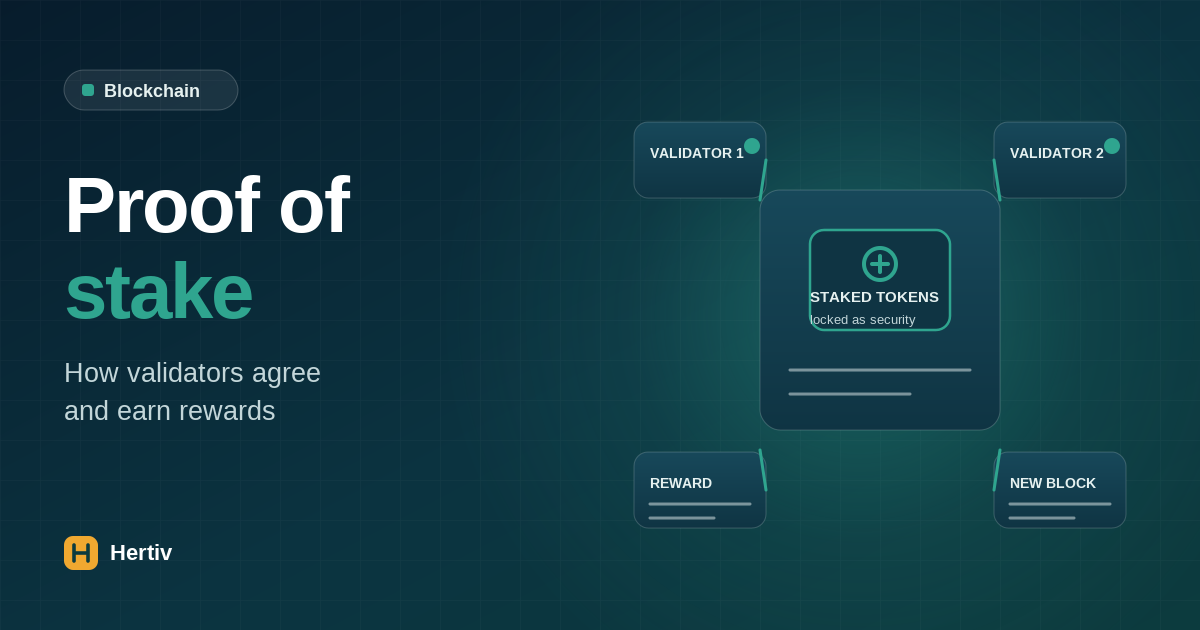
Proof of stake is a consensus design where participants lock up tokens as a stake, are chosen to propose and check new blocks, earn rewards for honest work, and lose part of their stake if they cheat.
What is proof of stake?
Proof of stake is a way for a blockchain to agree on which transactions are valid, by asking participants to lock up some of the chain's own tokens as a stake. Participants who lock tokens, called validators, are chosen to propose and check new blocks, and they earn a reward for doing the work honestly. If they cheat, part of their stake can be taken away.
The idea replaces the energy-heavy work of proof of work, where miners race to solve puzzles. In proof of stake, the security comes from money at risk, not from computing power. A validator who tries to approve a false transaction risks losing the tokens they locked, so honest behaviour pays and cheating costs.
Proof of stake is the consensus design behind several large chains, and it is the reason those chains use far less energy than proof-of-work networks. For a team building on chain, how Solana works is a useful comparison, because it uses a different consensus design for the same job.
How does proof of stake actually work?
Proof of stake works in a loop: lock tokens, get chosen, propose and check blocks, earn rewards, and lose stake for bad behaviour.
- Lock a stake. A validator deposits tokens into the chain's staking contract. The deposit is the security for their behaviour.
- Get chosen. The chain picks validators to propose the next block, usually at random, with larger stakes chosen more often.
- Propose and vote. The chosen validator proposes a block, and other validators vote on whether it is valid.
- Earn a reward. Validators who do the work correctly earn new tokens and a share of the transaction fees.
- Face a penalty. A validator who approves a false block, or who is offline too long, loses part of their stake. This penalty is called slashing.
People who do not want to run a validator can delegate their tokens to one instead. They share in the rewards and in the risk, which lets small holders take part without running a server. The chain's rules decide the minimum stake, the reward rate and the penalty, and those numbers vary from chain to chain.
Proof of stake versus proof of work
Proof of stake and proof of work solve the same problem, agreeing on the order of transactions, but they use different resources to do it. The table below shows the main differences.
| Point | Proof of stake | Proof of work |
|---|---|---|
| Security comes from | Tokens locked as a stake | Computing power spent on puzzles |
| Energy use | Low, servers only | High, mining hardware runs constantly |
| Who can take part | Anyone who holds and locks tokens | Anyone with mining hardware and cheap power |
| Penalty for cheating | Slashing: stake is taken away | Wasted work: the miner spent power for nothing |
| Finality speed | Usually minutes | Usually longer, with more confirmations |
Energy is the clearest difference. A proof-of-work chain needs miners to burn power continuously, while a proof-of-stake chain only needs validators to run ordinary servers. That is why the large chains that switched to proof of stake saw their energy use fall sharply. The trade-off is that stake concentrates where tokens concentrate, so the design has to watch who holds the most tokens.
How do you stake tokens?
You stake tokens by locking them in the chain's staking contract, either by running your own validator or by delegating to one that already exists.
Running a validator means setting up a server, keeping it online, and managing keys and updates. It earns the full reward, but it also carries the full risk of slashing and downtime. Delegating is simpler: you pick a validator, lock your tokens with them, and share the rewards, minus a small fee. You keep ownership of the tokens, but you cannot use them while they are locked.
Before staking, check three things: the minimum stake, the lock-up period, and the validator's record. Some chains lock tokens for days or weeks before you can withdraw them, so staked tokens are not ready cash.
A validator with a long record of uptime and no slashing events is a safer choice than a new one with a lower fee. The rules that govern staking in your market matter too, and the MiCA regulation is a good place to start for European teams.
Example (hypothetical): staking for a small holder
Example (hypothetical): a holder owns 1,000 tokens on a proof-of-stake chain and decides to delegate them to a validator. The validator charges a 5% fee on rewards, and the chain pays a reward rate of 5% a year on staked tokens.
The gross reward is 1,000 times 5%, which is 50 tokens a year. The validator takes 5% of that, which is 2.5 tokens, leaving the holder with 47.5 tokens a year. The holder's balance grows from 1,000 to 1,047.5 tokens in a year, if the reward rate and the token price both stay the same.
The holder also accepts two risks. First, the tokens are locked for 14 days, so they cannot sell quickly if the price falls. Second, if the validator is slashed for bad behaviour, the holder can lose a share of their stake. The arithmetic is simple, but the risks are real, and they are the reason the validator's record matters more than a small difference in fees.
What are the common mistakes?
The most common proof-of-stake mistakes are picking a validator on fee alone, ignoring the lock-up, and assuming staking is risk-free.
- Picking the cheapest validator. A validator with a low fee and a poor uptime record will earn less than a reliable one with a fair fee.
- Ignoring the lock-up period. Staked tokens cannot be sold quickly. Keep enough unstaked to cover what you might need.
- Thinking staking is free money. Rewards are paid in tokens, and if the token price falls, the reward can be worth less than the stake.
- Forgetting the tax position. Staking rewards are income in many markets. Check the rules before you stake a large amount.
- Leaving everything with one validator. Spreading a stake across two or three validators reduces the damage if one is slashed.
How should a team choose a proof-of-stake chain?
A team should choose a proof-of-stake chain by checking the validator set, the fee, the finality time and the tools, in that order.
- Count the validators. A chain with many independent validators is harder to control than one with a handful.
- Check the fee. A low fee is good, but a fee that is too low may mean the chain cannot pay validators fairly.
- Measure finality. Test how long a transaction takes to become final, not just how fast it is confirmed.
- Check the tooling. Wallets, explorers and libraries matter more than the consensus design once you start building.
- Read the staking rules. Minimum stake, lock-up and slashing rules shape what your users can do.
If your product needs to issue or move tokens, start with how to create a cryptocurrency, which covers the choices that sit on top of the consensus layer.
Key takeaways
- Proof of stake secures a chain with tokens at risk, not computing power
- Validators earn rewards for honest work and lose stake for cheating
- It uses far less energy than proof of work, with faster finality
- Delegating lets small holders stake without running a validator
- Check the validator's record, the lock-up and the slashing rules before staking
Frequently asked questions
What is staking in simple terms?
Staking means locking some of a chain's tokens in its staking contract to help secure the network. Validators who do the work honestly earn rewards, and those who cheat can lose part of their stake. People who do not run a validator can delegate their tokens to one and share the rewards.
Is proof of stake safe?
It is safe when the validator set is broad and the slashing rules work. A validator who approves a false block loses stake, which makes cheating costly. The main risks are concentration, where a few large holders control the chain, and bugs in the staking contract itself.
How much can you earn from staking?
Reward rates vary by chain and by how much is staked, so there is no fixed figure. A chain with a 5% reward rate pays about 5% of the staked amount in new tokens each year, minus the validator's fee. If the token price falls, the reward can be worth less than the stake.
Can you lose money by staking?
Yes. If your validator is slashed for bad behaviour, you can lose part of your stake. If the token price falls while your tokens are locked, you cannot sell quickly. Staking is not risk-free, and the reward is payment for taking that risk.
What is slashing?
Slashing is the penalty a proof-of-stake chain applies to a validator that breaks the rules, such as approving a false block or being offline too long. Part of the validator's stake, and part of the stake delegated to it, is taken away. It is what makes cheating costly.
Which chains use proof of stake?
Several large chains use proof of stake, including the largest smart contract platform, which switched from proof of work. Other chains use different designs, such as proof of history, so the choice depends on what the application needs: energy use, finality time and validator count all differ.


