What Is Solana, and How Does It Work?
Solana is a public blockchain built for fast, low-cost transactions. This guide explains proof of history, SOL, and what you can build on it.
On this page
Short answer
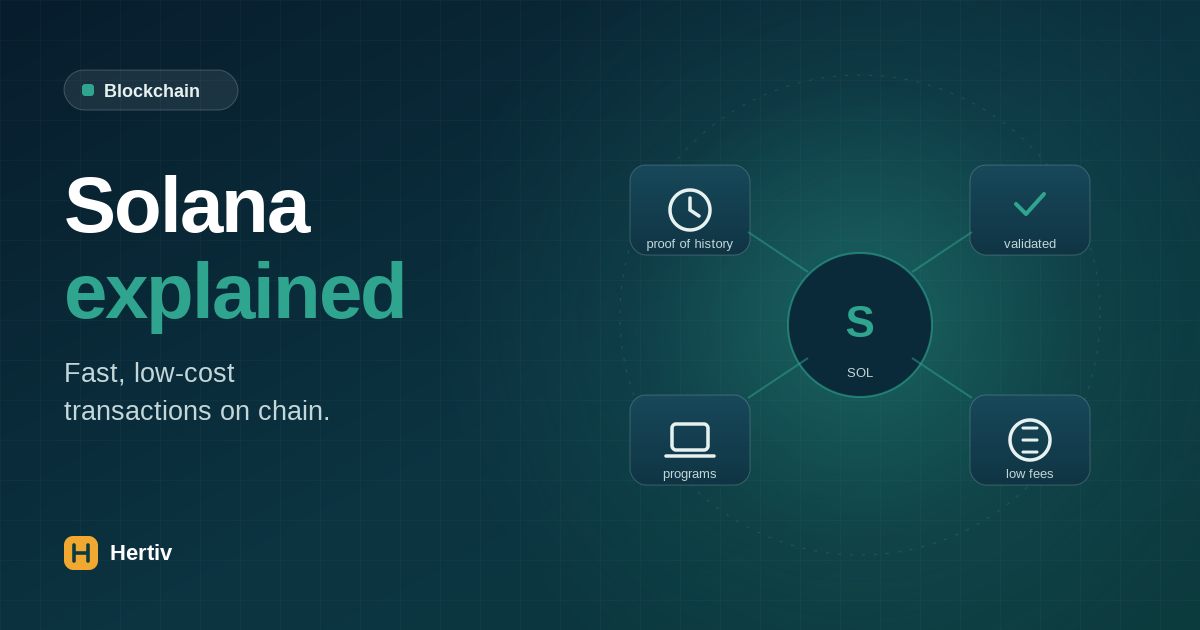
Solana is a public blockchain designed for fast transactions with very low fees. It combines proof of history, a built-in clock that orders transactions, with proof of stake, where validators secure the network. Developers use it for payments, trading apps, games and NFTs.
What is Solana?
Solana is a public blockchain that lets anyone send value and run programs without a central operator. It was designed to handle a large number of transactions quickly while keeping fees low enough for everyday use.
Like other public blockchains, Solana keeps a shared record of transactions that anyone can read and check. Validators around the world run the software, agree on the order of transactions, and add new blocks to the chain.
Solana is best known for two things: speed and cost. A payment or trade usually confirms in seconds, and the fee is typically a tiny fraction of the amount sent. That combination makes it a practical choice for apps where users transact often, such as payments, trading and games.
How does Solana reach agreement so fast?
Solana reaches agreement quickly because it uses proof of history, a method that stamps each transaction with a time, so validators spend less effort agreeing on the order of events.
Most blockchains ask validators to agree on both the order of transactions and their validity. Solana separates the two jobs. Proof of history creates a verifiable sequence of events, and proof of stake then lets validators vote on that sequence. Validators lock up SOL tokens as a stake, which gives them a reason to follow the rules.
The network also processes transactions in parallel when they do not touch the same accounts. A payment between two wallets and a trade on a decentralised exchange can be handled at the same time, which raises throughput without requiring bigger blocks alone.
This design has a trade-off. Running a validator needs capable hardware and a reliable connection, which raises the bar for participation compared with lighter chains. Teams choosing a chain should weigh speed against how easy it is for new validators to join.
What is proof of history?
Proof of history is a cryptographic clock built into Solana that records the passage of time between events, so validators can agree on the order of transactions without constant back-and-forth messages.
It works as a chain of hashes. Each step takes the previous output, combines it with new data, and produces the next output. Because the sequence can only be computed in order, anyone can verify that a given event happened after another one.
Think of it like a numbered ticket queue. If every transaction carries a verifiable number showing when it arrived, validators do not need to ask each other what happened first. They can check the numbers and move on to validating the transactions themselves.
Proof of history does not replace consensus. Validators still vote on blocks through proof of stake, and a block is only final once enough stake has voted for it. The clock simply removes one round of coordination from the process.
What can you build on Solana?
You can build payments, trading apps, NFT marketplaces, games and consumer apps on Solana, and most of them benefit from fast confirmation and low fees.
| Use case | Why Solana fits | What to watch |
|---|---|---|
| Payments | Fast settlement, tiny fees | Wallet support and off-ramps |
| Trading and DeFi | High throughput for order books | Price moves during congestion |
| NFTs and collectibles | Cheap minting and transfers | Marketplace liquidity varies |
| Games | Frequent small transactions | Onboarding non-crypto players |
| Consumer apps | Near-instant user actions | Key management for users |
Programs on Solana are written mainly in Rust, and the ecosystem has tools for wallets, token creation and indexing. If you are planning a product, Solana development covers the stack and the build process in more depth.
What is SOL used for?
SOL is Solana's native token. It pays transaction fees, secures the network through staking, and is the unit of account for most activity on the chain.
Every transaction on Solana pays a small fee in SOL. The fee is usually a fraction of a cent, which is why micropayments and frequent in-app actions are practical. Fees also discourage spam, since flooding the network costs the sender.
Staking is the second use. SOL holders can delegate tokens to a validator, which increases that validator's voting weight. In return, stakers earn a share of network rewards. Delegated tokens stay in the holder's wallet, and the holder can move them to another validator if performance drops.
SOL also prices most assets on the chain. NFT listings, trading pairs and lending markets usually quote in SOL, so teams building on Solana need to plan for its price moving against the currency their users think in.
Example (hypothetical): a small payments app on Solana
Example (hypothetical): a team builds a payments app for a market of 2,000 small sellers. Each seller receives about 50 payments a month, so the app processes 100,000 payments a month in total.
At a fee of half a cent per payment, the monthly fee bill is 100,000 times $0.005, which is $500. That is the whole network cost for the month, before the team's own servers and support costs.
Compare that with a card network charging 2.5% on an average $20 payment. That would be $0.50 per payment, or $50,000 a month on the same volume. The difference is why low-fee chains attract payment apps, even though the team still needs fiat on-ramps and customer support.
The team also budgets for edge cases: failed transactions during congestion, wallets that lose access, and sellers who want payouts in local currency. Those operational costs, not the chain fee, usually decide whether the product works.
What are the common mistakes?
The most common Solana mistakes are assuming fees stay near zero under load, ignoring wallet onboarding, and building as if the chain never goes down.
- Ignoring congestion. Fees and confirmation times can rise when the network is busy. Test under load and set user expectations.
- Skipping key management. If users lose their keys, they lose their funds. Plan recovery flows and clear warnings from day one.
- Treating SOL as stable. Fees are small, but SOL's price moves. Price your product in the currency your users understand.
- No fallback for outages. Solana has halted before. Decide what your app shows users when the chain is unavailable.
- Copying an Ethereum design. Solana programs work differently from Ethereum contracts. Budget time to learn the account model.
If you want a broader comparison before committing, blockchain development explains how teams pick between chains.
For a hands-on path, how to build on Solana walks through the first steps.
Key takeaways
- Solana is a public blockchain built for fast transactions with very low fees
- Proof of history orders transactions with a verifiable clock, so validators agree faster
- SOL pays fees, secures the network through staking, and prices most on-chain activity
- Payments, trading, NFTs and games fit best; wallet onboarding and key management still matter
- Plan for congestion, price moves and outages instead of assuming ideal conditions
Frequently asked questions
Is Solana a cryptocurrency or a blockchain?
Solana is a blockchain, and SOL is its native cryptocurrency. The blockchain is the network that records transactions and runs programs, while SOL is the token used to pay fees and stake. People often use the name for both, but the distinction matters when you plan a product.
How is Solana different from Ethereum?
The main differences are speed, fees and design. Solana aims for faster confirmation and lower fees using proof of history and parallel processing, while Ethereum is the older, larger ecosystem with more developers and tooling. The right choice depends on your users, not on which chain is more popular.
Do I need SOL to use apps on Solana?
Yes, usually a small amount. Transactions need SOL to pay fees, even when the app itself deals in another token. Wallets can hold SOL alongside other tokens, and many apps help new users buy a small amount when they first sign up.
Is Solana decentralised?
Solana is run by validators around the world, but running a validator needs capable hardware, which limits who can participate compared with lighter chains. Supporters point to the number of independent validators, while critics point to the hardware bar. Check current validator counts before deciding.
Can Solana handle real payment volumes?
It was designed for that use case, with fast confirmation and low fees. Payment apps still need fiat on-ramps, customer support and compliance, and they should test under load and plan for congestion. The chain fee is only one part of the total cost of a payments product.
What programming language is used on Solana?
Programs on Solana are usually written in Rust, with some teams using C or frameworks that compile to the same runtime. The ecosystem also has JavaScript and Python libraries for building the front end and for talking to the chain from a server.


