What Is Polygon 2.0, and How Does It Work?
Polygon 2.0 turns Polygon from a single chain into a network of ZK-powered chains sharing liquidity. Its POL token replaces MATIC, and AggLayer links the chains.
On this page
Short answer
Polygon 2.0 is an upgrade to the Polygon network that turns it from a single blockchain into a network of connected chains, all secured with zero-knowledge proofs and sharing liquidity. Its native token, POL, replaces the older MATIC token.
What is Polygon 2.0?
Polygon 2.0 is an upgrade to the Polygon network that turns it from a single blockchain into a network of connected chains, all secured with zero-knowledge proofs and sharing liquidity. Its native token, POL, replaces the older MATIC token.
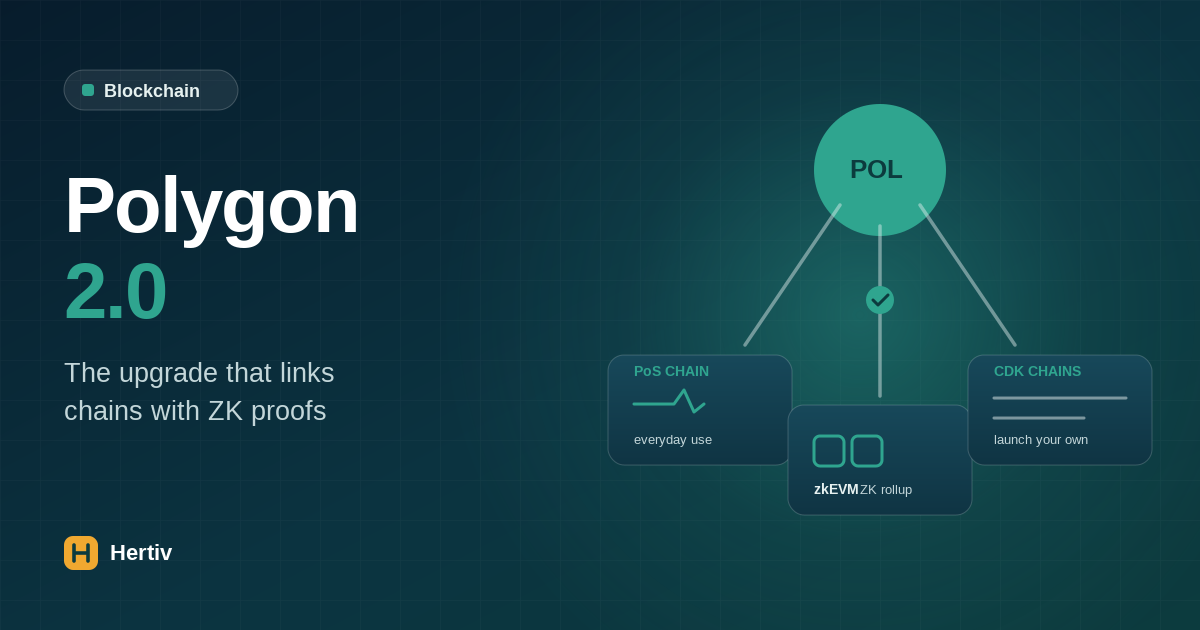
Before the upgrade, Polygon was best known for its proof-of-stake chain, a fast and cheap chain for apps and payments. Polygon 2.0 keeps that chain and adds more: a ZK rollup called Polygon zkEVM, a toolkit for launching new chains, and a shared layer that links them together.
The goal is simple to state and hard to build: many chains that feel like one. A user should be able to move value between chains without thinking about bridges, and a developer should be able to launch a chain without losing access to the wider network's liquidity.
| Piece | What it does | Polygon 2.0 change |
|---|---|---|
| Polygon PoS | Main chain for everyday use | Becomes one chain in a wider network |
| Polygon zkEVM | ZK rollup for cheaper transactions | Core part of the new design |
| POL token | Token for fees and staking | Replaces MATIC as the native token |
| Polygon CDK | Toolkit to launch new chains | Chains share liquidity through AggLayer |
| AggLayer | Links chains together | New layer for shared liquidity |
What changed from Polygon 1.0?
Polygon 1.0 was mainly one chain, Polygon PoS, plus a set of separate tools and chains that did not share much. Polygon 2.0 reorganises the network around zero-knowledge proofs, so that chains can prove their state to each other without trusting a central party.
The most visible change is the token. POL replaces MATIC as the native token for fees and staking across the network. Holders of MATIC were able to migrate to POL, and new staking and governance use POL.
The second change is the architecture. Instead of one chain doing everything, Polygon 2.0 has several kinds of chain: the PoS chain for everyday use, zkEVM as a ZK rollup, and new chains launched with the Polygon Chain Development Kit. A shared layer, AggLayer, connects them so value can move between chains more easily.
The third change is the focus on liquidity. In the old model, each chain had its own liquidity, which split users and funds across many places. AggLayer lets chains share liquidity, so a user on one chain can trade with a user on another without moving funds through a slow bridge.
How does Polygon 2.0 work?
Polygon 2.0 works by having each chain produce zero-knowledge proofs of its state, which are checked by the shared layers before value moves between chains. A proof shows that the chain's transactions are valid without revealing every detail.
The flow looks like this:
- A user acts on one chain. They send a payment, swap a token or use an app on a Polygon chain.
- The chain batches the work. Transactions are grouped and a zero-knowledge proof is produced for the batch.
- The proof is checked. The shared layer verifies the proof, so other chains can trust the result without re-running every transaction.
- Value moves across chains. Once the proof is accepted, funds can move to another chain in the network.
- Staking secures the network. POL holders stake their tokens to help secure the chains and earn rewards.
Zero-knowledge proofs are the key piece. They let chains prove they followed the rules without sharing all their data, which is what makes it possible for many chains to work together. For the basics of the technology, see what a ZK rollup is.
What can you build on Polygon 2.0?
You can build the same kinds of apps on Polygon 2.0 as on other chains: payments, tokenised assets, games, identity and DeFi. The difference is that you can choose the chain that fits your app, rather than fitting your app to one chain.
A payments app might use the PoS chain for speed and low fees. A game might launch its own chain with the CDK, so its players are not affected by other apps' traffic. A DeFi app might use zkEVM, where proofs give stronger security guarantees.
Developers can also launch a chain of their own. The CDK provides the code to start a chain, and AggLayer connects it to the rest of the network, so the new chain can access shared liquidity from the start. For a step-by-step guide to building on Polygon, see how to build on Polygon.
The trade-off is complexity. A network of chains is harder to understand than a single chain, and tooling is still catching up. Teams should start on one chain and only add more when they have a clear reason.
Example (hypothetical): a payments team chooses a Polygon chain
Example (hypothetical): a small team builds a payments app for freelancers in three countries. It needs low fees, fast settlement and a way to pay people in different currencies. It considers building on the Polygon PoS chain.
The team tests with 200 payments. On the PoS chain, each payment settles in seconds and the fee is a fraction of a cent, so 200 payments cost under a dollar in network fees. The team then checks the same flow on zkEVM and finds it works the same way, with proofs adding security for larger transfers.
The team decides to start on the PoS chain for everyday payments and keep zkEVM in mind for larger settlements. It does not launch its own chain, because its volume does not yet justify the extra work. The decision is written down with the numbers, so it can be revisited when volume grows.
Later, when the team adds a second currency, it uses AggLayer to move value between chains without building its own bridge. The shared liquidity means its users can trade without the team holding large reserves on each chain.
What are the common mistakes?
The most common Polygon 2.0 mistakes are treating it as one chain, ignoring the token migration, and launching a new chain before the app needs one.
- Treating it as a single chain. Polygon 2.0 is a network. Pick the chain that fits your app, not the one you heard of first.
- Ignoring the POL migration. Old guides and tools may still mention MATIC. Check that what you read applies to POL.
- Launching a chain too early. A dedicated chain adds work. Start on a shared chain and move only when volume or control demands it.
- Assuming bridges are gone. Cross-chain movement is easier, but it still has risks. Test with small amounts first.
- Skipping the proof model. If you rely on ZK proofs, understand what they prove and what they do not.
How to start with Polygon 2.0
You start with Polygon 2.0 by picking one chain, building a small app on it, and learning how the pieces fit before you commit to a larger design.
- Pick a chain. Use the PoS chain for everyday apps and zkEVM when you need stronger proof guarantees.
- Get POL for fees. You need a small amount of POL to pay for transactions while you test.
- Build a small app. A simple payment or token transfer is enough to learn the flow end to end.
- Test cross-chain movement. Try moving a small amount between chains to see how AggLayer works in practice.
- Read the current docs. Check the Polygon docs for the latest tooling, because the network is still changing. For the rollup projects built on this model, see ZK rollup projects worth knowing.
If you are choosing between chains for a new product, compare Polygon 2.0 with the alternatives on fees, speed, tooling and the apps already running there. The right chain is the one where your users and your team can work most easily.
Key takeaways
- Polygon 2.0 turns one chain into a network of ZK-powered chains
- POL replaces MATIC as the native token for fees and staking
- AggLayer lets chains share liquidity instead of splitting it
- Pick the chain that fits your app; do not launch your own too early
- Test cross-chain moves with small amounts before you rely on them
Frequently asked questions
What is the difference between Polygon and Polygon 2.0?
Polygon was mainly one chain, Polygon PoS. Polygon 2.0 is an upgrade that turns it into a network of connected chains secured with zero-knowledge proofs, with a new token, POL, and a shared layer for liquidity.
Is MATIC still used in Polygon 2.0?
No. POL replaces MATIC as the native token for fees and staking across the network. Holders of MATIC were able to migrate to POL, and all new activity on the network uses POL.
What is Polygon zkEVM?
Polygon zkEVM is a ZK rollup in the Polygon 2.0 network. It batches transactions, produces a zero-knowledge proof that they are valid, and settles that proof so other chains can trust the result.
What is AggLayer?
AggLayer is the shared layer in Polygon 2.0 that links chains together so they can share liquidity. It lets value move between chains more easily than through separate bridges, with proofs checked along the way.
Do I need my own chain on Polygon 2.0?
Usually not. Most apps should start on an existing chain such as Polygon PoS or zkEVM. Launching your own chain with the CDK makes sense only when you need control over fees, throughput or rules.
Is Polygon 2.0 finished?
No. It is a staged upgrade, and parts of it are still being built. Check the current Polygon documentation before you make technical decisions, because names and tooling can change.


