What Is Polygon, and How Does It Work?
Polygon is a set of scaling tools for Ethereum, led by the Polygon PoS chain, that lets apps run with lower fees and faster confirmations than the main chain.
On this page
Short answer
Polygon is a scaling ecosystem for Ethereum, built around the Polygon PoS sidechain and the newer Polygon zkEVM, that lets applications run transactions with lower fees and faster confirmations than Ethereum itself while still settling value on Ethereum.
What is Polygon?
Polygon is a set of scaling tools for Ethereum, led by the Polygon PoS chain, that lets applications run transactions with lower fees and faster confirmations than the Ethereum main chain.
Ethereum is secure but expensive and slow when many people use it at once. Polygon chains run beside it, process transactions on their own, and periodically record their state on Ethereum. Users get cheaper, faster transactions, and developers get a network that works with the same tools and the same token standards as Ethereum.
Polygon started as the Matic Network and rebranded in 2021. Today the name covers several chains and tools, but most people mean the Polygon PoS chain when they say Polygon, and that is the chain most apps use.
How does Polygon work?
Polygon works by running its own chain with its own validators, processing transactions quickly, and then posting checkpoints of its state to Ethereum so the record is anchored to the main chain.
On the Polygon PoS chain, validators stake MATIC, the network token, and take turns producing blocks and voting on them. A block is produced roughly every two seconds, and a transaction is confirmed in a few seconds rather than the minutes a busy Ethereum can take.
Fees are paid in MATIC and are usually a small fraction of an Ethereum fee, because the chain has more capacity and lower demand per block. That makes Polygon practical for apps where users transact often, such as games, loyalty programmes and small payments, where a main-chain fee would cost more than the action itself.
Polygon PoS vs Polygon zkEVM: what is the difference?
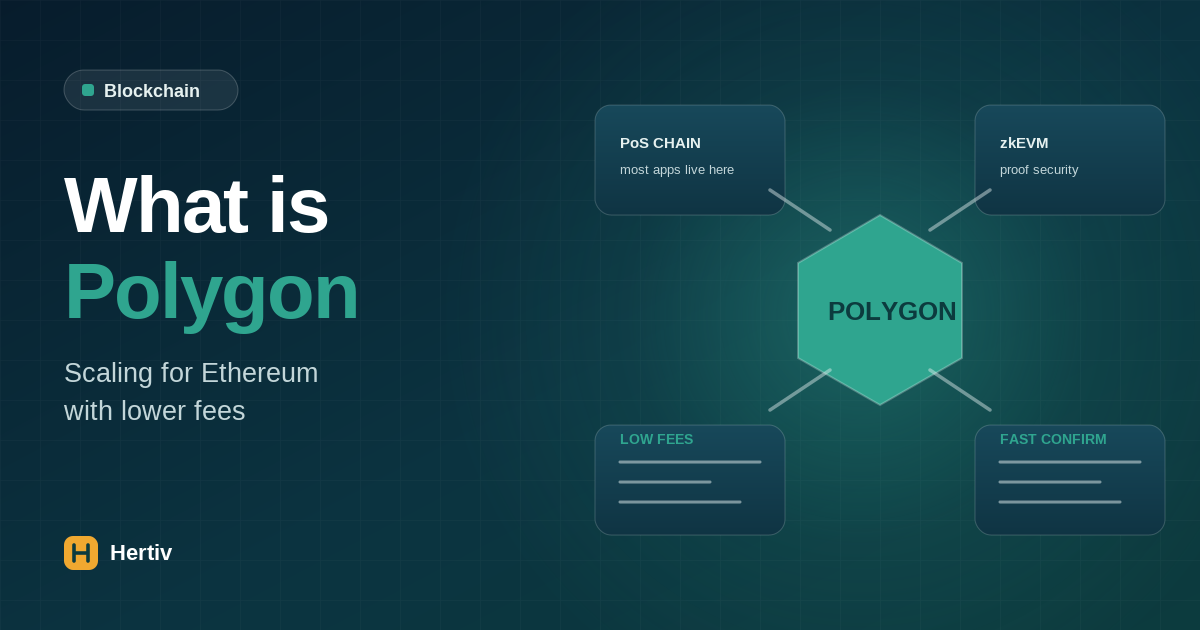
Polygon PoS and Polygon zkEVM are two chains in the same ecosystem with different trade-offs: PoS is the established chain with the most apps, while zkEVM uses zero-knowledge proofs to inherit more of Ethereum's security.
| Feature | Polygon PoS | Polygon zkEVM |
|---|---|---|
| How it works | Validators stake MATIC | Zero-knowledge proofs |
| Security basis | Its own validator set | Ethereum proofs |
| App support | Largest, most apps | Growing, EVM compatible |
| Best for | Games, loyalty, payments | Apps needing proof security |
Most teams start on Polygon PoS because the tooling, wallets and exchanges are already there. zkEVM fits teams that want proof-based security and are happy with a smaller app ecosystem. For the proof technology itself, what is a zk rollup explains how the proofs work.
What can you build on Polygon?
You can build on Polygon almost anything that works on Ethereum, from payments and tokenised assets to games and loyalty programmes, with the same smart contract language and the same wallet standards.
Common uses include stablecoin payments for small amounts, NFT collections and game items, tokenised loyalty points, and DeFi apps that need frequent transactions. Because fees are low, these apps can afford to record more on-chain, such as each game action or each loyalty earn, instead of batching everything off-chain.
Polygon also fits enterprise pilots, such as supply-chain records and shared registries, where a public chain is acceptable and the cost of main-chain transactions would rule the idea out. The trade-off is that the PoS chain relies on its own validators rather than Ethereum's full security, so teams weigh that against the cost saving for each use case.
How to start building on Polygon
You start building on Polygon by setting up the same Ethereum tooling you already use, pointing it at the Polygon network, and deploying a small contract to the test network first.
- Use your Ethereum tools. Solidity, Hardhat or Foundry and MetaMask all work with Polygon, so there is no new language to learn.
- Get test MATIC. Use the Polygon test network faucet to fund a test wallet and deploy without spending real money.
- Deploy a small contract. Start with one contract, such as a token or a simple registry, and test every function before adding more.
- Test the user flow. Walk through the wallet connection, the transaction and the confirmation as a user would, and check the fees at each step.
- Bridge carefully. Moving assets between Ethereum and Polygon uses a bridge, so test the bridge flow and the waiting times before launch.
- Audit before mainnet. Get an independent review of the contracts and the bridge setup before real funds are involved.
The build itself is covered in how to build on Polygon.
The token economics in what is Solana are a useful contrast, since Solana takes a different scaling path.
Example (hypothetical): a game studio moving items to Polygon
Example (hypothetical): a game studio with 20,000 players wants each in-game item to be a token players can trade, but main-chain fees would cost more than most items are worth.
The studio deploys its item contract on Polygon PoS. Minting an item costs a fraction of a cent in fees, so the studio can mint items as players earn them instead of batching them weekly. Trading happens on a Polygon marketplace, and players keep the same wallets they already use.
The arithmetic is simple: if each player mints 10 items a month, that is 200,000 mints. At a hypothetical fee of $0.01 per mint, the monthly cost is $2,000, against $200,000 at a hypothetical $1 fee on the main chain. The studio checks the real fees on the network before committing, and keeps the game logic off-chain so only ownership moves on-chain.
What are the common mistakes?
The most common mistakes are treating Polygon as Ethereum, ignoring the bridge, and building on-chain features that should stay off-chain.
- Assuming Ethereum security. Polygon PoS relies on its own validators, so it is not the same security model as Ethereum. Read the trade-off before holding large value there.
- Skipping bridge testing. Moving assets between chains takes time and has its own risks. Test the bridge flow with small amounts first.
- Putting everything on-chain. Game logic, images and private data belong off-chain. Only ownership, payments and proofs need the ledger.
- Ignoring wallet support. Check that the wallets your users already have support the Polygon network before launch.
- Launching without an audit. A contract bug on a live chain cannot be undone by a support ticket. Audit first, even for a small contract.
If you are planning a Polygon build and want the contracts and the bridge reviewed, Polygon development is the place to start.
Key takeaways
- Polygon is a scaling ecosystem for Ethereum, led by the PoS chain
- Fees are low and confirmations fast, which suits frequent small transactions
- zkEVM adds proof-based security for teams that need it
- The same Ethereum tools and wallets work on Polygon
- Test the bridge and audit the contracts before real funds move
Frequently asked questions
Is Polygon the same as Ethereum?
No. Polygon is a separate chain that works with Ethereum and records checkpoints on it. It uses the same smart contract language and wallet standards, so Ethereum developers can build on it without learning a new stack.
What is MATIC used for?
MATIC is the token used to pay transaction fees on the Polygon PoS chain, and validators stake it to secure the network. Users need a small amount in their wallet to send transactions, just as Ethereum users need ETH for fees.
Is Polygon safe to use?
Polygon PoS is widely used and has run for years, but its security model differs from Ethereum because it relies on its own validator set. Teams should understand that trade-off, audit their contracts and avoid holding more value on the chain than the use case needs.
How do I move assets to Polygon?
Assets move through a bridge that locks the token on Ethereum and releases a matching token on Polygon. The transfer takes time and has its own risks, so test it with small amounts first and check the bridge you use is the official one.
Can I build an NFT collection on Polygon?
Yes. Polygon is a common choice for NFT collections and game items because minting and trading cost far less than on the main chain. The same token standards apply, so marketplaces and wallets that support Ethereum usually support Polygon too.
What is Polygon zkEVM?
Polygon zkEVM is a second chain in the ecosystem that uses zero-knowledge proofs to verify transactions on Ethereum. It offers stronger security guarantees than the PoS chain, with a smaller app ecosystem, and suits teams that prioritise proof-based security.


