What Is Polkadot, and How Does It Work?
Polkadot is a blockchain network that connects specialised chains called parachains to one relay chain, so they share security. DOT is the token that pays for it.
On this page
Short answer
Polkadot is a blockchain network that connects specialised blockchains, called parachains, to a central relay chain so they share security and communicate with each other. The relay chain validates parachain blocks, DOT is the native token used for staking, governance and buying blockspace, and cross-chain messages travel through XCM.
What is Polkadot?
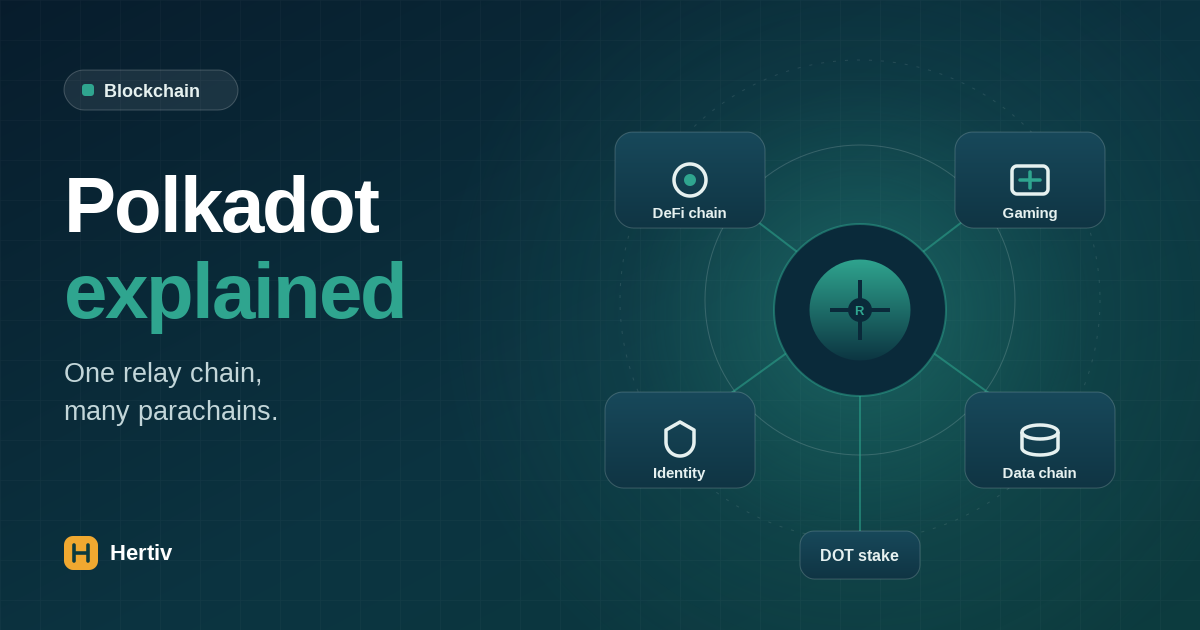
Polkadot is a blockchain network that connects multiple specialised chains, called parachains, to a central relay chain, so each chain can focus on one job while sharing the security of the whole network.
Most blockchains are single chains that do everything themselves: consensus, execution and data. Polkadot splits the work. The relay chain provides security and coordination, and the parachains run the applications, each with its own rules, token model and fee structure. A parachain can be built for finance, gaming, identity or supply chain tracking without recruiting its own validators.
Polkadot launched in May 2020. It is a proof-of-stake network, and its ongoing development and governance are managed on-chain by DOT holders, with no central company deciding upgrades. For the comparison that most readers want first, see Cosmos versus Polkadot.
How does Polkadot work?
Polkadot works by letting parachains process their own transactions, then having relay chain validators check the results and finalise them, so security is shared across every connected chain.
Follow a transaction from start to finish:
- A user submits a transaction on a parachain. The parachain processes it with its own rules. A chain built for EVM contracts runs them; a chain built for DeFi runs swaps.
- The parachain packages its block into a proof of validity. This proof confirms the block was processed correctly, so the relay chain can trust the outcome without re-running every transaction.
- A random subset of relay chain validators checks the proof. Validator assignments rotate, which makes collusion expensive, and checks run in parallel across the validator set.
- The relay chain finalises the block. Polkadot uses GRANDPA, a finality mechanism that confirms blocks once enough validators agree, so finalised blocks cannot be reversed.
- Cross-chain messages travel through XCM. Sending tokens or triggering logic on another chain goes through Cross-Consensus Messaging, built into the protocol.
The relay chain itself does not run general applications by design. Application logic lives on the parachains, which is why Polkadot is sometimes called a layer-0 network: it is a foundation that other chains build on.
What are parachains and coretime?
Parachains are application-specific chains that borrow the relay chain's security, and coretime is the way they pay for it: a slice of validator computation rented for a fixed period, replacing the old slot auctions.
Under the original model, a project won a parachain slot for up to two years in a candle auction by locking DOT, and supporters pooled DOT through crowdloans. That model ended on 19 September 2024, when Agile Coretime went live and every existing lease converted to a 28-day bulk coretime core.
| Model | How a chain gets blockspace | Commitment |
|---|---|---|
| Slot auctions (to 2024) | Win a lease by locking DOT | Up to two years, large lock-up |
| Bulk coretime | Buy a core for 28 days | Renewable monthly, smaller outlay |
| On-demand coretime | Buy blockspace for one block | Pay only when used |
| Elastic scaling | Use several cores at once | For high-traffic chains |
Elastic scaling, which lets a chain use several cores in parallel, went live in September 2025. Smart contracts reached Polkadot Hub on 27 January 2026, so developers can now deploy contracts on the hub chain itself. See Polkadot smart contract development for how that works in practice.
What is DOT used for?
DOT is Polkadot's native token, and it has three jobs: staking to secure the network, voting on governance, and buying coretime to run a parachain.
Staking is how the network is secured. DOT holders bond tokens to back validators, and validators that behave correctly earn rewards while misbehaving validators can lose bonded tokens. Nominated proof of stake lets holders nominate validators rather than running one themselves.
Governance runs through OpenGov, which went live in 2023 and replaced the earlier council model. Any DOT holder can submit a proposal, and any holder can vote on protocol upgrades, fee parameters and treasury spending. In March 2026, governance voted to cap DOT supply at 2.1 billion tokens, ending years of open-ended issuance.
The third job is buying blockspace. A project that wants to run a parachain pays DOT for coretime, so demand for blockspace is demand for the token. That links the token's use to the network's actual workload rather than to speculation alone.
How does Polkadot compare with Ethereum and Cosmos?
Polkadot, Ethereum and Cosmos all support many applications, but they differ in where security comes from and how chains talk to each other, which decides what each one is good at.
| Feature | Polkadot | Ethereum | Cosmos |
|---|---|---|---|
| Security model | Shared across all parachains | Shared across rollups | Each chain secures itself |
| Chain model | Parachains on a relay chain | Rollups on a base layer | Independent zones with IBC |
| Cross-chain messaging | XCM, built in | Bridges and rollup links | IBC, built in |
| Governance | On-chain, OpenGov | Off-chain, core developers | Per-chain, on-chain |
| Smart contracts | On parachains and Polkadot Hub | Native to the base layer | Per chain, usually CosmWasm |
The practical difference is the trade-off. Polkadot gives a new chain shared security from day one, at the cost of renting coretime and fitting the relay chain's model. Cosmos gives a chain full independence, at the cost of finding its own validators.
Ethereum gives a chain the largest developer ecosystem, at the cost of competing for base-layer blockspace. See the evolution of Ethereum for how its model changed.
For a contrasting single-chain design, see what Solana is.
Example: a DeFi chain renting coretime on Polkadot
Example (hypothetical): a team wants to launch a DeFi chain on Polkadot. Instead of recruiting validators, it buys one bulk coretime core for six 28-day periods, at a planned price of 10 DOT per period, so blockspace costs 6 x 10 = 60 DOT for the half-year.
The team also stakes 5,000 DOT to nominate validators and take part in governance. Its chain processes swaps locally, packages each block into a proof of validity, and the relay chain validators check and finalise it. When a user on its chain wants to send a token to a lending chain, the transfer goes through XCM with no external bridge.
Compare that with launching a standalone chain: the team would need to recruit validators, pay them from inflation or fees, and build a bridge for every chain it wanted to connect to. The coretime model trades a recurring DOT cost for shared security and built-in messaging.
The numbers are illustrative and the coretime price is a planning figure, not a market quote. The point is the shape of the costs: a small, recurring payment for security and messaging, rather than a large upfront lock-up.
What are the common mistakes?
The most common mistakes with Polkadot are treating a parachain as a cheaper Ethereum, ignoring the coretime cost in the budget, and assuming cross-chain messaging removes all trust assumptions.
- Treating it as Ethereum with different branding. Parachains are separate chains with their own runtimes, not smart contracts on a shared chain. The design and tooling differ.
- Forgetting coretime in the budget. Blockspace is a recurring cost. A chain that cannot pay for its core stops producing blocks.
- Assuming XCM means trustless everything. XCM moves messages between chains that share Polkadot's security. Messages to chains outside Polkadot still need bridges.
- Ignoring governance. DOT holders vote on upgrades and treasury spending, so protocol changes can arrive faster than on chains with off-chain governance.
- Betting on JAM too early. JAM, the proposed successor design, has no mainnet date as of late 2026. Build on what is live, not on the roadmap.
Key takeaways
- Polkadot connects parachains to one relay chain that provides shared security
- Parachains rent coretime in 28-day blocks instead of winning two-year auctions
- DOT is used for staking, OpenGov voting and buying blockspace
- XCM moves tokens and data between parachains without an external bridge
- DOT supply is capped at 2.1 billion tokens since March 2026
Frequently asked questions
Is Polkadot a blockchain or a network of blockchains?
It is a network of blockchains. The relay chain provides security and coordination, and the parachains are the individual blockchains that run applications. The whole system is often called a layer-0 network because it is a foundation other chains build on.
What is the difference between a parachain and a sidechain?
A parachain shares the relay chain's security and validators, so it does not need to recruit its own. A sidechain runs its own consensus and validators, and only connects to another chain through a bridge. The security difference is the point.
Do I need DOT to use an app on Polkadot?
Usually not directly. You pay fees in the parachain's own token or in the token its app accepts. DOT is needed for staking, governance voting and buying coretime, which are network-level activities rather than everyday app use.
What happened to parachain auctions?
They ended on 19 September 2024, when Agile Coretime went live. Slot auctions and crowdloans were replaced by renting coretime, either in 28-day bulk cores or on demand for single blocks. Existing leases were converted to bulk coretime cores.
What is JAM?
JAM, the Join-Accumulate Machine, is a proposed successor design for Polkadot that would replace the relay chain with a more general computation layer. As of late 2026 it has no mainnet date, so it is a roadmap item rather than something to build on today.
Is Polkadot decentralised?
Governance is on-chain through OpenGov, where any DOT holder can propose and vote, and validation is done by a rotating set of validators under nominated proof of stake. Like every network, it has concentrations of stake and influence, but there is no central company that decides upgrades.


