The Evolution of Ethereum: From Launch to Today
Ethereum began in 2015 as a programmable blockchain and has changed its consensus and scaling plan several times. Its history explains how the network works today.
On this page
Short answer
Ethereum launched in July 2015 as a public blockchain that runs smart contracts, and it has changed in clear stages since: a split after the DAO hack in 2016, a long move to proof of stake that ended with the Merge in 2022, and upgrades in 2023 and 2024 that cut the cost of using layer 2 networks. Each stage solved a problem the last one had created.
What is the evolution of Ethereum?
The evolution of Ethereum is the story of how a network that launched in 2015 as a simple programmable blockchain grew into a system with proof-of-stake consensus, layer 2 networks and a steady upgrade plan. It changed in stages, and each stage was a response to a limit the network had hit.
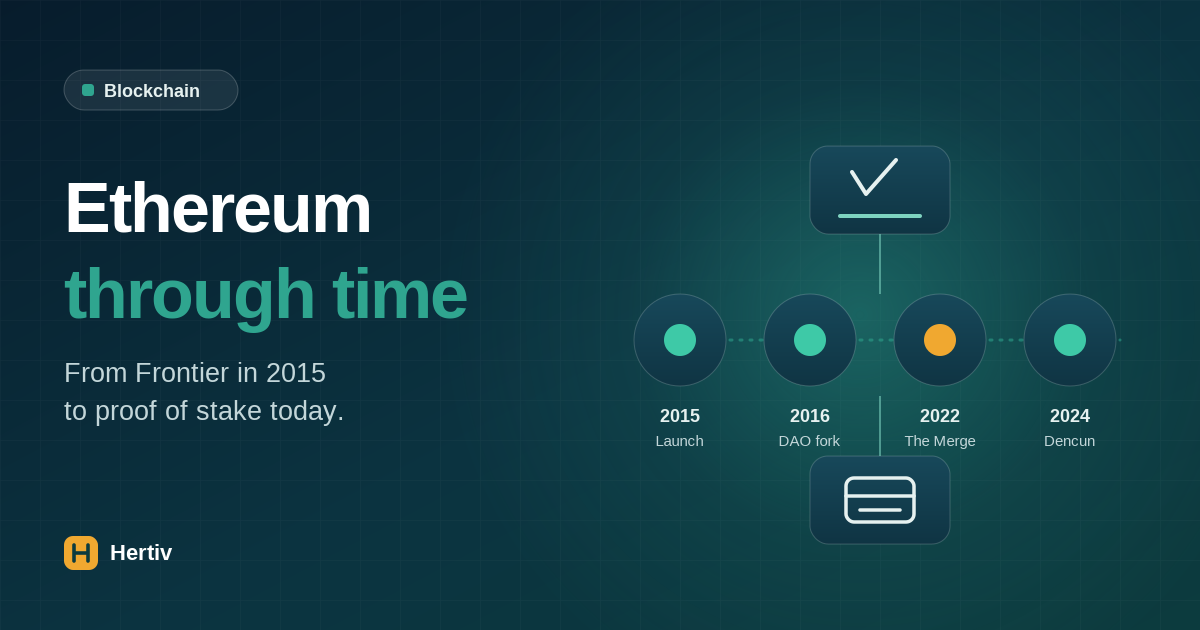
| Year | Change | What it did |
|---|---|---|
| 2015 | Frontier launch | First live network, smart contracts run |
| 2016 | DAO fork | Split after the DAO hack |
| 2017 | Token sale boom | Congestion shows one chain cannot scale |
| 2020 | Beacon Chain | Proof-of-stake chain starts running |
| 2022 | The Merge | Proof of stake replaces mining |
| 2023 | Shanghai | Stakers can withdraw staked ether |
| 2024 | Dencun | Cheaper data for layer 2 networks |
If you need the basics first, read what Ethereum is before following the timeline below. The history is worth knowing because it explains why the network looks the way it does today, from its fees to its layer 2 networks.
The launch years: 2015 to 2017
Ethereum went live on 30 July 2015, after a white paper in late 2013 and a public sale in 2014. The first version, called Frontier, was aimed at developers, and it let anyone deploy a smart contract, a program that runs exactly as written without a central server.
In 2016, the DAO, a large fund built as a smart contract, was drained by an attacker using a flaw in its code. The community voted to reverse the theft, which split the chain: Ethereum kept the reversal, and Ethereum Classic kept the original history. The split is still the clearest example of how a blockchain community settles a hard dispute.
In 2017, token sales filled the network, and a single game about digital cats slowed it down for days. The congestion proved that one chain could not carry every app, and it set the direction for everything that followed: scale by moving activity off the main chain.
The long road to proof of stake
Ethereum originally used proof of work, the same mining system as Bitcoin, where computers compete to add blocks. Mining secured the network, but it used a lot of energy and it limited how fast the chain could change, so the plan to replace it began almost as soon as the network launched.
The replacement arrived in two steps. The Beacon Chain started in December 2020 as a separate proof-of-stake chain where validators staked ether to vote on blocks. In September 2022, the Merge joined the two chains, and proof of stake replaced mining in a single upgrade, without stopping the network.
The Merge cut the energy the network used, and it changed who secures it: validators now stake ether instead of running mining hardware. It did not lower fees on its own, which is a point many guides get wrong, and the scaling work still had to come from layer 2 networks.
Scaling after the Merge
After the Merge, the work turned to scaling, and the answer was layer 2 networks: separate chains that run transactions and settle them on Ethereum. The main chain had to make room for them, and two upgrades did most of that work.
| Upgrade | When | What changed |
|---|---|---|
| Shanghai | April 2023 | Stakers can withdraw staked ether |
| Dencun | March 2024 | Cheap data blobs for layer 2 networks |
| Layer 2 growth | 2023-2024 | More transactions move off the main chain |
Dencun matters because it gave layer 2 networks a cheaper place to store their data on Ethereum. Before it, a layer 2 paid main-chain fees for every batch of transactions; after it, those batches cost far less to post, which is why fees on layer 2 networks fell.
Layer 2 networks are now where most everyday activity happens, and their growth is the next chapter of the story. See future Ethereum layer 2 trends for where that work is heading.
Where Ethereum stands now
Ethereum today is a proof-of-stake network with a large set of validators, a busy set of layer 2 networks and a regular upgrade rhythm. The main chain is the place where value settles, while most everyday transactions happen on layer 2 networks that post their results back to it.
For builders, the practical effect is a split: write contracts for the main chain when you need its security, and build on a layer 2 when you need low fees and fast confirmations. For users, the effect is choice, because the same wallet can hold ether on the main chain and on several layer 2 networks at once.
The comparison with other large chains still matters when you pick a base. See Solana vs Ethereum for how the two leading smart contract chains differ today.
Example (hypothetical): working out a gas fee
Example (hypothetical): a team tests a contract call that uses 120,000 units of gas, and the network gas price is 25 gwei, where one gwei is a billionth of an ether. The fee is 120,000 x 25 = 3,000,000 gwei, which is 0.003 ether.
The same call on a layer 2 network might use the same 120,000 gas but at a gas price of 0.1 gwei, which is 12,000 gwei, or 0.000012 ether. The work is the same, but the price of the gas is far lower, which is why teams move high-volume features to layer 2 networks.
The lesson is to price the gas before you promise a fee to users. A feature that costs 0.003 ether per call on the main chain may cost a fraction of that on a layer 2, and that difference decides whether the feature can run at all.
Common mistakes
The most common mistake is saying the Merge lowered fees. It did not: fees depend on how full the blocks are, and the Merge changed consensus, not block space. The fee cuts came later, from Dencun and from layer 2 networks.
A second mistake is treating Ethereum and Ethereum Classic as the same chain. They split in 2016, they run different networks with different histories, and an address or a contract on one does not exist on the other in the same way.
A third mistake is building everything on the main chain by default. A feature with thousands of small transactions belongs on a layer 2, and only the settlement and the assets that need the strongest security belong on the main chain.
Key takeaways
- Ethereum launched in 2015 and changed in stages, not all at once.
- The DAO hack in 2016 split the chain into Ethereum and Ethereum Classic.
- The Merge in 2022 replaced mining with proof of stake.
- Dencun in 2024 cut the cost of posting layer 2 data.
- The Merge did not lower fees; layer 2 networks did that work.
Frequently asked questions
When did Ethereum launch?
Ethereum went live on 30 July 2015, after a white paper in late 2013 and a public sale in 2014. The first version was called Frontier and was aimed at developers, who could deploy smart contracts from the start.
What was the DAO hack?
The DAO was a large fund built as a smart contract, and in 2016 an attacker drained it using a flaw in its code. The community voted to reverse the theft, which split the chain into Ethereum, which kept the reversal, and Ethereum Classic, which kept the original history.
What did the Merge change?
The Merge in September 2022 replaced proof-of-work mining with proof-of-stake consensus, so validators now stake ether instead of running mining hardware. It cut the energy the network used, but it did not lower transaction fees on its own.
What is Dencun?
Dencun was the March 2024 upgrade that gave layer 2 networks a cheaper place to store their transaction data on Ethereum. It cut what layer 2 networks pay to post batches, which is why fees on those networks fell.
Is Ethereum Classic the same as Ethereum?
No. The two chains split in 2016 after the DAO hack, and they have run as separate networks with different histories ever since. An address or contract on one does not carry the same state on the other.
Should new apps build on the main chain or a layer 2?
It depends on the feature. High-value settlement and assets that need the strongest security belong on the main chain, while features with many small transactions usually belong on a layer 2, where fees are lower and confirmations are faster.


