Ethereum Layer 2 Trends: 8 Worth Watching
Ethereum layer 2 trends to watch: ZK rollups, based rollups, shared sequencing, cheaper data and safer bridges, plus the fragmentation and sequencer risks to check.
On this page
Short answer
Ethereum layer 2 trends point in one direction: cheaper, faster transactions that still settle on Ethereum. Zero-knowledge rollups are maturing, sequencing is moving back toward Ethereum, shared sequencing and cheaper data are cutting costs, and bridges are getting safer. The main risks are fragmentation across networks and sequencers that are still run by one operator.
Which Ethereum layer 2 trends are worth watching?
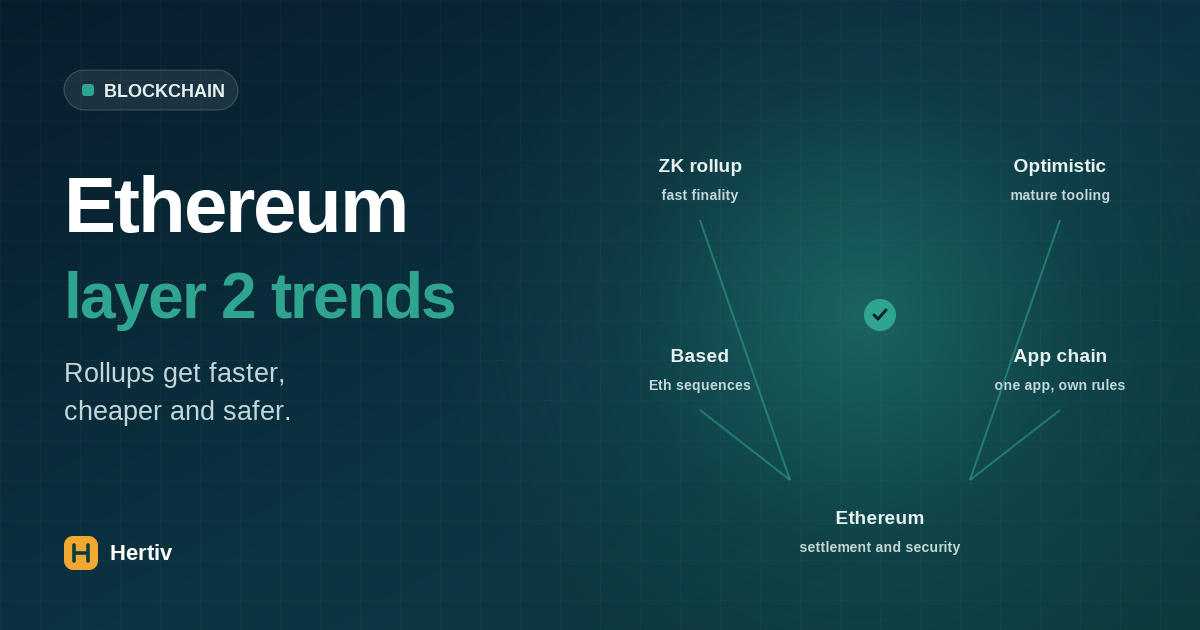
The Ethereum layer 2 trends worth watching are the ones that change what a team can build, not the ones that rename an old idea. Zero-knowledge proofs are getting cheap enough to use in production, sequencing is moving back toward Ethereum itself, and data costs are falling. Each trend below changes a real constraint: cost, speed, trust or how easily users move between networks.
Use this comparison to shortlist. Maturity is a rough guide, not a promise: a trend marked early can still be the right bet for a team that can wait.
| Trend | What changes | Who it helps | Maturity |
|---|---|---|---|
| ZK rollups go mainstream | Proofs verify batches fast and cheaply | Apps that need low fees and fast finality | Growing |
| Based rollups | Ethereum sequences the rollup itself | Teams that want less trust in one operator | Early |
| Shared sequencing | One sequencer serves several rollups | Apps that span more than one network | Early |
| Cheaper data availability | Posting data costs less per transaction | High-volume apps such as games | Growing |
| Better bridges | Moving assets between networks gets safer | Users and apps on several networks | Growing |
| Account abstraction | Wallets act more like accounts | Consumer apps and new users | Growing |
| App-specific rollups | One app gets its own chain | Games and high-volume apps | Early |
| Decentralised sequencers | No single operator orders transactions | Teams that need censorship resistance | Early |
Start with the first two rows if you are choosing a network today. The rest matter more for teams planning a year ahead than for teams shipping next quarter.
ZK rollups and based rollups
1. ZK rollups go mainstream: best for low fees and fast finality
Zero-knowledge rollups bundle many transactions, run them off Ethereum, and post a short proof that Ethereum can check. The proof does the verification work, so users get fast finality without waiting for a challenge window. As proving gets cheaper, more teams can afford this pattern, and it stops being a specialist choice.
The practical effect is lower fees per transaction and quicker confirmation that a payment is final. That matters for apps where users transact often, such as trading, gaming and payments. The trade-off is complexity: building with ZK tooling still needs more specialist knowledge than building on a plain optimistic rollup.
- Pro: fast finality and lower fees as proving costs fall
- Con: harder to build with, and fewer mature tools than optimistic rollups
2. Based rollups: best for teams that want less trust in one operator
A based rollup hands sequencing back to Ethereum. Instead of a single operator deciding the order of transactions, Ethereum validators order them as part of normal block production. The rollup keeps its own execution and fees, but the ordering step inherits Ethereum's decentralisation.
This matters because the sequencer is the part of a rollup that users must trust most. A single sequencer can delay transactions or go offline, and that risk grows as more value moves through the network. Based rollups remove that single point of trust, at the cost of giving up some control over block timing and ordering rules.
- Pro: sequencing inherits Ethereum's decentralisation
- Con: less control over block timing, and the design is still early
Shared sequencing and cheaper data
3. Shared sequencing: best for apps that span several rollups
Shared sequencing lets one sequencer order transactions for several rollups at once. That matters because today each rollup orders its own transactions, so an app that lives on two networks cannot easily do one action across both. A shared sequencer can order a pair of transactions together, which makes cross-rollup actions atomic instead of two separate steps.
The benefit is smoother movement between networks: a swap, a transfer and a follow-up action can happen as one unit. The risk is that the shared sequencer becomes a new trusted party, so teams need to check how it is run and what happens if it stops. For now this is a trend to track, not a default choice.
- Pro: atomic actions across rollups, less fragmentation for users
- Con: a new trusted party, and live deployments are still few
4. Cheaper data availability: best for high-volume apps
Rollups must post their transaction data somewhere so anyone can check it. That data posting has been one of the biggest costs, and it is falling as Ethereum adds dedicated space for rollup data and as separate data availability layers mature. Cheaper data means each transaction costs less to settle, which is what makes games and social apps viable on a rollup.
Teams should check what the cheaper data actually guarantees. Data posted to Ethereum carries the strongest guarantee; data posted elsewhere can be cheaper but weaker. The right choice depends on how much security the app needs, not just on the price per transaction.
- Pro: lower settlement cost, which opens up high-volume use cases
- Con: weaker guarantees from some data layers, so read the fine print
Better bridges and account abstraction
5. Better bridges: best for users on several networks
Bridges move assets and messages between Ethereum and its layer 2 networks, and they have been the weakest link in the whole stack. Newer designs use shared security, standard message formats and intent-based transfers, where a user states what they want and a solver delivers it. Each step reduces the trust a bridge needs and the damage when one fails.
For users, the visible change is simpler movement: one click instead of a multi-step transfer with long waits. For teams, the change is less support work, because fewer transfers get stuck. Bridges are still the part of the stack to audit most carefully, and a bridge with a small security budget is a risk whatever its design claims.
- Pro: simpler, faster movement between networks
- Con: bridges remain the most attacked part of the stack
6. Account abstraction: best for consumer apps and new users
Account abstraction lets a wallet behave more like an account: it can pay fees in a token other than ether, recover access without a seed phrase, and approve a batch of actions in one tap. On layer 2 networks, where fees are already low, this removes the two frictions that stop new users: buying ether first and managing a seed phrase.
The effect on product design is large. An app can sponsor a new user's first transactions, or let them sign in with an email and a passkey. The risk is that a badly configured account can be drained or locked, so teams need clear recovery rules and spending limits from day one.
- Pro: onboarding without seed phrases or buying ether first
- Con: misconfigured accounts can be locked or drained
App-specific rollups and decentralised sequencers
7. App-specific rollups: best for games and high-volume apps
An app-specific rollup is a layer 2 network built for one application. A game, an exchange or a social app gets its own block space, its own fee rules and its own upgrade schedule, instead of competing with every other app on a shared network. That control is what makes predictable performance possible when volume spikes.
The cost is isolation: the app's users live on a separate network, so moving assets in and out needs a bridge, and the team runs more infrastructure. App-specific rollups suit apps with steady, high volume and a team that can run a chain. They are a poor fit for a small app that would rather share a network's users and tooling.
- Pro: predictable performance and custom fee rules
- Con: more infrastructure to run, and users are isolated on one network
8. Decentralised sequencers: best for teams that need censorship resistance
Most rollups today run a single sequencer, which is a single operator that orders transactions. Decentralised sequencers replace that operator with a rotating set of participants, so no one party can delay or censor a transaction on its own. This is the last big centralisation risk in the rollup design, and several teams are working on it.
For most apps this is a future concern, not a launch blocker: a single honest sequencer works fine until it does not. For apps handling payments, identity or anything that must not be stopped by one party, it is worth tracking now. Ask any network you shortlist when its sequencer will be run by more than one operator.
- Pro: no single operator can delay or censor transactions
- Con: designs are early, and live decentralised sequencers are rare
How to choose a layer 2 trend to follow
Choose by the constraint your product actually hits, not by which trend is loudest. A team paying high fees cares about data costs; a team with users on three networks cares about bridges and shared sequencing; a team onboarding new users cares about account abstraction.
- Write down the one constraint that limits your product today: cost, speed, trust or user onboarding.
- Match that constraint to a trend in the table above, and ignore the rest for now.
- Check the maturity column, and ask whether your timeline can wait for an early trend.
- Test on a small scale: run a pilot on the network or pattern you picked, with real users and real fees.
- Revisit the choice every six months, because the maturity of these trends changes fast.
For a grounding in what layer 2 actually is, what is layer 2 explains the basics.
Top layer 2 blockchains compares the networks these trends run on.
What are the common mistakes?
Most mistakes come from chasing a trend instead of a constraint. Teams pick a network because it is new, then discover their users are elsewhere, or they pick a cheap network and find the bridge costs more than the savings.
- Choosing a network by fees alone, and ignoring where your users already are
- Trusting a bridge with a small security budget because the transfer looks cheap
- Treating an early trend as production-ready because the demo worked
- Ignoring sequencer centralisation until it causes a delay or outage
- Building on a network with weak tooling, then paying for it in development time
- Assuming cheaper data means the same security guarantees as Ethereum data
- Skipping a pilot and committing the whole product to one network on day one
If you want help weighing these trade-offs for a real product, blockchain development covers how teams evaluate networks before they build.
Key takeaways
- ZK rollups are maturing, and based rollups move sequencing back to Ethereum.
- Shared sequencing and cheaper data cut the cost of moving between networks.
- Bridges and account abstraction remove the frictions new users hit first.
- App-specific rollups suit high-volume apps; shared networks suit everyone else.
- Decentralised sequencers are the last big centralisation risk to watch.
- Pick by the constraint your product hits, not by the loudest trend.
Frequently asked questions
What is the biggest Ethereum layer 2 trend right now?
Zero-knowledge rollups maturing is the biggest trend, because cheaper proving makes fast finality and low fees available to more apps. Based rollups and shared sequencing matter too, but they change trust and coordination rather than cost, so their effect shows up more slowly.
Are optimistic rollups going away?
No. Optimistic rollups remain a solid choice for general apps, with mature tooling and large user bases. ZK rollups are catching up on cost and speed, but the two designs will coexist, with each suited to different apps and teams.
What is a based rollup in simple terms?
A based rollup lets Ethereum validators order its transactions instead of a single operator. The rollup still runs its own execution and fees, but the ordering step inherits Ethereum's decentralisation, so no one party controls which transaction goes first.
Why are bridges still risky?
Bridges hold assets and messages between networks, which makes them attractive targets, and their security depends on the design and the budget behind it. Newer designs reduce trust, but a bridge is still the part of the stack to check most carefully before moving value.
Do I need an app-specific rollup?
Only if your app has steady, high volume and needs predictable performance or custom fee rules, such as a game or an exchange. Most apps are better on a shared network, where they inherit users, tooling and liquidity without running extra infrastructure.
How do I pick a layer 2 network today?
Start from your product's main constraint: cost, speed, trust or onboarding. Match it to a trend, check the trend's maturity against your timeline, and run a small pilot with real users before committing the whole product.


