What Is Hyperledger Fabric, and How Does It Work?
Hyperledger Fabric is a permissioned blockchain framework for business networks, where known organisations share a ledger instead of mining coins.
On this page
Short answer
Hyperledger Fabric is a permissioned blockchain framework for building business networks in which known organisations share a ledger. Unlike public blockchains, it has no cryptocurrency and no mining: participants are identified, access is controlled, and only the organisations involved in a transaction see its details.
What is Hyperledger Fabric?
Hyperledger Fabric is a permissioned blockchain framework for business networks, built so that known organisations can share a ledger without opening it to the public. It is an open-source project under the Hyperledger umbrella, and it is designed for cases where the participants know each other and need privacy, not for anonymous public networks.
Fabric is a framework, not a finished product. It gives you the parts to build a network: a shared ledger, a way to agree on transactions, smart contracts called chaincode, and controls over who can see what. You run it on your own servers or in the cloud, and you decide who joins the network.
The key idea is that not every participant needs to see every transaction. In a supply-chain network, for example, a manufacturer and a shipper may share one set of records, while the manufacturer and a retailer share another. Fabric supports that through channels, so each group sees only its own data. For teams weighing a private network, how to create a private blockchain covers the wider decision.
How does Hyperledger Fabric work?
Hyperledger Fabric works by splitting the job of a blockchain into three steps: endorsing a transaction, ordering it, and committing it to the ledger. Different nodes do different jobs, which is what makes Fabric different from most blockchains.
The main parts are:
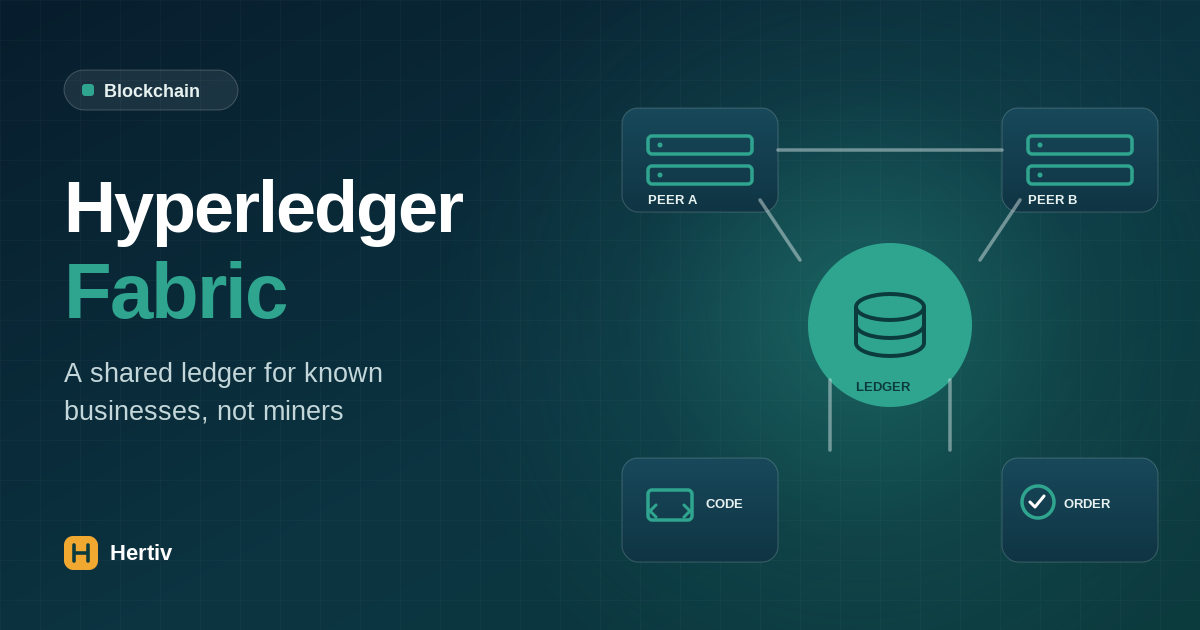
- Peers. Nodes run by each organisation that hold a copy of the ledger and run chaincode. Endorsing peers check a transaction against the rules before it is accepted.
- Orderers. Nodes that take endorsed transactions and put them in order, then send blocks to the peers. They do not check business rules; they only order.
- Channels. Private sub-ledgers shared by a subset of organisations on the network, so a transaction on one channel is invisible to the rest.
- Chaincode. Smart contracts written in a general-purpose language, such as Go, Java or JavaScript, that define what a transaction is allowed to do.
- Membership services. A certificate authority that issues identities to organisations and users, so every action is tied to a known participant.
A typical transaction flows like this: a client sends a proposal to the endorsing peers, which run the chaincode and sign the result; the client sends the endorsed transaction to the orderer, which puts it in a block; the peers then validate the block and add it to their ledger. Because endorsement happens before ordering, Fabric can run transactions in parallel when they do not conflict.
Hyperledger Fabric vs public blockchains
Hyperledger Fabric and public blockchains solve different problems, so the right choice depends on who the participants are and how much privacy the network needs.
| Feature | Hyperledger Fabric | Public blockchain |
|---|---|---|
| Who can join | Known organisations, by invitation | Anyone, without permission |
| Currency | None built in | Native coin used for fees |
| Consensus | Ordering service plus endorsement rules | Proof of work or proof of stake |
| Privacy | Channels and private data collections | All data is public by default |
| Throughput | Higher, since only members validate | Lower, since the whole network validates |
| Smart contracts | Chaincode in Go, Java or JavaScript | Usually a chain-specific language |
Fabric fits networks where the participants are known and the data is sensitive, such as banks settling trades or suppliers sharing shipment records. Public chains fit cases where anyone should be able to join and verify, such as open payment networks. Some projects use both: a public chain for open settlement and a Fabric network for the private business records behind it.
Where is Hyperledger Fabric used?
Hyperledger Fabric is used where a group of known organisations needs a shared record they can all trust, but where the data is too sensitive to put on a public chain.
Common uses include:
- Supply chains. Manufacturers, shippers and retailers record each handoff on a shared ledger, so a dispute about a shipment can be settled from one record instead of three systems.
- Trade finance. Banks and exporters share documents such as letters of credit, cutting the back-and-forth of paper copies and emailed PDFs.
- Healthcare records. Hospitals and insurers share permissioned access to records, so each organisation sees only the data it is allowed to see.
- Identity. Organisations issue and check credentials on a shared ledger, so a certificate can be verified without calling the issuer each time.
- Food traceability. Producers and retailers trace a batch from farm to shelf, so a recall can target the affected batch instead of the whole product line.
The pattern is the same in each case: a small group of organisations, a shared record, and a need to prove what happened without sharing everything with everyone. For permissioned designs in general, what a permissioned blockchain is explains the model Fabric belongs to.
How do you start a Hyperledger Fabric project?
You start a Hyperledger Fabric project by defining the network members and the data they will share, then building a small test network before anyone commits real records to it.
- Name the members. List the organisations that will run nodes and agree on who operates the ordering service and the certificate authorities.
- Define the data model. Decide what a record looks like, which fields are shared, and which stay private to a channel or a private data collection.
- Write the chaincode. Keep the first version small: create a record, update its state, and read it back. Add rules only after the basics work.
- Set the endorsement policy. Decide how many organisations must sign a transaction before it counts. One signature is fast but weak; requiring all members is strong but slow.
- Run a test network. Use the Fabric test network to try the full flow with sample data, and check that each member sees only what it should.
- Plan operations. Agree on who upgrades chaincode, how backups work, and how a new member joins, before the network goes live.
Most failed Fabric projects fail on governance, not on code: members disagree about who can see what, or nobody owns the ordering service. Settle those questions in writing before you build.
Example (hypothetical): a food distributor tracks shipments
Example (hypothetical): a food distributor moves 40 shipments a week, and each shipment changes hands three times: producer to distributor, distributor to warehouse, and warehouse to retailer. That is 120 handoffs a week, and each handoff is a record the next party needs to trust.
On paper, each handoff takes about 15 minutes to record, check and file, which is 120 times 15 minutes, or 30 hours a week across the network. On a Fabric network, each handoff is a transaction signed by both parties and written to the shared ledger in about 2 minutes, which is 120 times 2 minutes, or 4 hours a week.
The saving is 26 hours a week, and the record is the same for everyone.
The distributor starts with one product line and one channel shared by the producer, the distributor and the retailer. The warehouse sees only its own handoffs through a private data collection, not the prices the retailer pays. After two months of clean records, the group adds a second product line to the same channel.
What are the common mistakes?
The most common mistakes with Hyperledger Fabric are treating it like a public chain, skipping governance, and building chaincode that is too large to test or upgrade.
- Putting everything on one channel. A single channel means every member sees every transaction. Use channels and private data collections to limit what each member can see.
- Weak endorsement policies. Requiring only one signature lets a single member approve its own transactions. Match the policy to the trust in the network.
- No operations plan. Someone must run the ordering service, issue certificates and upgrade chaincode. If nobody owns those jobs, the network stalls.
- Chaincode that does too much. Large chaincode is hard to test and hard to upgrade. Keep each function small and test it on the test network first.
- Ignoring key management. Lost or leaked certificates can lock a member out or let an attacker sign as that member. Store keys properly and plan for rotation.
- Starting with real data. Test with sample data until the endorsement policy, channels and chaincode are all proven. Real records are hard to fix once written.
If you are planning a permissioned network and want the build handled by a team that has done it before, Hyperledger Fabric development is the place to start.
Key takeaways
- Hyperledger Fabric is a permissioned framework for business networks, with no coin and no mining
- Peers endorse, orderers order, and channels keep each group's data private from the rest
- Chaincode defines the rules, and the endorsement policy decides how many members must sign
- Fabric fits known groups sharing sensitive records, such as supply chains and trade finance
- Settle governance first: who joins, who sees what, and who runs the ordering service
Frequently asked questions
Is Hyperledger Fabric a cryptocurrency?
No. Fabric has no built-in coin and no mining. It is a framework for building permissioned ledgers between known organisations. If a network needs a token, the team builds it as an asset on the ledger, not as the framework itself.
How is Hyperledger Fabric different from Ethereum?
Ethereum is a public network where anyone can join, run a node and read the ledger. Fabric is permissioned: members are invited, identified by certificates, and can keep transactions private through channels. Fabric also splits endorsement and ordering, while Ethereum nodes do both.
What programming languages can I use for chaincode?
Chaincode is usually written in Go, Java or JavaScript, which are general-purpose languages most teams already know. That is a practical advantage over chain-specific languages, because the team can reuse its existing skills and testing tools.
Do I need a token to use Hyperledger Fabric?
No. Fabric networks run without any token. Transactions are ordered by the ordering service, not paid for with fees, so there is no gas cost. Teams that need a digital asset can model it as a record on the ledger.
How many organisations can join a Fabric network?
There is no fixed limit, but most production networks have a small number, often between three and twenty organisations. Larger networks are possible, yet each new member adds governance work: certificates, channels, endorsement policies and upgrades all need agreement.
Is Hyperledger Fabric still maintained?
Yes. It is an open-source project under the Linux Foundation, with regular releases and a community of contributors. Check the project site for the current supported version before starting, since older versions stop receiving fixes.


