What Is Anomaly Detection, and How Does It Work?
Anomaly detection finds data points that differ sharply from the normal pattern, so a team can catch fraud, faults and failures early.
On this page
Short answer
Anomaly detection is a technique that finds data points, events or behaviour that differ sharply from the normal pattern. It flags the unusual few so a person or a system can look at them, instead of asking someone to watch everything all the time.
What is anomaly detection?
Anomaly detection is a technique that finds data points, events or behaviour that differ sharply from the normal pattern. It flags the unusual few so a person or a system can look at them, instead of asking someone to watch everything all the time.
Most data has a shape. Payments from a shop usually fall in a narrow range. A machine usually vibrates within a known band. A user usually logs in from the same country at similar times. An anomaly is a point that breaks that shape: a payment ten times the usual size, a vibration twice the usual band, a login from a new country at 3 a.m.
An anomaly is not proof of a problem. It is a signal that something is worth checking. A large payment may be a genuine bulk order. A strange login may be a user on holiday.
The job of the detector is to narrow a mountain of normal data down to a small pile of cases a person can review. That idea sits at the heart of machine learning, where models learn the normal pattern from past data.
The main types of anomaly
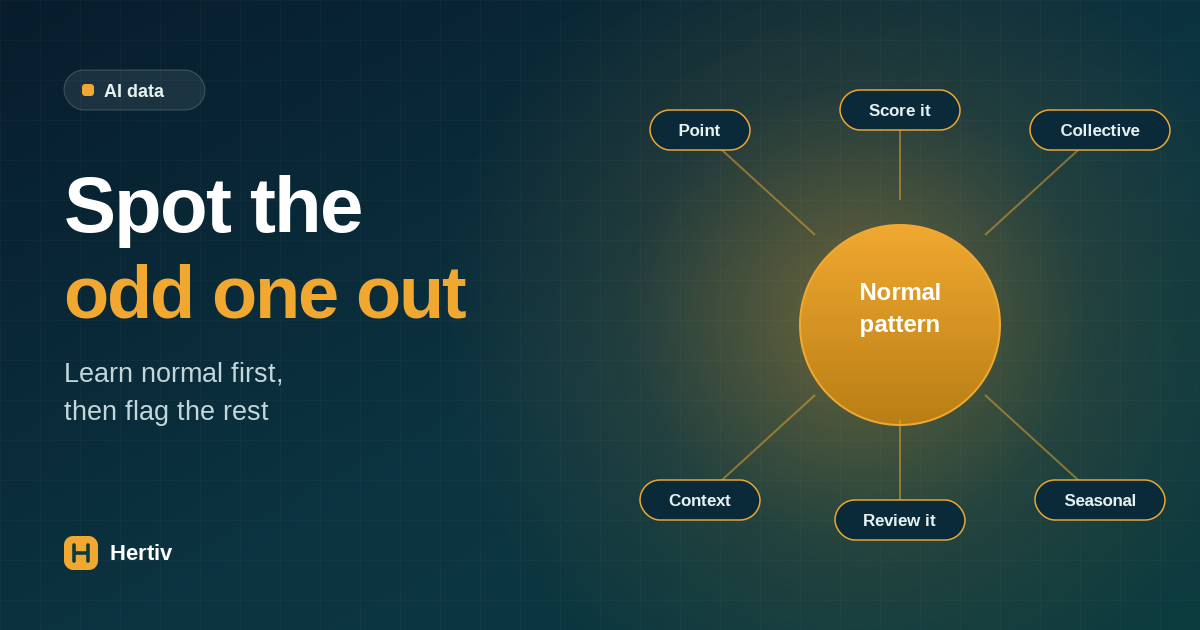
Anomalies come in three shapes, and the type decides how to find them. Point anomalies are single values that stand out, such as one payment far above the rest. Contextual anomalies are normal in one setting and strange in another, such as high heating use in summer. Collective anomalies are a group of points that look fine alone but strange together, such as a slow rise in failed logins across many accounts.
| Type | What it looks like | Example |
|---|---|---|
| Point | One value far from the rest | A payment ten times the usual size |
| Contextual | Normal value, wrong setting | High heating use in summer |
| Collective | A group that drifts together | Many failed logins at once |
| Seasonal | A break in a repeating pattern | No sales spike on a sale day |
Most real problems are contextual or collective, which is why simple limits miss them. A payment just below the limit can still be strange if it comes at an odd hour from a new device. Good detectors look at the whole picture, not one number at a time.
How does a detection system work?
A detection system has four parts. First it collects the data: logs, sensor readings, payments or user actions, with the time each event happened. Second it builds a picture of normal, either from rules a person writes or from a model trained on past data.
Third it scores each new event. The score says how far the event sits from normal. A simple method compares the value with the average and the spread. A model-based method asks how likely the event is under the learned pattern. Either way, the output is a number, not a yes or no.
Fourth it decides what to do with the score. A high score can raise an alert, block a payment, or add the event to a review queue. The threshold matters: set it too low and the team drowns in false alarms; set it too high and real problems slip past. Most teams start with a loose threshold and tighten it as they learn which alerts matter.
Where do teams use anomaly detection?
Fraud is the best-known use. Banks watch for payments that break a customer's pattern, and card networks watch for many small tests before a large charge. The goal is to stop the payment before the money leaves, not to explain it afterwards.
Factories use it for machines. A sensor that watches vibration, heat or sound can flag a bearing that is wearing out days before it fails. Fixing it during a planned stop costs far less than a breakdown in the middle of a shift.
Software teams use it for their own systems. A sudden rise in errors, a slow database or a strange login pattern can be caught minutes after it starts, instead of hours later when users complain.
The same approach helps security teams spot an account behaving in a way its owner never does. Each use follows the same shape: learn normal, score the new, and review the strange few. That pattern is part of artificial intelligence work in general, where a model learns from past behaviour.
Example (hypothetical): catching a faulty sensor
Imagine a delivery company that tracks the temperature inside its refrigerated vans. Each van reports its temperature every minute, and the normal range is 2 to 4 degrees. One van starts reporting 6 degrees, then 7, then 8 over two hours.
A simple limit set at 8 degrees would flag the van only at the end of the two hours. A detector that watches the trend flags it after 30 minutes, when the reading has risen by 1 degree three times in a row. The company calls the driver, who finds a door seal that has come loose, and the goods are moved to another van.
Suppose the load is worth 2,000 dollars and a full failure would spoil half of it, losing 1,000 dollars. The early flag costs one phone call and a 40-dollar seal. The detector paid for itself many times over with a single catch, and it did so by watching a pattern, not a single number.
Limits of anomaly detection
Anomaly detection cannot tell you why something is strange. It can say a payment is unusual, but not whether it is fraud or a genuine purchase. A person still has to decide, and that review work is the real cost of running a detector.
Normal also changes. A shop's sales pattern shifts at Christmas, a machine behaves differently after a repair, and a user moves to a new country. A detector trained on old normal will flag the new normal as strange until it is retrained.
Finally, rare events are hard to learn from. A type of fraud that has happened twice gives a model almost nothing to learn. Rules written by people still handle those cases better, which is why most working systems mix rules and models rather than relying on one alone. Testing AI models before they go live is how teams check that the mix actually works.
Common mistakes
Alerting on everything is the most common mistake. A detector that raises a hundred alerts a day will be ignored by the end of the week. Start with a small number of high-quality alerts, and add more only when the team can act on them.
Using dirty data is another. A sensor that reports in the wrong unit, a log with missing times, or a dataset that mixes two products will teach the model the wrong normal. Clean the data first, even if that means the project starts a week later.
Finally, do not expect the detector to work without review. The alerts are the start of the work, not the end. A team that reads its alerts, labels them right or wrong, and feeds that back into the model gets better every month. A team that installs a detector and walks away gets noise.
Key takeaways
- An anomaly is a signal to check, not proof of a problem.
- Point, contextual and collective anomalies need different methods.
- A detector scores events; a threshold decides what gets reviewed.
- Normal changes, so models must be retrained.
- Start with a few good alerts, not a flood of them.
Frequently asked questions
What is the difference between anomaly detection and fraud detection?
Anomaly detection is the method; fraud detection is one use of it. Anomaly detection finds anything unusual in data. Fraud detection uses that, plus rules and history, to decide whether a payment or account is likely fraud. Most fraud systems combine both.
Do you need labelled data to detect anomalies?
Not always. Unsupervised methods learn the normal pattern from data without labels, which works well when anomalies are rare. Labelled data helps when you want to tell fraud from a genuine exception, but many teams start without it and add labels from their reviews.
What is a false positive in anomaly detection?
A false positive is a normal event flagged as strange. A user on holiday, a bulk order or a machine after repair can all look strange to a detector. Too many false positives make teams ignore alerts, so tuning the threshold to keep them low is part of the job.
Can anomaly detection work in real time?
Yes. Many systems score each event as it arrives and raise an alert within seconds. Real-time scoring needs fast data and a light model, so teams often use a simple model live and a heavier one for overnight review.
How often should a model be retrained?
Retrain when normal changes: after a product launch, a seasonal shift, a machine repair or a move to a new market. Many teams retrain monthly and check weekly whether the alert rate has drifted. A model that is never retrained slowly stops matching reality.
Is anomaly detection the same as outlier detection?
The two terms overlap. Outlier detection usually means finding single values far from the rest, which is the point anomaly type. Anomaly detection is the wider term and covers contextual and collective anomalies too, where the strangeness depends on timing or on a group of events.


