What Is Artificial Intelligence, and How Does It Work?
Artificial intelligence is software that learns patterns from data and uses them to predict, generate or act. Learn how it works, where it is used, and how to start.
On this page
Short answer
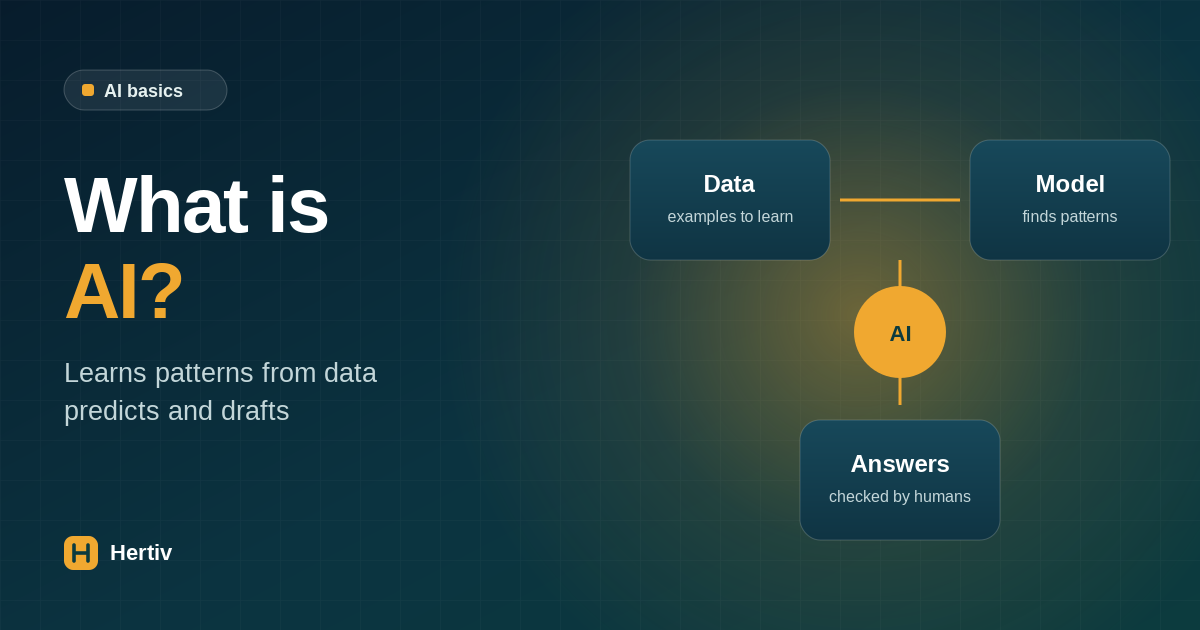
Artificial intelligence is software that learns patterns from data and uses those patterns to make predictions, generate content or take actions. Instead of following only hand-written rules, an AI system improves its behaviour by training on examples, then applies what it learned to new inputs it has never seen.
What is artificial intelligence?
Artificial intelligence, or AI, is a field of computer science that builds systems able to perform tasks that normally need human judgement: understanding language, recognising images, making decisions and creating new content. The key idea is learning from data rather than following fixed rules.
A traditional programme does exactly what its code says. An AI system is given examples — thousands of emails labelled as spam or not, or thousands of photos labelled by what they show — and it finds the patterns that separate one label from another. Once trained, it can judge new examples it has never seen.
AI is not one technology. It is a family of methods, and the right one depends on the task. The sections below explain the main branches and how a team picks between them.
How does AI actually work?
Most AI systems follow the same loop: collect data, train a model on it, test the model on data it has not seen, and then use it to make predictions. The model is a mathematical function with many adjustable settings, and training adjusts those settings until the model's answers match the training examples.
Three ingredients decide how well this works. First, the data: a model trained on clean, representative examples will beat one trained on messy or biased data. Second, the algorithm: different tasks suit different model types. Third, evaluation: the model must be tested on fresh examples, because a model that only memorises its training data fails on new inputs.
Once a model is in use, it needs monitoring. Data changes over time — customer language shifts, products change, fraud patterns move — and a model that is never re-checked slowly gets worse. For the most common production pattern, see what machine learning is and how it works.
What are the main branches of AI?
AI splits into branches by the kind of input it handles. Most real products combine two or three of them: a support agent, for example, uses language understanding to read a ticket and generation to draft a reply.
| Branch | What it does | Typical use |
|---|---|---|
| Machine learning | Learns patterns from data | Predictions, scoring, ranking |
| Natural language processing | Understands and writes text | Chatbots, search, summarising |
| Computer vision | Understands images and video | Quality checks, face and object detection |
| Generative AI | Creates new text, images or code | Drafting, copilots, content |
| Speech and audio | Turns speech into text and back | Voice assistants, transcription |
| Robotics and control | Moves and acts in the physical world | Warehouses, vehicles, drones |
Generative AI is the branch most people meet first today, because chatbots and copilots are visible. Behind them, machine learning does most of the quiet work: ranking, forecasting, fraud checks and recommendations. The best-known generative tools are large language models; see what GPT is for how those models work.
Where is AI used today?
AI is used wherever there is a lot of data and a repeatable decision. In customer support, it drafts replies and routes tickets. In finance, it scores credit risk and flags unusual transactions. In healthcare, it helps read scans and schedule appointments. In retail, it forecasts demand and recommends products.
The common thread is that a human still owns the outcome. AI drafts, ranks and suggests; a person checks, approves and takes responsibility. The products that work best keep that boundary clear, with a human review step for anything that affects money, health or legal rights.
AI also fails in ways that are easy to miss: it can repeat biases in its training data, or perform well on average while failing badly for one group of users. Testing across different user groups matters as much as testing overall accuracy.
How to start with AI in five steps
Starting with AI does not mean hiring a research team. Most teams begin with one narrow workflow where the output is already checked by a human, so a wrong answer is caught before it costs anything.
- Pick one workflow with a clear owner and a measurable outcome, such as answering support tickets.
- Gather a sample of real inputs and the correct outputs, to use as an evaluation set.
- Try the simplest approach first, such as a hosted model with your own documents.
- Measure the result on the evaluation set before rolling it out to users.
- Add guardrails: logging, a human review step and a fallback for low-confidence answers.
A short AI proof of concept with a fixed evaluation set is the cheapest way to learn whether an idea is real. If the proof of concept cannot beat the current manual process on the evaluation set, it is not ready.
Example (hypothetical): a support team tries AI replies
Example (hypothetical): a support team of six people answers 240 tickets a day, and each reply takes about 6 minutes to write. That is 240 × 6 minutes = 1,440 minutes, or 24 hours of writing a day across the team. The team tries an AI draft tool that writes a first draft from the help centre, and a human edits each draft in about 1.5 minutes.
With the tool, the same 240 tickets take 240 × 1.5 minutes = 360 minutes, or 6 hours a day of editing. That saves about 18 hours a day of writing time, which the team spends on the hard tickets that need judgement. The saving only holds if the drafts are good enough to edit rather than rewrite, so the team tracks how many drafts are accepted with light edits.
The team also sets a rule: the model never sends a reply on its own. Every draft passes through a human, and billing or account-closure tickets skip the model entirely. After a month, the team checks the numbers again, because the first week's results are rarely the final ones.
Common mistakes about artificial intelligence
The most common mistake is expecting AI to work without good data. A model trained on outdated help articles will give outdated answers, and no amount of prompt tuning fixes that. Clean the data first.
- Treating a demo as proof the system works in production
- Skipping an evaluation set, so quality debates are anecdotal
- Letting a model act without a human check on important decisions
- Starting with a broad assistant instead of one workflow with an owner
- Assuming the vendor's benchmark predicts results on your own data
- Forgetting that models need monitoring as data changes over time
AI works best as a narrow tool with a clear job, a good evaluation set and a human in the loop. Teams that start that way learn faster than teams that start with a big platform. If you want help scoping a first use case, AI consulting covers how to pick one.
Key takeaways
- AI is software that learns patterns from data instead of following fixed rules.
- Data quality decides model quality more than the choice of model does.
- Most products combine branches: language, vision, prediction and generation.
- Keep a human in the loop for decisions that affect money, health or rights.
- Start with one narrow workflow and an evaluation set, not a broad platform.
Frequently asked questions
What is artificial intelligence in simple words?
Artificial intelligence is software that learns from examples instead of following only hand-written rules. You show it many examples, it finds the patterns in them, and then it uses those patterns to judge new cases, write text, recognise images or make recommendations.
How does AI learn?
AI learns by training: a model adjusts its internal settings until its answers match the training examples. Training data is the examples, and evaluation data is a separate set used to check whether the model learned the pattern or just memorised the examples.
What is the difference between AI and machine learning?
Machine learning is a branch of AI. AI is the broad field of building systems that do tasks needing judgement, and machine learning is the method of learning those tasks from data. Most AI in use today is machine learning.
Can AI replace human workers?
AI replaces specific tasks, such as drafting replies or sorting documents, rather than whole jobs. In practice it shifts human work towards checking, deciding and handling exceptions, which is why a human review step matters.
Is AI always accurate?
No. AI systems make mistakes, can repeat biases in their training data, and can produce confident-sounding answers that are wrong. That is why evaluation sets, logging and human review are part of any serious AI deployment.
What do I need to start using AI?
You need one workflow with a clear owner, a sample of real inputs with correct outputs, and a way to measure results. You do not need a research team or a large budget to run a first proof of concept.


