What Is AI TRiSM, and How Does It Work?
AI TRiSM is a way to manage trust, risk and security for AI systems, from design to daily use. See what it covers, how it works in practice, and how to start.
On this page
Short answer
AI TRiSM stands for AI Trust, Risk and Security Management. It is a way of running AI systems so that they are fair, explainable, safe and checked throughout their life, from the first design to daily use. It brings together model testing, data rules, monitoring and human oversight into one routine.
What is AI TRiSM?
AI TRiSM stands for AI Trust, Risk and Security Management. It is a set of practices that keeps an AI system trustworthy, controlled and safe from the day it is designed to the day it is retired. The idea is that an AI model is not a one-off project but a system that needs ongoing care.
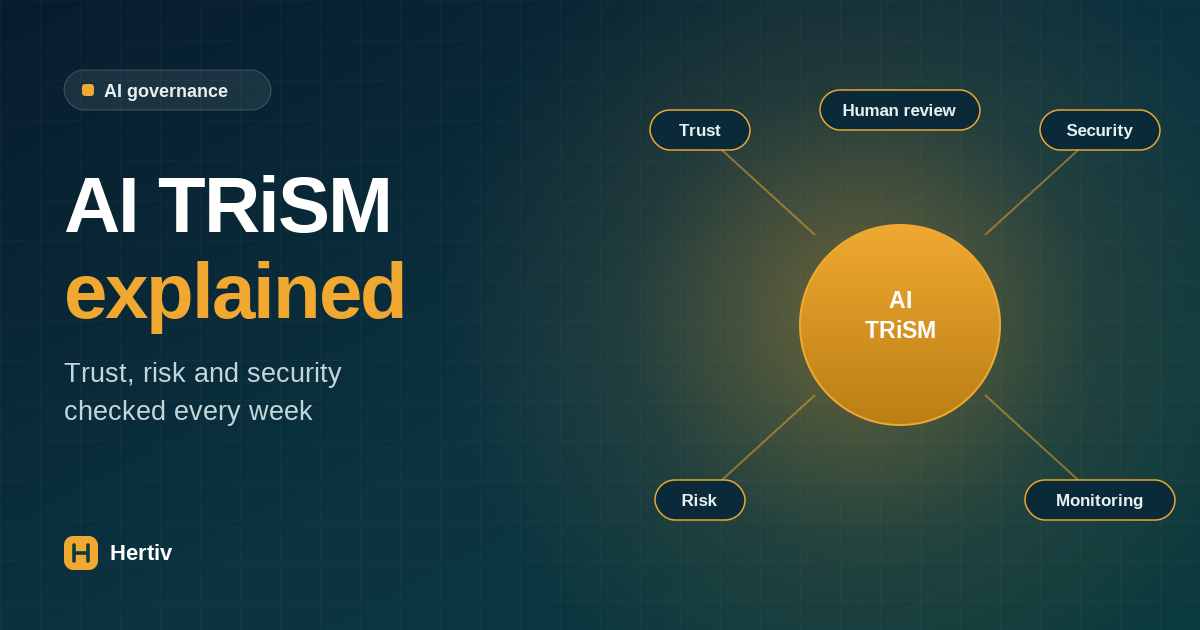
TRiSM has three parts. Trust means the model behaves fairly, explains its decisions in a way people can follow, and does what it claims to do. Risk means the team knows what can go wrong, how likely it is, and what will catch it. Security means the model and its data are protected from misuse, theft and attack.
The term comes from Gartner, and it is used most by teams that run AI in regulated or high-stakes work, such as lending, hiring or healthcare. The table below shows what each part covers.
| Part | What it covers | Example check |
|---|---|---|
| Trust | Fairness, explanations, accuracy | Can a user see why a decision was made? |
| Risk | Governance, monitoring, human review | Who approves a new model version? |
| Security | Data protection, access, attacks | Can a prompt leak private data? |
| ModelOps | Versioning, testing, rollback | Can the old model be restored in an hour? |
| Data rules | Quality, consent, retention | Is the training data allowed to be used? |
None of these parts is new on its own. What TRiSM adds is the habit of treating them as one routine, so a model is not tested once and forgotten, but checked every time it changes and every week it runs.
Why does TRiSM matter?
TRiSM matters because AI systems change after they are built. A model that was fair and accurate on its training data can drift as the real world changes, and a model that was safe can become unsafe when it meets new kinds of input.
It also matters because the cost of a mistake is high. A hiring model that treats some candidates unfairly, a lending model that cannot explain a refusal, or a support model that leaks customer data can each cause real harm and real legal trouble.
Rules are catching up too. Data protection laws, AI regulations and industry standards increasingly expect teams to show how their models were tested, who approved them, and how they are watched. TRiSM gives a team the records to answer those questions.
How does TRiSM work in practice?
In practice, TRiSM is a loop, not a single check. Before a model is built, the team writes down what the model must do, what it must never do, and which data it may use. That list becomes the test the model must pass.
During building, the model is tested on data it has not seen, checked for unfair results across groups, and probed with tricky inputs to see how it fails. Each test is recorded, with the version of the model and the data it ran on.
After launch, the model is watched. The team tracks its decisions, looks for drift, and reviews a sample of its outputs every week. Testing AI models is part of this loop, and it repeats every time the model or its data changes.
How to start TRiSM in 5 steps
- List every AI model your team runs, what it decides, and who is affected by each decision.
- Rank the list by risk, and start with the model whose mistakes would cost the most.
- Write down what that model must do and must never do, and turn the list into tests it must pass.
- Set up a weekly review: a sample of outputs, a check for drift, and a named person who signs off.
- Record everything in one place, so an auditor or a manager can see the tests, the results and the sign-offs.
Start with one model, not all of them. A team that tries to cover everything at once usually ends with paperwork and no checks. Machine learning basics help here: the team that understands what the model does can write better tests for it.
Example (hypothetical): screening loan applications
Example (hypothetical): a small lender uses a model to screen 500 loan applications a month. The model approves most, but it flags 50 as high risk. A person reviews each flagged application for about 10 minutes, which is 50 times 10 minutes, or 8 hours 20 minutes a month.
Under TRiSM, the team also checks the model's decisions each month. It compares approval rates across applicant groups, and it reviews 20 approved applications at random, at 10 minutes each, which is 3 hours 20 minutes. The total review time is 8 hours 20 minutes plus 3 hours 20 minutes, or 11 hours 40 minutes a month.
That time buys something concrete: the team can show that the model is checked, that its decisions are recorded, and that a human reviews the cases that matter. If the monthly check finds that one group is refused far more often than others, the team can pause the model and fix it before the problem grows.
Common mistakes
The most common mistake is treating TRiSM as a form to fill in once. A model that passes its first test can still fail later, when the data changes or when users find new ways to use it. TRiSM only works as a weekly habit.
The second mistake is testing on the same data the model was trained on. A model will look accurate on data it has already seen, so tests must use fresh data, tricky inputs and real cases the team has collected.
The third mistake is having no named owner. AI systems in use need someone who owns the checks, the sign-offs and the decision to pause a model. Without an owner, the checks stop the first time the team is busy.
What TRiSM does not do
TRiSM does not make a model perfect. It makes the model's limits visible, so the team knows where it can be trusted and where a person must step in. A model with known limits and a human check is safer than a model no one has tested.
It also does not replace the law. Data protection rules, anti-discrimination law and industry standards still apply, and TRiSM is a way of meeting them, not a substitute for them.
Finally, TRiSM does not remove the need for good data. A model trained on poor, biased or unlawful data will stay poor, biased or unlawful no matter how many checks run on top. AI governance starts with the data, and TRiSM keeps the discipline going after the model is live.
Key takeaways
- TRiSM covers trust, risk and security for AI, from design to daily use.
- Trust means fair, explainable decisions; risk means known dangers and checks; security means protected models and data.
- It is a weekly loop of testing, monitoring and human review, not a one-off form.
- Start with the highest-risk model and one named owner for the checks.
- TRiSM makes a model's limits visible; it does not make the model perfect.
Frequently asked questions
What does AI TRiSM stand for?
AI TRiSM stands for AI Trust, Risk and Security Management. It is a way of running AI systems so that they are fair, explainable, safe and checked throughout their life, from the first design to daily use.
Is TRiSM only for large companies?
No. Small teams can use the same ideas on a smaller scale: list the models, rank them by risk, test the highest-risk one, and review a sample of its outputs each week. One model and one owner is a good start.
How is TRiSM different from AI governance?
AI governance sets the rules and the ownership for how AI is used. TRiSM is the working routine that carries those rules out: testing, monitoring, security checks and human review for each model. Governance decides; TRiSM does.
How often should a model be checked?
At least weekly, with a sample of its outputs reviewed by a person, plus a check every time the model or its data changes. High-risk models, such as those used in lending or hiring, need more frequent and deeper checks.
What is model drift?
Model drift is when a model's performance changes over time because the real world no longer matches the data it was trained on. Regular monitoring catches drift by comparing current decisions with past ones and with expected results.
Can TRiSM stop all AI mistakes?
No. It cannot make a model perfect, but it makes mistakes visible early, so the team can pause a model, fix it and limit the harm. A model with known limits and a human check is safer than one no one has tested.


