What Is a Non-Fungible Token (NFT)? A Plain Explanation
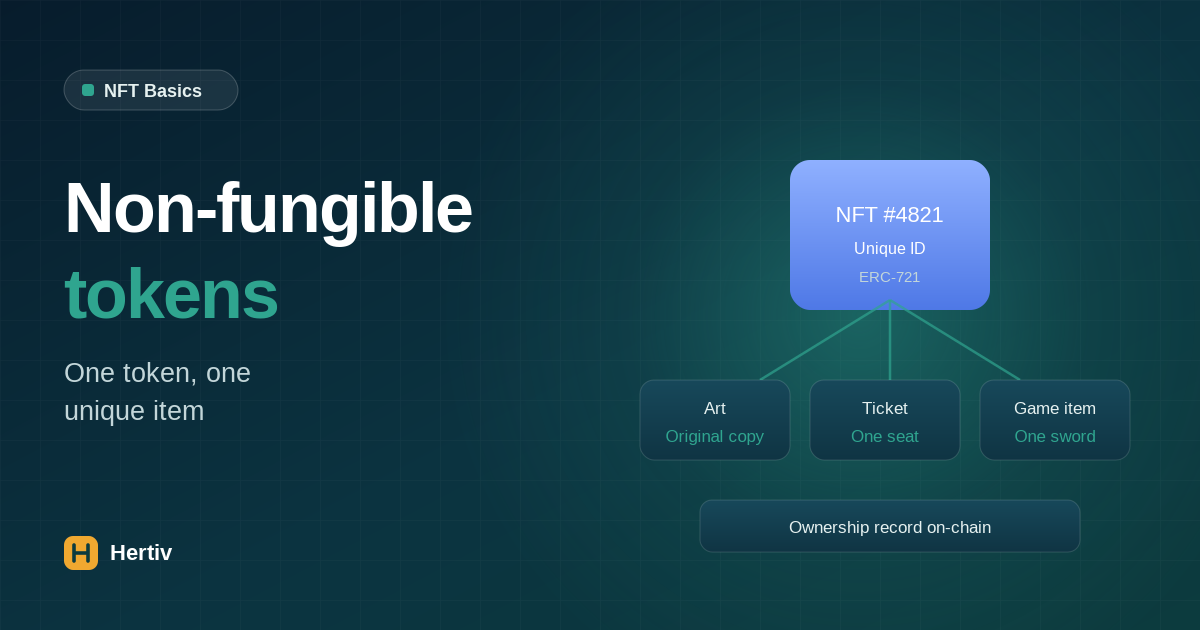
A non-fungible token is a unique digital record on a blockchain that proves ownership of one specific item, such as art, a ticket or a game item.
On this page
Short answer
A non-fungible token, or NFT, is a unique digital record on a blockchain that proves ownership of one specific item, such as a piece of digital art, a ticket, a game item or a certificate. Unlike a coin, which can be swapped for any identical coin, each NFT is distinct and cannot be exchanged one-for-one with another.
What is a non-fungible token?
A non-fungible token, or NFT, is a unique digital record on a blockchain that proves ownership of one specific item, such as a piece of digital art, a ticket, a game item or a certificate. The token lives on a blockchain, so anyone can check who owns it and how it has changed hands, without asking a central company.
The word non-fungible means the item is not interchangeable. One dollar is fungible, because any dollar is worth the same as any other dollar. An NFT is the opposite: each token has its own identifier, and one NFT is not equal to another, even if they come from the same collection.
Most NFTs live on Ethereum and follow the ERC-721 token standard, which defines how a unique token is created, transferred and tracked. Some use ERC-1155, which can hold both unique and identical items in one contract. The standard matters because wallets, marketplaces and games all need to agree on how to read the token.
Fungible vs non-fungible: what is the difference?
Fungible and non-fungible describe whether one unit can replace another. Money and most cryptocurrencies are fungible; NFTs, tickets and deeds are not.
| Feature | Fungible | Non-fungible |
|---|---|---|
| Interchangeable | Yes, any unit equals another | No, each unit is distinct |
| Examples | Dollars, SOL, ETH | Art, tickets, game items |
| Identifier | None per unit | Unique token ID |
| Divisible | Yes, into smaller units | Usually no |
| Supply | Large or unlimited | Fixed per token or collection |
| Standard | ERC-20, SPL | ERC-721, ERC-1155 |
The comparison is useful because it sets expectations. An NFT is not a currency and should not be judged like one. Its value comes from what it represents and what the holder can do with it, not from being spendable in small amounts.
How does an NFT work on a blockchain?
An NFT works on a blockchain as a smart contract entry that links a unique token ID to an owner address and to metadata describing the item. The contract records every transfer, so the ownership history is public and cannot be rewritten.
The usual flow has four steps. First, a creator writes or uses a smart contract that follows the ERC-721 or ERC-1155 standard. Second, minting creates the token and assigns it a unique ID, often with metadata that points to an image, a video or a document stored off-chain.
Third, the token is listed on a marketplace, where a buyer pays in cryptocurrency. Fourth, the contract transfers the token to the buyer's wallet, and the blockchain records the sale.
The image or file itself usually does not live on the blockchain. The token stores a link to it, and the file sits on a server or a decentralised storage network. That distinction matters: owning the token means owning the record and the rights the contract grants, not necessarily owning the file itself. For the standard behind the token, see what is ERC-721.
What are NFTs used for?
NFTs are used for digital art and collectibles, tickets, game items, membership passes, certificates and real-world asset records, wherever a unique, verifiable record of ownership is useful.
Digital art was the first large use case. An artist mints a work as an NFT, and the token proves which copy is the original, even though anyone can copy the image. Collectors buy the token, not the image file, and the artist can set a royalty that pays on later resales through the marketplace.
Tickets and memberships are the more practical use cases. An NFT ticket cannot be duplicated the way a QR code can, and the organiser can see every resale. Game items work the same way: a sword or a skin owned as an NFT can move between players and, in some games, between games.
Certificates and credentials use NFTs to prove that a document was issued by a specific organisation and has not been altered. The range of uses is covered in NFT use cases.
What do you actually own when you buy an NFT?
When you buy an NFT, you own the token and whatever rights the creator or the contract grants, which is usually far less than owning the underlying work itself.
Buying an NFT does not normally transfer copyright. The artist keeps the copyright unless the sale terms say otherwise, so the buyer cannot reproduce the work commercially or claim to be its creator. What the buyer gets is the verifiable record of ownership, the right to display the work in most cases, and any perks the project attached to the token, such as event access or future drops.
The metadata link is the other weak point. If the image is stored on a server that goes offline, the token still exists but points to nothing. Projects that store metadata on decentralised storage reduce that risk, but they do not remove it. Before buying, check where the metadata lives and what rights the terms actually grant.
Example (hypothetical): a gallery sells 100 NFT tickets
Example (hypothetical): a gallery mints 100 NFT tickets for an exhibition, each with a unique token ID, and prices them at 0.05 ETH. The contract records each sale on the blockchain, so the gallery can see exactly how many tickets are sold and to which wallets.
Of the 100 tickets, 80 sell in the first week, which is 80 x 0.05 = 4 ETH in primary sales. The other 20 sell later.
Ten of the first buyers resell their tickets on a marketplace, and the contract pays the gallery a 5% royalty on each resale. If those 10 tickets resell at 0.08 ETH each, the resale total is 10 x 0.08 = 0.8 ETH, and the gallery receives 0.8 x 0.05 = 0.04 ETH in royalties.
The gallery also gains a fraud benefit: at the door, staff check the ticket against the blockchain record, so a copied QR code or screenshot does not get anyone in. The lesson is that the NFT's value here is the verifiable record and the royalty, not the image attached to the ticket.
What are the common mistakes?
The most common mistakes with NFTs are confusing the token with the file, ignoring the storage behind the metadata, and treating an NFT as an investment without checking the terms.
- Thinking you own the image. Owning the token does not transfer copyright or stop others copying the file.
- Ignoring metadata storage. A token that points to a dead server loses the item it was meant to represent.
- Buying without reading the terms. Royalties, resale rules and perks are set by the project, not by the token standard.
- Forgetting gas fees. Minting and transferring on Ethereum costs network fees, which can exceed the price of a cheap NFT.
- Trusting screenshots. A screenshot of an NFT proves nothing; only the on-chain record shows ownership.
- Losing the wallet. If the wallet's recovery phrase is lost, the NFT is lost with it, because no company can restore it.
How to buy your first NFT safely
You buy your first NFT safely by setting up a wallet, checking the project and the contract, and starting with a small amount you can afford to lose.
- Set up a wallet. Install a wallet that supports the chain the NFT lives on, and store the recovery phrase offline.
- Fund it carefully. Buy the cryptocurrency the marketplace accepts, and keep a little extra for network fees.
- Check the project. Read the terms, find where the metadata is stored, and confirm the contract address from the project's own site, not from a search result.
- Buy on a known marketplace. Use a marketplace with a track record, and check the seller's history and the token's transfer record.
- Verify after purchase. Confirm the token appears in your wallet and that the on-chain record shows your address as the owner.
Marketplaces are where most first purchases happen, and the way they work is covered in NFT marketplace use cases, which also explains how royalties and listings are handled.
Key takeaways
- An NFT is a unique blockchain record that proves ownership of one specific item
- Fungible units are interchangeable; each NFT has its own ID and is not equal to another
- Most NFTs follow ERC-721 or ERC-1155, and the token usually links to a file stored off-chain
- Buying an NFT does not normally transfer copyright; check the terms for what you actually get
- Verify ownership on-chain, check metadata storage, and keep your wallet recovery phrase safe
Frequently asked questions
What is a non-fungible token in simple terms?
A non-fungible token, or NFT, is a unique digital record on a blockchain that proves ownership of one specific item, such as a piece of digital art, a ticket or a game item. Each NFT has its own identifier and cannot be swapped one-for-one with another NFT.
Are NFTs the same as cryptocurrency?
No. Cryptocurrencies such as ETH and SOL are fungible, so any unit is worth the same as any other unit. NFTs are unique, so each token is distinct, has its own ID, and is usually not divisible into smaller units.
Where is the NFT image actually stored?
Usually not on the blockchain. The token stores a link to the image or file, which sits on a server or a decentralised storage network. If that storage goes offline, the token still exists but points to nothing, so check where the metadata lives before buying.
Do you own the copyright when you buy an NFT?
Normally no. The creator keeps the copyright unless the sale terms say otherwise. Buying an NFT usually gives you the ownership record, the right to display the work, and any perks the project attached, but not the right to reproduce it commercially.
What was the first popular NFT project?
CryptoKitties, a game of collectible digital cats launched in 2017, was the project that brought NFTs to wide attention. It showed that unique tokens could be bought, sold and bred on Ethereum, and it pushed the ERC-721 standard into common use.
Can an NFT be copied?
The image or file can be copied by anyone, but the token cannot. Only one wallet holds the token at a time, and the blockchain record shows the full ownership history, which is what makes the token, rather than the file, the proof of ownership.


