What Are NFT ETFs, and How Do They Work?
An NFT ETF is a fund that gives exposure to NFTs or NFT-related companies through ordinary shares. Learn how it works, what it holds and the risks to check.
On this page
Short answer
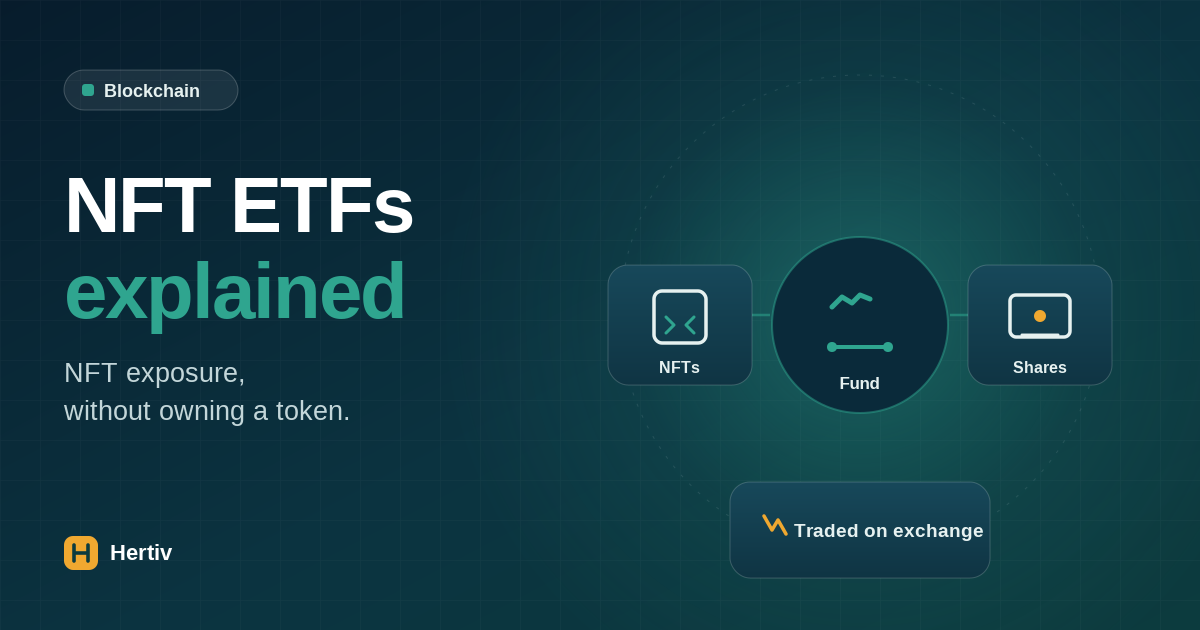
An NFT ETF is an exchange-traded fund that gives investors exposure to non-fungible tokens or to companies involved in the NFT market, without owning individual NFTs directly. Some funds hold shares of NFT-related companies, while others aim to track an index of NFT assets. You buy and sell the fund on a stock exchange like any other ETF.
What is an NFT ETF?
An NFT ETF is a fund that lets investors gain exposure to the NFT market through shares traded on a stock exchange. NFT stands for non-fungible token: a unique digital item, such as a piece of digital art or a collectible, recorded on a blockchain. An NFT ETF wraps exposure to that market into a familiar product you can buy from a brokerage account.
The key point is that you do not buy individual NFTs. You buy shares in a fund, and the fund manages the exposure. That removes the need for a crypto wallet, a marketplace account and the work of judging individual tokens, but it also means you do not own any NFT yourself.
NFT ETFs are a small and new corner of the fund market. They exist because some investors want exposure to digital collectibles and the companies around them without dealing with the NFT market directly.
How does an NFT ETF work?
An NFT ETF works like any other ETF: the fund manager collects money from investors, buys the assets its strategy calls for, and lists shares of the fund on a stock exchange. The share price moves with the value of what the fund holds, minus fees.
The mechanics are simple:
- The fund sets a strategy, such as tracking an index of NFT-related companies or holding a basket of NFTs through a custodian.
- It buys the underlying assets and stores them, or holds the shares of the companies in its index.
- Shares in the fund are listed on a stock exchange, where investors buy and sell them during market hours.
- The fund publishes its holdings and its net asset value, so investors can see what backs their shares.
- The manager charges an annual fee, taken from the fund's assets, for running the fund.
Because the fund trades on an exchange, you can buy and sell during market hours at a visible price, which is very different from selling a single NFT, where finding a buyer can take days or never happen.
What do NFT ETFs hold?
What an NFT ETF holds depends on its strategy, and the differences matter more than the name. Some funds hold company shares, others aim to hold NFTs themselves, and the risk profile changes completely between the two.
| Fund type | What it holds | Main risk |
|---|---|---|
| NFT company basket | Shares of NFT marketplaces and related firms | Company results, not NFT prices |
| NFT index fund | A basket chosen to track NFT market prices | Index may not match the real market |
| Direct NFT fund | NFTs held by a custodian | Illiquid tokens, custody and valuation |
| Blockchain and metaverse fund | Shares of firms building NFT infrastructure | Broader theme, weaker NFT link |
Read the fund's own documents before investing. Two funds with similar names can hold very different things, and the name alone does not tell you whether your money tracks NFT prices or the share prices of companies near the NFT market.
NFT ETF vs buying NFTs directly
An NFT ETF and buying NFTs directly are different ways of taking the same bet, and the trade-offs are about control, cost and liquidity. Direct ownership gives you the token itself; the fund gives you a share in a managed basket.
Buying an NFT directly means you pick the token, hold it in your wallet and can use it, display it or sell it on a marketplace. The cost is effort and risk: you need to judge the token, keep your wallet safe and find a buyer when you want out. Prices for single NFTs can fall sharply and stay illiquid for a long time.
An NFT ETF removes the wallet and the picking, and you can sell during market hours. In return you pay a management fee, you do not own any NFT, and your return follows the fund's basket rather than any single token. If you want to learn how individual tokens are created first, see what NFT minting is.
What are the risks of NFT ETFs?
The risks of NFT ETFs start with the NFT market itself, which is volatile and thin. Prices for digital collectibles can fall fast, and a fund that tracks them will fall with them. A fund that holds company shares instead carries a different risk: the companies may do well or badly for reasons that have little to do with NFT prices.
Other risks to check are fees, liquidity and valuation. New funds can charge higher fees than broad index funds, and a small fund may trade thinly, so buying or selling a large position moves the price. Funds that hold NFTs directly also face valuation questions, because there is no single market price for a unique token.
Regulation is another open question. Rules for crypto-linked funds differ by country and change over time, and a fund's structure may need to change to stay compliant. That is a reason to read the fund's documents and to treat NFT ETFs as a small, speculative part of a portfolio rather than a core holding. The underlying tokens live on chains such as Ethereum, so chain fees and congestion can also affect the market.
Example (hypothetical): a $10,000 position
Example (hypothetical): an investor puts $10,000 into an NFT ETF that tracks a basket of NFT-related companies and charges a 0.75% annual fee. After one year the basket has fallen 20% in value.
The position is now worth $10,000 times 0.8, which is $8,000. The annual fee is 0.75% of the average assets, roughly $75 for the year at the starting value, so the investor has paid about $75 in fees and lost about $2,000 on the basket.
Compare that with buying a single NFT for $10,000. If no buyer appears, the investor cannot sell at any price, and the token may sit unsold for months. The fund's advantage is that the shares could still be sold during market hours for around $8,000, while the direct token may have no buyer at all. Liquidity, not the price move, is the difference that matters most here.
What are the common mistakes?
The most common mistakes are buying on the name alone, ignoring fees, and treating an NFT ETF as if it were a direct NFT investment.
- Buying on the name. Two funds called NFT ETFs can hold very different assets. Read the holdings list first.
- Ignoring the fee. A high annual fee eats into returns every year, and new thematic funds often charge more than broad funds.
- Expecting to own an NFT. Fund shares give you exposure, not ownership. You cannot display, use or transfer the underlying tokens.
- Overweighting a speculative theme. NFT markets are volatile, so a large position can dominate your portfolio's risk.
- Skipping the liquidity check. A small fund may trade thinly, so check daily trading volume before buying.
An NFT ETF is a wrapper, not a shortcut. Understand what the fund holds, what it charges and how it trades before you buy. If the underlying tokens interest you, start with what NFT token gating is to see how NFTs are used in practice.
Key takeaways
- An NFT ETF gives exposure to NFTs or NFT firms through exchange-traded shares
- Some funds hold company shares, others aim to track NFT prices directly
- You do not own any NFT when you hold the fund
- Fees, liquidity and holdings vary widely between funds
- Read the fund's own documents before investing
Frequently asked questions
Do I own an NFT if I buy an NFT ETF?
No. You own shares in a fund, and the fund owns the underlying assets or company shares. You cannot display, use, transfer or sell the individual NFTs, and your return follows the fund's basket rather than any single token.
Are NFT ETFs available on ordinary stock exchanges?
Some NFT-related funds trade on major stock exchanges through a normal brokerage account, while others are available only in certain countries or to certain investors. Availability depends on local regulation, so check with your broker and read the fund's documents.
What fees do NFT ETFs charge?
Thematic funds often charge more than broad index funds, and fees vary by fund. Check the annual expense ratio in the fund's own documents; see the fund provider's site for current figures. Fees are taken from the fund's assets each year.
How is an NFT ETF different from a crypto ETF?
A crypto ETF tracks cryptocurrencies such as bitcoin or ether, while an NFT ETF tracks NFTs or companies involved in the NFT market. The two markets behave differently: crypto prices move on supply and demand for fungible coins, while NFT prices depend on demand for unique digital items.
Can NFT ETFs lose all their value?
A fund holding company shares is unlikely to fall to zero, but a fund tracking NFT prices can fall sharply if the NFT market collapses. Diversification inside the fund helps, but it does not remove the risk of the theme itself. Treat it as a speculative position.
Should I buy an NFT ETF or an NFT directly?
Buy the ETF if you want liquid exposure without a wallet or picking individual tokens. Buy an NFT directly if you want to own, use or display a specific token. The ETF suits investors; direct ownership suits collectors and users of the token.


