What Is NFT Token Gating, and How Does It Work?
NFT token gating gives holders of an NFT access to content, events or products. The app checks the wallet, not a password, and access ends when the token is sold.
On this page
Short answer
NFT token gating is a way to control access using an NFT: a person who holds a specific token in their wallet can open a page, join a community, claim a product or attend an event, while anyone without it cannot. The wallet acts as the ticket, and access follows the token when it changes hands.
What is NFT token gating?
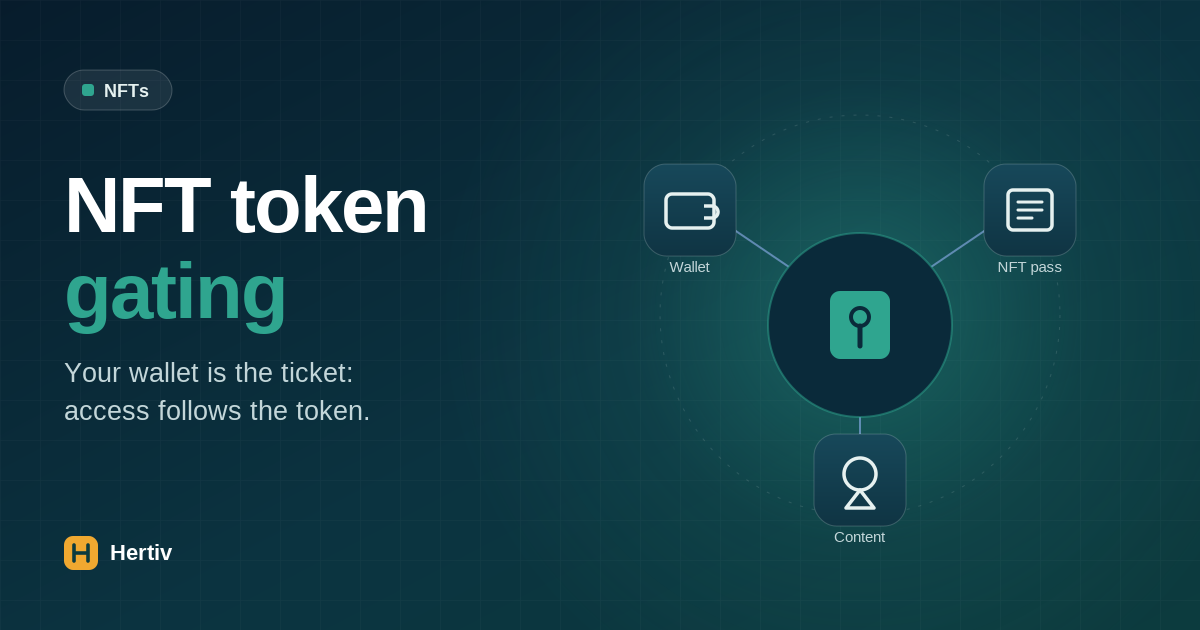
NFT token gating is access control based on token ownership. Instead of a username and password, the app asks the user to connect a wallet and checks whether it holds a token from a named collection. If the token is there, the door opens; if it is not, the user sees a message explaining which token they need.
It works because the token is a public, checkable record. The app reads the chain, so it does not need to store passwords or run its own identity system. The check happens on each visit, so access ends as soon as the token leaves the wallet.
Common uses include members-only content, private chat channels, early access to a product, event entry and discounts. The token is the membership card, and the blockchain is the list of members.
How does token gating work in practice?
Token gating follows the same four steps in almost every app. First, the user connects a wallet. Second, the app reads the wallet address and checks the chain for the required token. Third, if the token is present, the app creates a session that lasts for the visit. Fourth, the app re-checks on later visits, so a sold token stops working.
- The user connects a wallet to the app or site.
- The app checks the chain for the required token in that wallet.
- Access is granted and a short session is created.
- Later visits re-check the wallet, so sold tokens lose access.
The check can run on the server or in the browser, but the server must do the final check for anything that matters. A browser-only check can be bypassed, because the user controls their own browser.
What can you gate with an NFT?
Almost anything digital can sit behind a token check, but the best fits are things where membership itself has value. Content, communities and events work well because the token also signals belonging.
| What is gated | How it works | Good fit when |
|---|---|---|
| Articles and videos | Page checks the wallet before showing content | Content is made for a known audience |
| Chat and community | Joining a channel needs the token | Members want a closed group |
| Events | Entry or ticket claim needs the token | Attendance is limited |
| Products and drops | Purchase page opens only for holders | Demand exceeds supply |
| Software features | Premium tools need the token | Features suit a paying group |
| Discounts | Checkout checks the wallet for a discount | Loyalty should be rewarded |
Physical goods can be gated too, usually by checking the wallet at checkout and shipping to the address the holder gives. The token proves the right to buy; it does not prove who receives the parcel.
Which tokens work for gating?
Most gating uses NFTs from a single collection, because a collection is easy to name in the rule: hold any token from this set. Membership passes, event tickets and art editions all fit this pattern, and the rule is simple to explain to users.
Soulbound tokens, which cannot be transferred, suit cases where access should stay with one person, such as a course certificate or a staff pass. Fungible tokens can gate too, for example holding at least 100 of a token, but the rule is harder to explain and the token price can swing.
For a clear picture of the wider uses, NFT use cases covers how tokens are used beyond access control.
What are the risks and limits?
Token gating has real limits. A token can be borrowed, so a person can hold it for a minute, pass the check and return it. A token can be sold, so a member can leave and a stranger can take their place. And a wallet can be shared, so one token can serve several people.
It also excludes people who do not have a wallet or cannot afford the token, which is fine for a premium club but wrong for a public service. Gating should match the audience: if the goal is wide reach, a token wall works against it.
Price swings are a further risk. If the token price rises sharply, new members are priced out, and if it falls, the gate stops meaning anything. Some projects set the rule by token count rather than price to avoid this.
Example (hypothetical): a music club gates its recordings
Example (hypothetical): a music club sells 500 membership tokens and gates its live recordings behind them. A fan connects a wallet, the site checks for the token, and the recordings play. When a member sells the token, the buyer can listen and the seller cannot.
The arithmetic is simple. The club charges $40 per token and sells 500, which is $20,000. It spends $6,000 on recording and $2,000 on the site, leaving $12,000 for the artists. If 100 tokens change hands in a year, the club earns nothing from those sales unless it set a royalty, which is a detail to decide before launch.
How token ownership works in general is covered in how tokenization works, which explains what a token represents and how it moves.
How do you set up token gating for a small project?
Setting up token gating for a small project takes four steps and no custom identity system. First, choose the token: an existing collection, or a new one minted for members. Second, write the access rule in one sentence, such as "hold any token from this collection".
Third, add the wallet check to the pages that need it, with the final check on the server. Fourth, write the message a visitor sees when they do not hold the token, and tell them where to get one.
Test the setup with three wallets: one that holds the token, one that does not, and one that held it and sold it. The first should pass, the second should see the message, and the third should lose access. If any of those behaves differently, the check has a gap.
Start with one gated page, not the whole site. A single members-only article or event page shows whether people will connect a wallet at all, and it keeps the rest of the site open while you learn.
What are the common mistakes?
Most gating failures come from trusting the browser check alone or from a rule nobody can explain.
- Checking the token only in the browser, where it can be bypassed
- Gating support pages or refund terms behind the token
- Using a token whose price swings, so the gate means different things each week
- Forgetting that borrowed tokens pass the check
- No plan for holders who lose wallet access
- Announcing the gate without telling users which token they need
For the contract side, smart contract development covers the checks and audits a gating contract needs.
Key takeaways
- Token gating checks the wallet, not a password.
- Access follows the token: sell it and access ends.
- Always verify on the server; a browser-only check can be bypassed.
- It fits clubs, content and events, not public services.
- Borrowed tokens pass the check, so it is not proof of identity.
- Write the access rule in one plain sentence for users.
Frequently asked questions
What is the difference between token gating and a paywall?
A paywall charges money for access, usually once or by subscription. Token gating checks whether you hold a specific token, which you may have bought, earned or been given. The token can also be resold, which a subscription cannot.
Can someone share a gated NFT with friends?
Yes, in practice. A wallet can be shared, and a token can be lent for a few minutes to pass a check. Token gating proves the wallet holds a token at the moment of the check, not that the person is the owner.
Do I need a crypto wallet to access gated content?
Yes, for most gated sites. You connect a wallet, and the site checks it for the token. Some sites offer an email login that creates a wallet in the background, but the token check still happens on the chain.
What happens if I sell my gating NFT?
You lose access. The next check finds no token in your wallet and the content closes. The buyer gains access instead, because the token now sits in their wallet.
Is token gating secure?
It is as secure as the check behind it. A server-side check against the chain is sound. A check that runs only in the browser can be bypassed, and a borrowed token passes any check. Use it for membership, not for secrets.
Can token gating work with fungible tokens?
Yes. The rule can be to hold a minimum amount of a token, such as 100 tokens. It is less common because the token price can swing, which changes who can pass the gate from week to week.


