Web3 Infrastructure for Tokenization: The Layers That Matter
Tokenization needs more than a smart contract: chains, nodes, oracles, custody and compliance tools must work together before a token can be trusted.
On this page
Short answer
Web3 infrastructure for tokenization is the set of systems that lets a real asset, such as a fund share or a property, be represented by tokens on a blockchain. It covers the chain itself, the nodes that read and write it, the oracles that bring in outside data, the wallets and custody that hold the tokens, and the compliance tools that check who may buy them.
What is Web3 infrastructure for tokenization?
Web3 infrastructure for tokenization is the stack of systems that turns a real asset into tokens people can buy, hold and sell on a blockchain. The smart contract is only one piece. Without the layers around it, the token cannot be priced, transferred safely or sold to the right people.
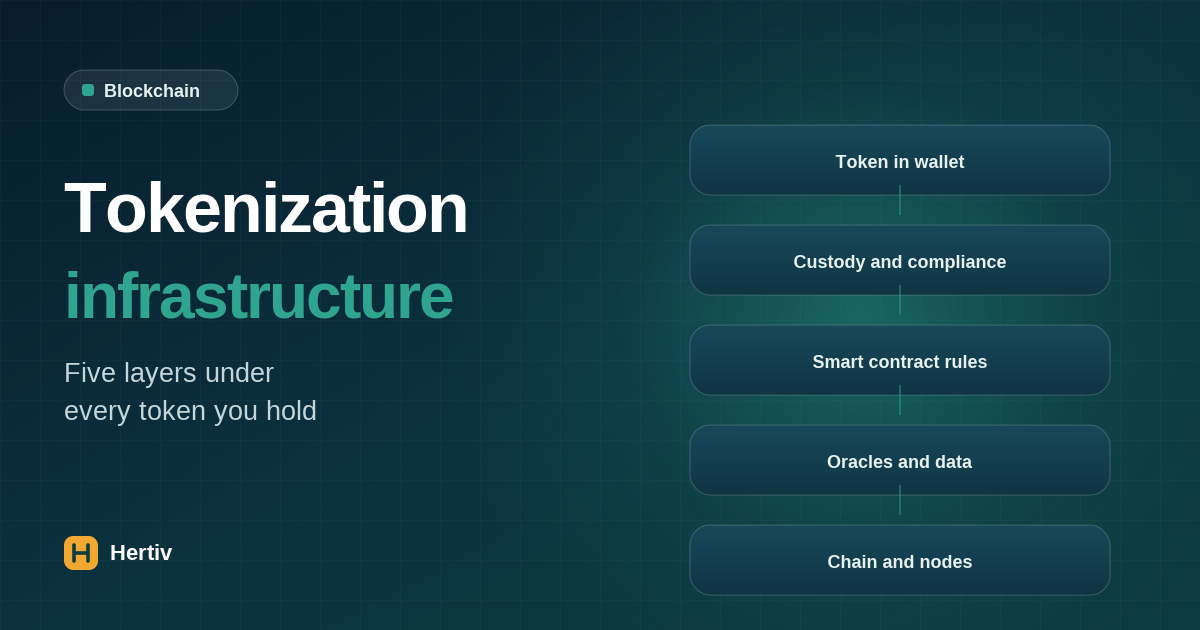
Think of it as a building. The chain is the foundation, the nodes are the doors, the oracles are the windows that let outside facts in, custody is the safe, and compliance is the front desk that checks who may enter. If one layer is weak, the whole building is hard to trust. The background is covered in how tokenization works.
| Layer | What it does | Example parts |
|---|---|---|
| Chain | Records who owns which tokens | Ethereum, Polygon, Solana |
| Nodes and RPC | Let apps read and write the chain | Node providers, indexers |
| Smart contracts | Enforce the token rules | Token contract, transfer limits |
| Oracles | Bring outside facts on chain | Price feeds, asset values |
| Custody and wallets | Hold tokens and keys safely | Custodians, MPC wallets |
| Compliance | Check who may buy and sell | Identity checks, allow lists |
Each layer can be run by the project itself or bought from a provider. Most teams buy the lower layers from providers and keep control of the token rules and the compliance checks, because those are the parts that carry the legal risk.
What does each layer do?
Each layer in the tokenization stack does one job, and the layers pass work to each other in order. The chain keeps the record of ownership. Nodes and RPC services let an app read that record and send new transactions without running its own node. Indexers turn raw chain data into a form an app can search, such as a list of all holders of a token.
Smart contracts hold the token rules: how many tokens exist, who may hold them, and what happens on a transfer. Oracles feed in facts from outside the chain, such as the current value of the asset or a price in normal money. Without an oracle, the contract cannot know what the asset is worth today.
Custody and wallets hold the tokens and the keys that control them. A project may use a custodian for large holdings and let small investors hold tokens in their own wallets.
Compliance tools sit in front of transfers and check that the buyer passed an identity check and is allowed to hold that kind of token. A team building on these layers can look at what a blockchain is to see how the base layer works.
How do tokens move from asset to wallet?
Tokens move from an asset to a wallet in a set order. First the asset is held by a legal entity, such as a company that owns the property or the fund. Then a token contract is written that says how many tokens exist and what each one represents. Then the tokens are issued, usually to the issuer's own wallet or to a custodian.
Next, investors buy tokens. The compliance layer checks each buyer first, then the transfer is recorded on chain and the buyer's wallet shows the new balance. From then on, a token can be sold to another approved buyer, and each sale is a new on-chain transfer that the compliance layer checks again.
The key point is that the token is a claim on the asset, not the asset itself. The legal link between the token and the asset lives in documents and in the issuer's records, not in the code. A buyer should read those documents before buying, because the code alone cannot prove the link.
Where do oracles and data fit in?
Oracles and data fit into tokenization wherever the contract needs a fact from outside the chain. A token that represents a fund needs the fund's current value. A token that pays income needs to know how much income arrived. A token that tracks a commodity needs the market price. The chain cannot see any of these, so an oracle brings them in.
An oracle is a service that reads a fact from a trusted source and writes it on chain in a form the contract can use. The risk is that the oracle becomes the weakest link: if the price feed is wrong or the source is compromised, the contract acts on bad data. That is why serious projects use several sources and check them against each other.
Data also matters for reporting. Investors want to see who holds the token, what it is worth and what income it paid. Indexers collect the on-chain events and turn them into dashboards, so the project can show its investors a clear picture without asking them to read the chain directly. The same need for clean data shows up in real estate tokenization, where buyers want to see the property behind the token.
What about custody and compliance?
Custody and compliance are the layers that decide whether a token is safe to hold and legal to sell. Custody is about the keys: whoever holds the keys controls the tokens. A project may keep tokens with a regulated custodian, use a multi-party wallet that needs several approvals, or let investors hold their own keys. Each choice trades control against risk.
Compliance is about the rules: who may buy, in which countries, and under what limits. Many tokens can only be sold to investors who passed an identity check, and some can only change hands between approved buyers. The smart contract enforces these limits, but the checks themselves run off chain, in the issuer's systems.
These two layers are where most tokenization projects fail or succeed. A project with good custody and clear compliance can be audited and trusted. A project that lets anyone buy without checks, or that keeps all the keys in one place, carries a risk that no smart contract can fix. Buyers should ask who holds the keys and who may buy before they invest.
Example (hypothetical): tokenizing a small property fund
Example (hypothetical): a small property fund owns one building and wants to sell shares as tokens. The fund creates 1,000 tokens, each worth 100 dollars, so the total is 100,000 dollars. Forty investors each buy 25 tokens, which is 1,000 tokens in total, and each investor pays 2,500 dollars.
The fund runs its tokens on a public chain, uses a node provider to read the chain, and uses an oracle to publish the building's rental income each month. The rent for one month is 4,000 dollars, and the fund pays it out to the token holders. Each token earns 4 dollars, so an investor with 25 tokens receives 100 dollars that month.
The fund also runs a compliance check before every sale, so a token can only move to a buyer who passed the identity check. When one investor sells 25 tokens to a new buyer, the check runs first, the transfer is recorded on chain, and the new buyer starts receiving the monthly income. The building, the rent and the rules all stay the same; only the way ownership is recorded has changed.
What are the common mistakes?
The most common mistakes in tokenization infrastructure are trusting one data source, ignoring custody, and treating the token as the asset itself.
- One oracle, no backup. If the only price feed fails or is wrong, the contract acts on bad data, so use more than one source.
- Keys in one place. A single wallet holding all the tokens is a single point of failure; split control across several approvals.
- No compliance check. A token anyone can buy may break the law in the buyer's country, even if the code allows the sale.
- Confusing token and asset. The token is a claim, not the building or the fund, so read the legal documents first.
- Skipping the audit. Smart contracts and oracles should be checked by someone who did not write them.
Key takeaways
- Tokenization needs a stack, not just a smart contract
- Chains record ownership, nodes and indexers make it readable, oracles bring in outside facts
- Custody holds the keys and compliance decides who may buy
- The token is a claim on the asset, not the asset itself
- Check the keys, the buyers and the price source before trusting a token
Frequently asked questions
Is tokenization just a smart contract?
No. The smart contract holds the token rules, but the chain, the nodes, the oracles, the custody and the compliance checks around it decide whether the token can be priced, transferred and sold safely. A contract on its own cannot tell you what the asset is worth or who is allowed to buy it.
Which chain should a tokenization project use?
It depends on cost, speed, security and where the buyers already are. A project should pick a chain with reliable node providers, a clear fee model and enough users to support trading. The chain choice matters less than the custody and compliance layers, which carry most of the risk.
What is an oracle in tokenization?
An oracle is a service that brings a fact from outside the blockchain into a smart contract, such as a price, an asset value or an income figure. The contract cannot see the outside world on its own, so it relies on the oracle. Serious projects use several sources so one bad feed cannot break the system.
Can anyone buy a tokenized asset?
Often not. Many tokens can only be sold to buyers who passed an identity check, and some are limited to certain countries or investor types. The smart contract enforces these limits, but the checks run in the issuer's systems. Buyers should check the rules before they try to buy.
What happens if the custodian fails?
It depends on how the custody is set up. With a regulated custodian, the tokens are held in segregated accounts and can be moved to another custodian. With a single wallet, the tokens may be lost. That is why buyers should ask who holds the keys and what happens if that holder fails.
How much does tokenization infrastructure cost?
Costs vary widely, so a project should get quotes from its providers. The main costs are chain fees, node and indexer services, oracle feeds, custody and legal work for the compliance checks. Teams should compare providers on their own pricing pages, since fees change often.


