Vaultless vs Vault Tokenization: How They Differ
Vault tokenization stores card data in a secure vault; vaultless tokenization replaces it with a mathematical token. Here is how each works and when to use it.
On this page
Short answer
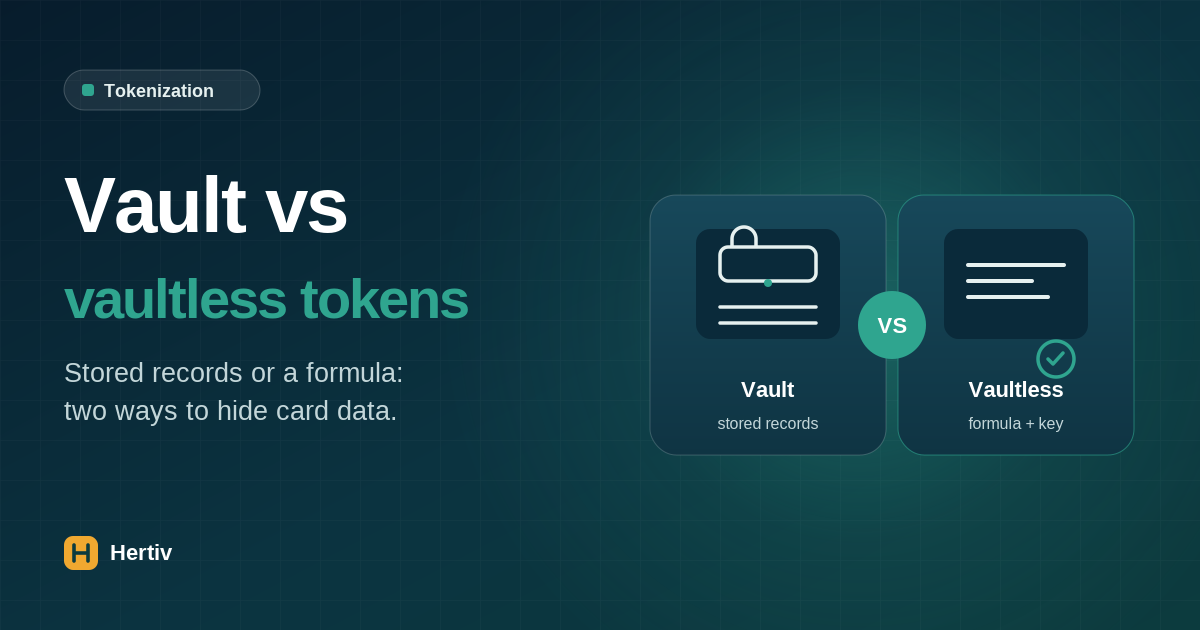
Vault tokenization replaces sensitive data, such as a card number, with a random token and stores the original in a secure vault, while vaultless tokenization generates the token from the data itself using a mathematical formula, so no vault is needed. Both keep the real value out of everyday systems, but they differ in storage, lookup and compliance.
What is tokenization, and what is a vault?
Tokenization is a way to protect sensitive data, such as a card number, by replacing it with a token: a value that looks similar but cannot be used on its own to spend the money. Systems that need to work with the card, such as a shop's checkout or a subscription billing system, store and use the token instead of the real number.
In vault tokenization, the real number is stored in a secure database called a vault, and the token is a random value linked to it. In vaultless tokenization there is no vault: the token is generated from the real number by a mathematical formula, and the real number can be recovered from the token only with a secret key.
Both approaches keep the real card number out of everyday systems, which reduces the damage if those systems are breached. The difference is where the link between token and real number lives: in a stored record, or in a calculation.
How does vault tokenization work?
Vault tokenization works by storing the sensitive value once, in a hardened database, and handing out a random token in its place. When a customer pays, the checkout sends the card number to the tokenization service, which stores it in the vault and returns a token. The shop stores only the token.
When the shop needs to charge the card again, for a subscription or a refund, it sends the token to the service, which looks it up in the vault and uses the real number. The token itself is meaningless without the vault, so a stolen database of tokens is of little use to an attacker.
The vault must be protected carefully: it holds every real value, so it becomes the most sensitive system in the company. It needs strong access controls, encryption, monitoring and regular audits, and it must be backed up and recoverable without exposing the data.
How does vaultless tokenization work?
Vaultless tokenization works by running the sensitive value through a format-preserving encryption formula with a secret key, producing a token that has the same shape as the original, for example a 16-digit number for a card. The real value is never stored anywhere.
To use the token, the system runs it through the reverse formula with the same key and recovers the real number. Because the token is produced by a calculation, the same input always produces the same token with the same key, which is useful when different systems need to match records for the same card.
The secret key is the critical asset: anyone with the key and the formula can recover every real value. Key management, rotation and hardware protection matter more here than in a vault design, because there is no stored record to fall back on if the key is lost.
How do vault and vaultless tokenization compare?
The two approaches solve the same problem in different ways, and the choice depends on how the tokens will be used, how the system scales and what the compliance rules require.
| Aspect | Vault tokenization | Vaultless tokenization |
|---|---|---|
| Where the link lives | Stored record in a vault | Calculated from the value and a key |
| Same card, same token? | Usually one token per card | Yes, deterministic with the same key |
| Storage needed | One vault record per token | None, apart from the key |
| Main risk | Vault breach or loss | Key theft or loss |
| Scaling | Vault grows with every token | No storage growth |
| Lookup speed | Database lookup | Calculation, usually fast |
Vault designs are simpler to reason about: the token is random, so it reveals nothing, and the vault is a single system to protect. Vaultless designs scale better and make matching records easier, but they depend entirely on the key, so key management must be strong from the start. For asset work, real-world asset tokenization uses similar ideas to represent value on a ledger.
When should you choose each?
Choose vault tokenization when the tokens do not need to match across systems, when the volume is modest, or when the compliance rules expect a stored record that can be audited and deleted. It is the safer default for most payment and subscription systems.
Choose vaultless tokenization when the same card must produce the same token across several systems, when the volume is large enough that a growing vault becomes a burden, or when the system must work without a central database. It suits large platforms that tokenise millions of values and need to match them reliably.
Either way, the decision should be made with the compliance team, because the rules for storing, deleting and auditing card data differ by region and by scheme. Regulation such as MiCA shapes how tokenized assets are handled in Europe, and payment rules add their own requirements on top.
Example (hypothetical): a retailer tokenising 50,000 cards
Example (hypothetical): a retailer holds 50,000 customer cards for subscriptions and refunds, and wants to remove the real numbers from its own systems. It compares the two designs before choosing.
With a vault, it stores 50,000 records, one per card, and each lookup is a database call. Migrating the cards takes 250 hours at 200 cards an hour, because each card must be sent to the vault and the token returned. With a vaultless design it stores no records at all, and tokenising the same 50,000 cards by calculation also takes 250 hours at the same rate.
The difference is not the migration time but what comes after: the vault needs backups, access controls and audits for 50,000 records, while the vaultless design needs strong key management and a plan for rotating the key. The retailer chooses the vault, because its volume is modest and its compliance team wants a stored record it can delete per customer.
What are the common mistakes?
The most common tokenization mistakes are treating the token as safe on its own, underestimating key or vault protection, and forgetting that tokens still need access controls.
- Treating tokens as harmless. A token is safer than a card number, but it can still be used for fraud if the system that accepts it does not check it properly.
- Weak key management. In a vaultless design, a stolen key exposes every value, so keys need hardware protection and rotation.
- Neglecting the vault. In a vault design, the vault is the most sensitive system; it needs the strongest controls in the company.
- Forgetting deletion. When a customer asks for their data to be deleted, the vault record or the ability to recover the value must be removed too.
- Mixing token types. Using vault tokens in one system and vaultless tokens in another for the same cards creates mismatches that are hard to untangle.
Key takeaways
- Tokenization replaces sensitive data with a token that cannot be used on its own
- Vault tokenization stores the real value in a vault and links it to a random token
- Vaultless tokenization generates the token by calculation, so no vault is needed
- Vault designs are simpler to audit; vaultless designs scale better and match records
- The choice depends on volume, matching needs and compliance rules
Frequently asked questions
What is the difference between tokenization and encryption?
Encryption scrambles data so it can be unscrambled with a key, while tokenization replaces the data with a different value that has no mathematical link to the original in a vault design. In a vaultless design the token is produced by encryption, but it stands in for the real value, so the real value never appears in everyday systems.
Can a token be used to spend money?
Not on its own, if the system is designed well. A token is only useful inside the system that issued it, and that system should check that the token is being used for the right purpose, by the right customer, before it acts. A token used without those checks is a sign the design is weak.
What happens if the vault is breached?
The real values stored in the vault could be exposed, which is why the vault must be the most strongly protected system in the company, with encryption, strict access controls, monitoring and regular audits. This is the main risk of a vault design, and it is also why some teams prefer a vaultless design with no stored values.
What happens if a vaultless key is lost?
The tokens can no longer be reversed to the real values, so subscriptions and refunds tied to those tokens stop working. That is why key management, backups and rotation plans matter so much in a vaultless design. Keys should be stored in hardware and never in the same place as the code that uses them.
Do tokenized systems still need compliance checks?
Yes. Tokenization reduces the scope of what must be protected, but it does not remove compliance duties. Teams must still show how data is stored, who can access it, how it is deleted and how incidents are handled, and the basics of how tokenization works are what regulators expect to see.
Which is better for a small business?
Vault tokenization is usually the safer default for a small business, because it is simpler to reason about and the volume is modest, so the vault stays small. A payment provider or tokenization service usually runs the vault, so the business never holds the real values at all.


