TRON Token Standards: TRC-10, TRC-20, TRC-721 and TRC-1155
TRON has four token standards: TRC-10, TRC-20, TRC-721 and TRC-1155. Learn what each one does, when to use it, and how to pick the right one for your token.
On this page
Short answer
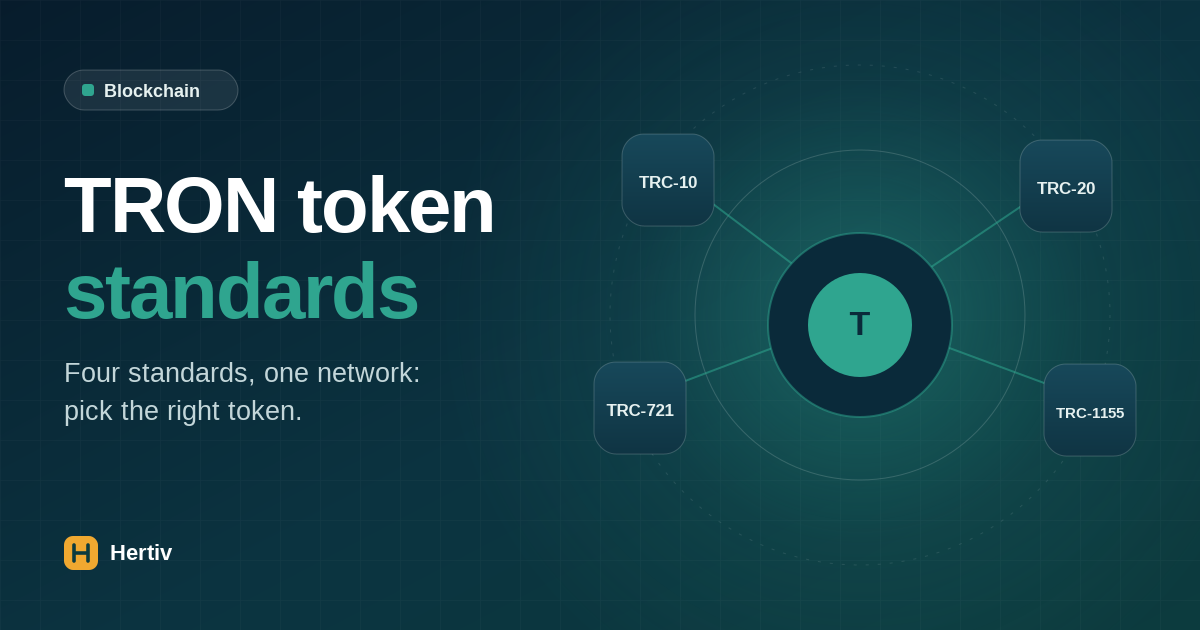
TRON token creation standards are the rules that define how a token is issued and used on the TRON network. TRC-10 is a simple native token, TRC-20 is the smart-contract standard for fungible tokens, TRC-721 covers unique NFTs, and TRC-1155 manages many token types in one contract. The right choice depends on whether the token is fungible, unique, or a mix of both.
What are TRON token creation standards?
TRON token creation standards are the shared rules that define how a token is issued, transferred and read on the TRON network. A standard is a contract interface: a fixed set of functions that wallets, exchanges and apps can rely on, so a token built by one team works with tools built by another.
TRON has four standards. TRC-10 is a native token built into the protocol itself, while TRC-20, TRC-721 and TRC-1155 are smart contracts that run on the TRON Virtual Machine. The table below shows how they compare.
| Standard | Token type | Smart contract? | Best for |
|---|---|---|---|
| TRC-10 | Fungible, native | No | Simple existing tokens |
| TRC-20 | Fungible | Yes | Stablecoins, DeFi, utility tokens |
| TRC-721 | Non-fungible | Yes | NFTs, collectibles |
| TRC-1155 | Mixed, multi-token | Yes | Games, batch assets |
The choice matters because it decides what the token can do and what it costs to run. A TRC-10 token cannot carry custom logic, while a TRC-20 token can, but it needs Energy to run. For the wider picture of building on the network, see how to develop a dApp on the TRON network.
What is TRC-10?
TRC-10 is TRON's native token standard. A TRC-10 token is issued directly by the TRON protocol, without deploying a smart contract, so creating one needs no Solidity code and no contract audit. Each account can issue only one TRC-10 token, and the network charges an issuance fee, currently 1,024 TRX.
Because there is no contract, a TRC-10 token can do very little on its own: it can be sent, received and held, but it cannot run custom rules, such as a vesting schedule or a fee on transfer. Transfers cost Bandwidth only, with no Energy, which keeps them cheap.
TRC-10 made sense when TRON was young and teams wanted a simple token fast. Today the TRON documentation recommends TRC-20 for new fungible token projects, and TRC-10 is kept for compatibility with tokens that already exist. If you hold an old TRC-10 token, it still works; if you are starting now, TRC-10 is rarely the right pick.
What is TRC-20?
TRC-20 is the fungible token standard on TRON. It is a smart contract that runs on the TRON Virtual Machine and matches Ethereum's ERC-20 at the interface level, so most ERC-20 contracts compile and run on TRON without changes. A TRC-20 token can carry custom logic: minting rules, transfer fees, freezing and burning.
TRC-20 is the standard behind most tokens people actually use on TRON, including the TRON versions of major stablecoins such as USDT, and most DeFi tokens. It works with decentralised exchanges, lending protocols and wallets, which is why new fungible token projects are told to use it. For the basics of the network itself, see what the TRON ecosystem is.
The trade-off is cost and complexity. Deploying a TRC-20 contract needs Energy, and a standard deployment takes roughly 200,000 to 400,000 Energy. The contract also needs an audit before it holds real value, because a bug in a token contract cannot be patched by editing it afterwards.
What is TRC-721?
TRC-721 is the non-fungible token standard on TRON. Each TRC-721 token has a unique ID and a single owner, so it can represent one artwork, one ticket, one game character or one certificate. It matches Ethereum's ERC-721 at the interface level, and TRON announced it in December 2020 as the network's first NFT standard.
Because every token is unique, TRC-721 fits anything where identity matters more than quantity. A marketplace, a wallet and an explorer can all read a TRC-721 contract the same way, because the standard fixes the functions for ownership, transfers and approvals. That shared rulebook is what makes an NFT tradable across apps.
There is one TRON-specific detail worth knowing when moving a contract from Ethereum: the receiver-hook return value differs from Ethereum's, which can cause hard-to-debug failures if it is copied unchanged. Test transfers to contracts, not only to wallets, before launch.
What is TRC-1155?
TRC-1155 is TRON's multi-token standard. A single TRC-1155 contract can manage many token types at once: fungible tokens, non-fungible tokens and semi-fungible tokens, such as game items that exist in limited numbers but are identical to each other. It matches Ethereum's ERC-1155.
The advantage is batching. A single call can transfer many token IDs at once, paying Bandwidth and Energy once instead of once per token. For a game with hundreds of item types, or a collection with many editions, that is far cheaper than one contract per token type, or one transfer per item.
TRC-1155 is the right pick when a project has a mix of token types that live together: a game's currency, its unique characters and its stackable items, for example. For a single classic NFT collection with unique ownership, TRC-721 is usually simpler, and it works with more existing NFT tooling.
Example (hypothetical): picking a standard for a game
Example (hypothetical): a small game studio plans a game with three kinds of assets: 500 unique hero characters, 20,000 identical energy potions, and 50 limited-edition swords that exist in runs of 100 each. The team needs one system that handles all three.
With TRC-721 alone, the studio would mint 500 unique heroes, which fits, but the 20,000 identical potions would each need their own token, and the swords would need 50 more contracts or awkward workarounds. With TRC-20 alone, nothing can be unique. With TRC-1155, one contract holds the heroes, the potions and the swords as different token IDs.
The batching matters too. Handing out 50 potions to a player takes 50 separate transfers with TRC-721, but one batch transfer with TRC-1155, saving 49 transactions. The studio picks TRC-1155 for the game items, and keeps TRC-20 for the game's currency, which needs to work with exchanges. For a related view of token use in apps, see real-world use cases of TRON smart contracts.
What are the common mistakes?
The most common mistakes with TRON token standards are picking a standard for the wrong asset type, skipping the audit, and assuming a token that works on Ethereum will work unchanged on TRON.
- Choosing TRC-10 for a new token that needs custom logic. A native token cannot run rules such as vesting or transfer fees.
- Using TRC-20 for unique items. Fungible tokens cannot give one item its own owner and history.
- Copying an ERC-721 contract without fixing the receiver hook. The TRON return value differs, and transfers to contracts can fail.
- Deploying without an audit. A bug in a token contract cannot be patched by editing it afterwards.
- Forgetting that contract calls cost Energy. Budget Energy for deployment and for launch day, or the launch stalls.
- Issuing a token before deciding what it is for. A token with no use and no users is a cost, not an asset.
Key takeaways
- TRON has four token standards: TRC-10 for simple native tokens, TRC-20 for fungible tokens, TRC-721 for NFTs, and TRC-1155 for mixed token types
- TRC-20 is the recommended standard for new fungible tokens, including stablecoins and DeFi tokens
- TRC-721 gives each NFT a unique ID and owner; TRC-1155 manages many token types in one contract with batch transfers
- TRC-10 needs no contract and costs only Bandwidth, but it cannot run custom logic
- Check the TRON receiver hook when porting an ERC-721 contract, and audit any contract before it holds value
Frequently asked questions
What is the difference between TRC-10 and TRC-20?
TRC-10 is a native token issued by the TRON protocol without a smart contract, so it cannot run custom logic. TRC-20 is a smart contract token that can carry rules such as minting, fees and freezing, and it matches Ethereum's ERC-20 at the interface level.
Which TRON standard should a new stablecoin use?
TRC-20. It is the standard the TRON documentation recommends for new fungible tokens, it works with exchanges, wallets and DeFi protocols, and the major stablecoins on TRON already use it.
Can a TRC-20 token be converted to TRC-10?
No, not directly. They are different standards with different mechanics, so moving value between them means issuing a new token and swapping the old one, usually through an exchange or a migration contract.
Do TRON tokens work in Ethereum wallets?
TRC-20 and TRC-721 match their Ethereum equivalents at the interface level, so the contract code is largely portable. But the tokens live on different networks, so a TRON token cannot be sent to an Ethereum address without a bridge.
What does TRC-1155 do that TRC-721 cannot?
TRC-1155 manages many token types in one contract, including fungible, non-fungible and semi-fungible tokens, and it supports batch transfers. TRC-721 handles one unique token per contract entry, so moving many items takes many transactions.
How much does it cost to create a TRON token?
A TRC-10 token costs the network issuance fee, currently 1,024 TRX, with no contract to deploy. A TRC-20 deployment takes roughly 200,000 to 400,000 Energy, plus the cost of an audit, which is the larger expense for a serious project.


