Tokenized Bond Projects Worth Knowing, and What Each Does
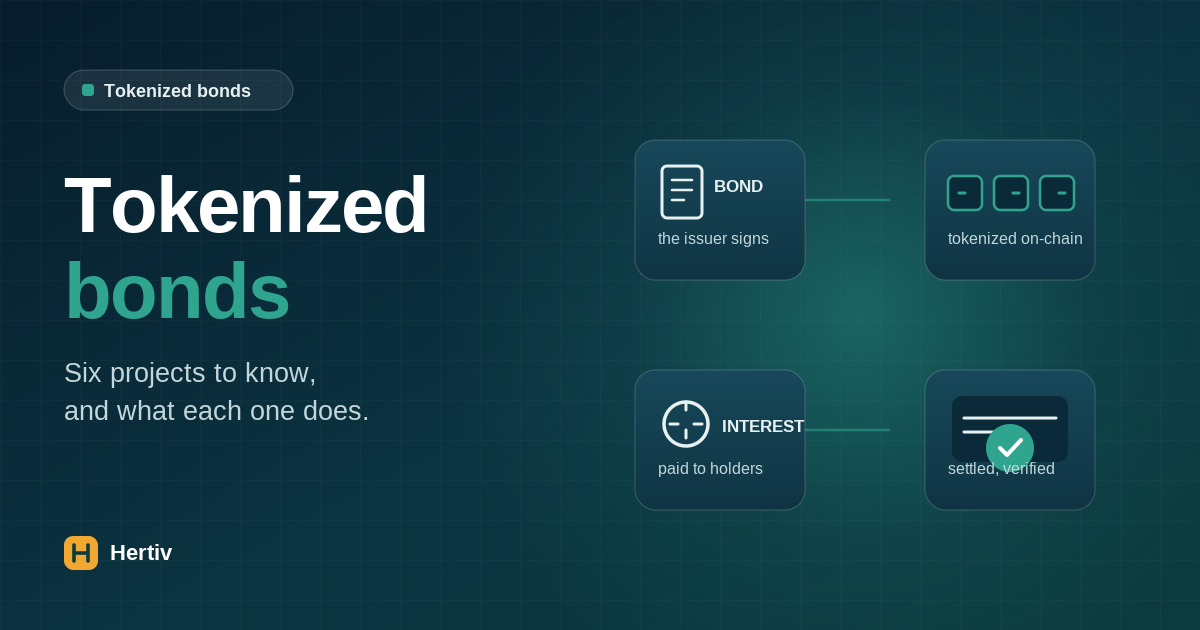
Tokenized bonds put a bond on a blockchain so it can be issued, traded and settled faster. These six projects show how it works in practice.
On this page
Short answer
Tokenized bond projects issue bonds as tokens on a blockchain, so ownership, interest payments and settlement are recorded on a shared ledger instead of across separate systems. The best-known examples come from public banks, corporates, governments and asset managers testing bonds, green bonds and tokenized treasury funds.
Which tokenized bond projects matter most?
Six projects cover most of what tokenized bonds look like today: public banks and corporates issuing digital bonds, governments issuing tokenized green bonds, and asset managers running tokenized funds that hold government debt. Each one tests a different piece of the idea.
| Project | Issuer type | What is tokenized | What it tests |
|---|---|---|---|
| European Investment Bank digital bond | Public bank | Bond | On-chain issuance and settlement |
| Siemens digital bond | Corporate | Bond | Corporate bond under existing law |
| Hong Kong tokenized green bond | Government | Green bond | Green finance on a blockchain |
| Franklin OnChain U.S. Government Money Fund | Asset manager | Fund shares | Fund ownership as tokens |
| BlackRock BUIDL | Asset manager | Fund shares | Treasury fund on-chain |
| Ondo OUSG | Asset manager | Fund shares | Short-term treasury exposure |
None of these projects replaces the traditional bond market. They are working examples that show which parts of a bond's life — issuance, trading, interest, settlement — a blockchain can handle, and which parts still need banks, lawyers and regulators. The background is covered in our guide to how tokenization works.
1. European Investment Bank digital bond: best for seeing on-chain settlement
1. European Investment Bank digital bond: best for seeing on-chain settlement
The European Investment Bank, the lending arm of the European Union, issued a digital bond recorded on a blockchain, with settlement handled on-chain as well. It was one of the first times a major public institution ran a full bond issue this way rather than as a small test of one step.
The point of the project was to show that the core bond workflow — issuing, holding and settling — can run on shared ledger infrastructure with fewer intermediaries. It also showed regulators and market participants what a digital bond looks like in practice, which matters more than any white paper.
Pros:
- Full bond life cycle tested on-chain, not just issuance
- Backed by a major public institution, so the market paid attention
- Showed regulators a working model to assess
Cons:
- A one-off issue, not a regular programme
- Still relied on traditional market participants for parts of the process
- Secondary trading remained limited
2. Siemens digital bond: best for a corporate issuer under existing law
2. Siemens digital bond: best for a corporate issuer under existing law
Siemens, the German industrial group, issued a digital bond under German law and settled it on a public blockchain. The project mattered because it was a corporate issuer, not a bank or a government, using the legal framework that already existed for electronic securities.
For companies watching from the sidelines, the Siemens bond answered a practical question: can a normal company issue a bond this way without waiting for new laws? The answer was yes, at least for a straightforward issue, and the settlement completed in days rather than the longer cycle of a traditional issue.
Pros:
- Proved a corporate issuer can use existing electronic securities law
- Settled on a public blockchain
- Shorter settlement than a traditional bond issue
Cons:
- A single issue, not a repeatable funding channel yet
- Investor base was small and mostly institutional
- Legal treatment varies by country
3. Hong Kong tokenized green bond: best for green finance on-chain
3. Hong Kong tokenized green bond: best for green finance on-chain
The Hong Kong government issued a tokenized green bond, using blockchain to record the bond and track the issue. The proceeds fund green projects, and the tokenized format was chosen to show that sustainable finance and digital issuance can work together.
The project is useful for two reasons. First, it links tokenization to a real policy goal — funding green infrastructure — rather than treating it as a technical demo. Second, it tested the format at government scale, with the processes and reporting a sovereign issuer needs.
Pros:
- Links tokenization to green finance, a real funding need
- Government-scale issue with proper reporting
- Tested the format for sovereign issuers
Cons:
- Green reporting still depends on off-chain verification
- Secondary market activity was limited
- Replicating it needs similar government backing
4. Franklin OnChain U.S. Government Money Fund: best for tokenized fund shares
4. Franklin OnChain U.S. Government Money Fund: best for tokenized fund shares
Franklin Templeton runs a US government money market fund whose shares are issued as tokens on a blockchain. Investors hold fund shares in token form, while the fund itself holds US government securities. The token records ownership; the fund does the investing.
This project matters because it separates two ideas that are often mixed up: tokenizing the bond itself, and tokenizing the fund that holds the bond. Here the token is a share in the fund, which is a simpler legal shape, and it lets investors hold and transfer shares on-chain without changing what the fund invests in.
Pros:
- Simple legal shape: tokens represent fund shares, not the bond
- Run by an established asset manager
- Investors can hold shares on-chain
Cons:
- Not a bond itself — it is a fund holding government securities
- Transfers depend on the fund's rules and whitelists
- Returns follow the underlying securities, not the token
5. BlackRock BUIDL: best for a large manager testing tokenized treasuries
5. BlackRock BUIDL: best for a large manager testing tokenized treasuries
BUIDL is BlackRock's tokenized fund that invests in US Treasury bills, cash and repurchase agreements, with its shares issued as tokens on a blockchain. It is one of the largest tokenized funds run by a traditional asset manager, and it is aimed at institutional investors.
The fund's size and backing made it a signal to the rest of the market: when the world's largest asset manager runs a tokenized treasury fund, other managers and investors take the format seriously. The design is conservative — short-term government debt, not exotic assets — which is part of why institutions were willing to use it.
Pros:
- Backed by the world's largest asset manager
- Holds short-term US government debt, a conservative base
- Showed institutions will use tokenized fund shares
Cons:
- Aimed at institutions, not retail investors
- Still a fund, not a directly tokenized bond
- Use depends on the manager's platform and rules
6. Ondo OUSG: best for short-term treasury exposure on-chain
6. Ondo OUSG: best for short-term treasury exposure on-chain
Ondo's OUSG is a tokenized fund that gives holders exposure to short-term US Treasuries. The fund holds the underlying securities and issues tokens that represent shares in it, so investors can hold treasury exposure in a token that moves on a blockchain.
OUSG is useful to watch because it comes from a crypto-native firm rather than a traditional manager, and it focuses on one narrow job: making short-term treasury yields available on-chain. It shows that tokenized government debt is being built from both directions — traditional managers moving on-chain, and blockchain firms building regulated fund structures. The wider pattern is covered in our guide to real-world asset tokenization use cases.
Pros:
- Focused on one job: short-term treasury exposure
- Built by a crypto-native team with on-chain distribution
- Shows the format works from both traditional and crypto-native sides
Cons:
- Smaller and newer than the large manager funds
- Access rules limit who can hold the tokens
- Yield follows short-term rates, so it moves with the market
How to choose
Choose which project to study by matching it to the question you are trying to answer, not by size or fame. A small corporate bond can teach you more about issuance than a large fund can.
- Define the question. Are you studying issuance, settlement, green finance or fund shares? Each project answers a different one.
- Check what is actually tokenized. A tokenized bond and a tokenized fund share are different legal shapes with different rules.
- Look at the issuer. Public banks, corporates, governments and asset managers face different rules and investor bases.
- Check the legal basis. Some projects used existing securities law; others needed new frameworks. The rules decide whether the model travels.
- Watch the secondary market. Issuance is the easy part; a tokenized bond only becomes useful when it can be traded and settled after issue. The rules that shape that market are covered in our guide to what the MiCA regulation is.
If you are building rather than studying, the fund route is usually the simpler starting point: tokenizing fund shares has a clearer legal shape than tokenizing a bond directly, as our guide to how to tokenize a fund explains.
Common mistakes
The most common mistakes are confusing a tokenized fund with a tokenized bond, assuming on-chain settlement means instant trading, and ignoring the legal framework.
- Mixing up bonds and funds. A token that represents a share in a fund holding bonds is not the same as a token that is the bond.
- Assuming issuance means liquidity. A bond can be issued on-chain and still have almost no secondary trading.
- Ignoring the law. The legal basis decides who can hold the token and where it can trade.
- Treating one issue as a market. A single successful bond does not prove the format works at scale.
- Forgetting the off-chain parts. Interest payments, reporting and green verification still rely on systems outside the chain.
Key takeaways
- Tokenized bonds record issuance, ownership and settlement on a shared ledger
- Public banks and corporates test direct bond issuance; asset managers test tokenized fund shares
- A tokenized fund share is not the same as a tokenized bond — check what the token represents
- Issuance is proven; secondary trading and liquidity are still the open questions
- The legal basis decides who can hold the token and whether the model works in another country
Frequently asked questions
What is a tokenized bond?
A tokenized bond is a bond issued as a token on a blockchain, so ownership and transfers are recorded on a shared ledger. Interest payments and settlement can also run through the ledger, but the bond still follows securities law and still needs an issuer, investors and a legal framework.
Are tokenized bonds the same as stablecoins?
No. A stablecoin is designed to hold a steady value against a currency or asset, while a tokenized bond is a debt instrument that pays interest and matures. Stablecoins can be used to settle a bond trade, but they are a different product with different rules.
Can anyone buy a tokenized bond?
Usually not. Most tokenized bond issues so far are aimed at institutional investors, with rules on who can hold the tokens. Retail access depends on the legal framework in each country and on the issuer's offering terms.
Do tokenized bonds pay interest?
Yes, when the underlying bond pays interest. The interest can be distributed to token holders, sometimes through the same on-chain system that records ownership. The rate and schedule come from the bond's terms, not from the token.
Why tokenize a bond instead of issuing it normally?
The main reasons are faster settlement, fewer intermediaries and a single shared record of ownership. Whether those benefits outweigh the cost depends on the issue size, the investor base and the legal framework — which is why most projects so far are tests, not replacements.
What is the difference between a tokenized bond and a tokenized fund?
A tokenized bond is the bond itself issued as a token. A tokenized fund issues tokens that represent shares in a fund, and the fund holds the bonds. The fund shape is simpler legally, which is why several large managers chose it first.


