Top ISO 20022 Cryptocurrencies Worth Knowing
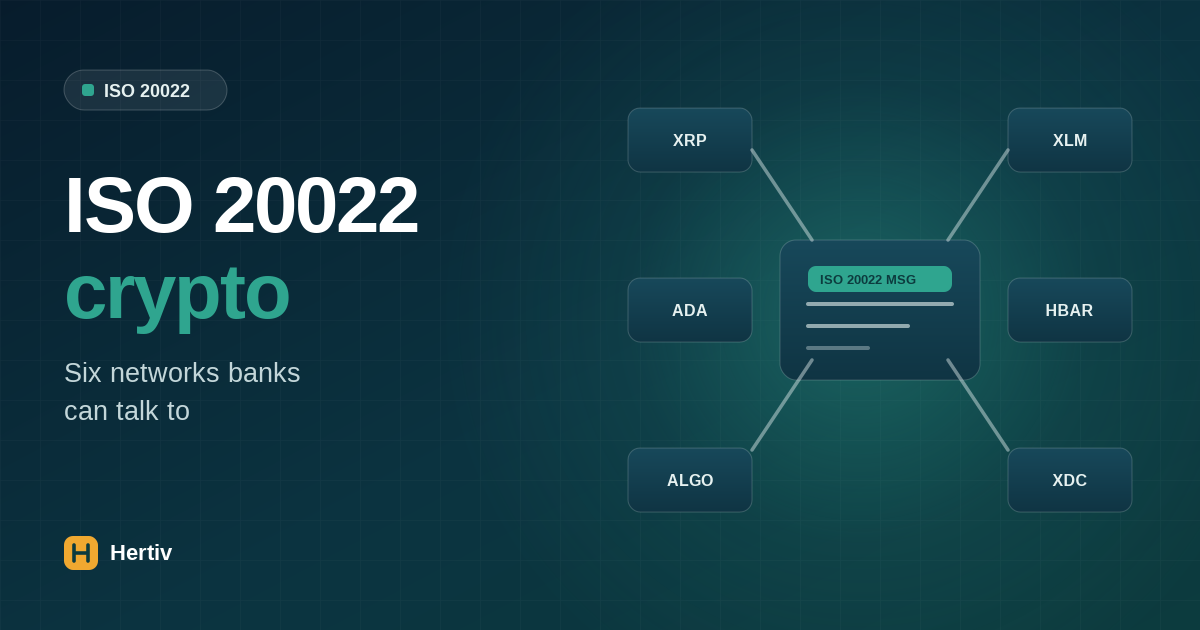
ISO 20022 is the messaging standard banks use for payments. These six cryptocurrencies are the ones most often described as compatible with it.
On this page
Short answer
The cryptocurrencies most often described as ISO 20022 compatible are XRP, Stellar, Cardano, Hedera, Algorand and XDC Network. ISO 20022 is a messaging standard for bank payments, not a crypto certification, so compatibility means a network can work with ISO 20022 payment messages rather than holding an official badge.
Which ISO 20022 cryptocurrencies are worth knowing?
The cryptocurrencies worth knowing in the ISO 20022 conversation are the ones whose networks are regularly described as compatible with the standard and that are actually used for payments or settlement. Compatibility here means the network can send and receive payment messages in the ISO 20022 format that banks use.
ISO 20022 itself is a messaging standard, not a crypto certification. No coin holds an official ISO 20022 badge. A network is called compatible when its design, or the tools built around it, can produce and read ISO 20022 messages, which matters for banks and payment firms that already run on the standard.
| Cryptocurrency | Network focus | Why it is linked to ISO 20022 | Best for |
|---|---|---|---|
| XRP | Cross-border payments | Built for bank settlement messages | Fast international transfers |
| Stellar (XLM) | Payments and remittances | Anchors connect to bank rails | Low-cost remittances |
| Cardano (ADA) | Smart contracts | Research-led design, bank pilots | Regulated applications |
| Hedera (HBAR) | Enterprise settlement | Governing council of large firms | Enterprise tokenisation |
| Algorand (ALGO) | Fast settlement | Instant finality, low fees | Payments and asset issuance |
| XDC Network (XDC) | Trade finance | Built for trade documents | Trade and supply-chain finance |
Use the table to shortlist, then check the current state of each network yourself: the standard is moving, and compatibility claims change as networks and banks update their systems. For the rules that surround these networks in Europe, see what MiCA regulation covers.
1. XRP: best for cross-border bank payments
1. XRP: best for cross-border bank payments
XRP is the coin most often named in the ISO 20022 conversation, because its ledger was designed for fast settlement between financial institutions and its payment tools work with bank messaging formats.
Transfers settle in seconds rather than days, and the ledger is built for payment firms that need to move value between currencies. That is why it appears in most lists of ISO 20022 compatible coins, even though the compatibility is a design claim rather than a certificate.
Pros:
- Fast settlement between institutions
- Designed around payment messaging
- Deep liquidity in major currency pairs
Cons:
- Regulatory history varies by country
- Centralisation questions are regularly raised
- Use depends on payment firms adopting it
2. Stellar (XLM): best for low-cost remittances
2. Stellar (XLM): best for low-cost remittances
Stellar is a payments network built for remittances and small transfers, and it connects to banks through anchors, which are regulated firms that hold deposits and issue tokens on the network.
The anchor model is what links Stellar to ISO 20022: an anchor can take a bank payment in one currency and issue a token on Stellar, so the value moves between the bank world and the crypto world. Fees per transaction are low, which suits small remittances.
Pros:
- Low fees suit small transfers
- Anchors bridge to regulated banks
- Built-in exchange between assets
Cons:
- Anchor coverage varies by corridor
- Less suited to complex smart contracts
- Remittance volumes depend on local partners
3. Cardano (ADA): best for regulated applications
3. Cardano (ADA): best for regulated applications
Cardano is a smart-contract platform built through peer-reviewed research, and it is often mentioned in ISO 20022 discussions because its design emphasises formal methods and compliance-friendly features such as identity and metadata.
Its link to the standard is looser than XRP's: Cardano is a general platform rather than a payments network, and its ISO 20022 relevance comes from pilots and integrations rather than a built-in payments role.
Pros:
- Strong research and formal verification culture
- Supports identity and metadata features
- Large developer community
Cons:
- Payments are not its main design goal
- Slower to ship new features
- Compatibility depends on third-party tools
4. Hedera (HBAR): best for enterprise settlement
4. Hedera (HBAR): best for enterprise settlement
Hedera is an enterprise network governed by a council of large companies, and it is used for tokenisation, settlement and record-keeping where firms want fast finality and predictable fees.
Its governance model is what attracts banks and enterprises: the council structure gives large firms a say in how the network runs, which fits the way regulated institutions prefer to work with new infrastructure.
Pros:
- Fast finality and fixed low fees
- Governance council includes large firms
- Suited to tokenisation and settlement
Cons:
- Governance model is more centralised
- Smaller developer base than the largest chains
- Enterprise adoption is still growing
5. Algorand (ALGO): best for payments and asset issuance
5. Algorand (ALGO): best for payments and asset issuance
Algorand is a network built for fast settlement with instant finality, which means a payment is confirmed and cannot be reversed within seconds. That property matters for banks and payment firms that need to know a transfer is final.
It is also used for issuing tokenised assets, from stablecoins to securities, and its low fees make it practical for high volumes of small payments.
Pros:
- Instant finality for payments
- Low and predictable fees
- Built-in asset issuance tools
Cons:
- Smaller ecosystem than the largest chains
- Less name recognition with banks
- Adoption depends on partner integrations
6. XDC Network (XDC): best for trade finance
6. XDC Network (XDC): best for trade finance
XDC Network is built for trade finance, the business of financing goods as they move between countries, and it is designed to work with the documents and messages that trade banks already use.
Its ISO 20022 link is direct: trade finance runs on standardised messages, and XDC is positioned as a network that can carry those messages on-chain. That makes it the most niche coin on this list, but also the most focused.
Pros:
- Built specifically for trade finance
- Works with trade documents and messages
- Low fees for settlement
Cons:
- Narrow focus outside trade finance
- Smaller ecosystem and liquidity
- Depends on trade-bank adoption
How to choose an ISO 20022 cryptocurrency
Choose by the job you need done, not by the label. ISO 20022 compatibility is a useful filter, but it does not tell you whether a network fits your use case.
- Define the payment job. Cross-border transfers, remittances, trade finance and tokenisation need different networks.
- Check the bank connection. Ask which banks, anchors or payment firms actually settle on the network today.
- Read the compliance position. Check how regulators in your country treat the coin and the network.
- Test with a small amount. Run a real transfer through the network before committing volume.
- Plan the exit. Know how you would move off the network if the partner or the regulation changes.
If the coin is a stablecoin rather than a volatile asset, the payment logic changes: what a stablecoin is explains the difference and the risks.
Common mistakes with ISO 20022 cryptocurrencies
The most common mistakes are treating compatibility as a certificate, buying on the label alone, and ignoring the bank connection.
- Treating compatibility as certification. ISO 20022 is a messaging standard; no coin holds an official badge for it.
- Buying on the label alone. A coin can be compatible with the standard and still be the wrong tool for your payment job.
- Ignoring the bank connection. Without a bank, anchor or payment firm settling on the network, the compatibility has little practical value.
- Assuming the list is fixed. Networks add and drop ISO 20022 tooling as banks change their systems, so check the current state.
- Confusing the coin with the network. Holding a coin is not the same as using the network for settlement; the two need different setups.
For payment products that need to move value between crypto and bank rails, crypto payment gateway development covers the integration work involved.
Key takeaways
- ISO 20022 is a bank messaging standard, not a crypto certification; no coin holds an official badge
- XRP and Stellar are the closest fit for cross-border payments and remittances
- Cardano, Hedera and Algorand are general platforms whose ISO 20022 link comes from pilots and tooling
- XDC is the most focused choice, built for trade finance messages
- Choose by the payment job and the bank connection, not by the compatibility label alone
Frequently asked questions
What does ISO 20022 mean for cryptocurrency?
ISO 20022 is the messaging standard banks use for payment instructions. For a cryptocurrency, being ISO 20022 compatible means its network or the tools around it can send and receive payment messages in that format, which helps banks work with it.
Is XRP ISO 20022 compliant?
XRP is often described as ISO 20022 compatible because its ledger was designed for bank settlement messaging. There is no official ISO 20022 certificate for a coin, so the claim is about design and tooling rather than a formal approval.
Which ISO 20022 cryptocurrency is best for remittances?
Stellar is the usual pick for remittances, because its anchor model connects to regulated banks and its fees suit small transfers. XRP also works for cross-border payments, but the right choice depends on the corridor and the local partners.
Do I need an ISO 20022 coin to receive bank payments in crypto?
No. A bank payment can settle in fiat and be converted to crypto separately. ISO 20022 compatibility matters when the crypto network itself needs to exchange payment messages with a bank's systems.
Is the list of ISO 20022 cryptocurrencies fixed?
No. Networks add and remove ISO 20022 tooling as banks update their systems, and new networks can become compatible. Check the current state of each network and its bank partners before relying on a list.
Are ISO 20022 cryptocurrencies a safe investment?
Compatibility with a messaging standard says nothing about price or investment risk. These coins are volatile like other cryptocurrencies, and the right question is whether the network fits a real payment job, not whether it will rise in value.


