Top Green Cryptocurrencies Worth Knowing
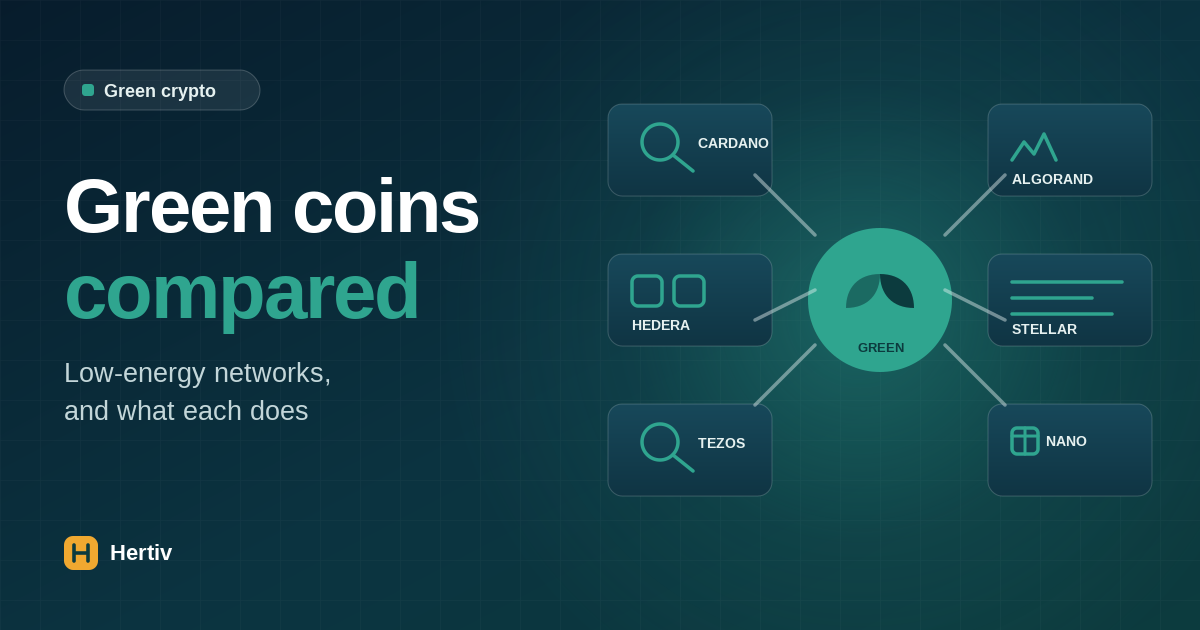
Green cryptocurrencies use far less energy than early mining coins, mostly by replacing mining with proof of stake. These six are the best-known examples.
On this page
Short answer
A green cryptocurrency is a coin whose network is designed to use little energy, usually by replacing mining with proof of stake or a similar low-energy design. The six below are the best-known examples, and they differ in what they are built for, how their networks agree on transactions, and how easy they are to use.
Which green cryptocurrencies are worth knowing?
A green cryptocurrency is worth knowing when its network is designed to use little energy and it is actually used for real payments, apps or settlement. The six below are the best-known examples, and they all avoid the energy-heavy mining used by early coins.
| Coin | Network design | Best for | Where it is used |
|---|---|---|---|
| Cardano | Proof of stake | Smart contracts | Apps and identity |
| Algorand | Proof of stake | Fast payments | Payments and assets |
| Hedera | Hashgraph | Business apps | Records and tokens |
| Stellar | Agreement protocol | Cross-border payments | Remittances |
| Tezos | Proof of stake | Upgradable apps | Art and contracts |
| Nano | Block lattice | Feeless payments | Everyday transfers |
None of these coins needs mining, so their energy use comes mainly from running ordinary validator or node software. For how proof of stake works, what is proof of stake explains the design in plain terms.
<h3>1. Cardano: best for smart contracts</h3>
Cardano is a proof-of-stake network built for smart contracts, identity and decentralised apps. It was designed from the start to avoid mining, and its validators are chosen by the amount of ADA staked to them, not by computing power.
It suits a team that wants a large, well-tested proof-of-stake network with a strong research culture. Its development is slower than some rivals, because changes go through a formal review process, but the network has run without interruption for years.
- Pros: Large proof-of-stake network; strong focus on formal checks; active developer community.
- Cons: Slower to add new features; fewer apps than the largest smart contract networks.
<h3>2. Algorand: best for fast payments</h3>
Algorand is a proof-of-stake network designed for fast payments and for issuing real-world assets such as stablecoins and tokenised securities. Its consensus picks a small, random set of validators for each block, which keeps the network fast without mining.
It suits a team that needs quick settlement and low fees for payments or asset transfers. Its trade-off is a smaller ecosystem than the largest networks, so a team may find fewer ready-made tools and apps.
- Pros: Fast settlement; low fees; designed for asset issuance.
- Cons: Smaller app ecosystem; fewer developers than the largest networks.
<h3>3. Hedera: best for business apps</h3>
Hedera is a network that uses hashgraph, a design in which nodes share information by gossip and agree on the order of events without mining. It is run by a council of companies and is used for records, tokens and business apps that need fast, final settlement.
It suits a business that wants predictable fees and a governed network, rather than a fully open one. Its trade-off is that governance sits with the council, so it is less decentralised than the open proof-of-stake networks.
- Pros: Fast and final settlement; predictable fees; business-friendly governance.
- Cons: Less decentralised than open networks; smaller developer community.
<h3>4. Stellar: best for cross-border payments</h3>
Stellar is a network built for cross-border payments and remittances. It uses an agreement protocol in which trusted nodes vote on each transaction, so there is no mining and settlement takes a few seconds.
It suits a team that moves money across borders, issues stablecoins, or builds payment apps for people without bank accounts. Its trade-off is that it is focused on payments, so it is not the best choice for complex smart contracts.
- Pros: Fast cross-border settlement; low fees; strong in payments and stablecoins.
- Cons: Limited smart contract ability; focused on one job.
<h3>5. Tezos: best for upgradable apps</h3>
Tezos is a proof-of-stake network that can upgrade itself without splitting into two chains. Token holders vote on changes, and the network applies the winning change automatically, which avoids the hard forks that split other networks.
It suits a team that wants a network that can change over time without breaking existing apps. It is used for art, collectibles and contracts, and its on-chain voting is the feature that sets it apart.
- Pros: Self-upgrading without hard forks; proof of stake from the start; active art community.
- Cons: Smaller than the largest networks; fewer tools for developers.
<h3>6. Nano: best for feeless payments</h3>
Nano is a payment network with a different design: each account has its own chain, called a block lattice, and transactions are confirmed by a vote of representatives. There are no fees, because there is no mining and no block reward to pay for.
It suits a person or a team that needs small, instant payments with no fee at all, such as tipping, micropayments or donations. Its trade-off is that it does one job only: it has no smart contracts, no tokens and no apps beyond payments.
- Pros: No fees; instant settlement; very simple design.
- Cons: Payments only, no smart contracts; smaller network than the others here.
How to choose a green cryptocurrency
Choosing a green cryptocurrency starts with the job, not the coin. A team that needs smart contracts should pick a network built for them, while a team that needs payments should pick one built for speed and low fees.
- Define the job. Write down whether you need payments, smart contracts, tokens or records, because each coin here is built for a different job.
- Check the consensus. Confirm the network really avoids mining, and read how its validators are chosen and rewarded.
- Check the ecosystem. Look for the wallets, exchanges and tools you will need, because a coin with no tooling is hard to use.
- Test a small transfer. Send a small amount first, and time it, so the speed and the fee are facts and not claims.
- Check the rules. Read the law in your market before holding or using a coin, because the treatment of crypto varies by country.
The small transfer test is the step teams skip, and it is the one that saves the most trouble. A coin that looks green on paper may be hard to buy, hard to move or hard to sell, and a small test finds that out cheaply. For the stablecoin side of the same market, what is a stablecoin explains the payment coins most businesses actually use.
What are the common mistakes?
The most common mistakes when choosing a green cryptocurrency are trusting a label, confusing low energy with low risk, and picking a coin for one job and using it for another.
- Trusting the label. A coin that calls itself green may still run on a network with high energy use. Check the consensus design, not the marketing.
- Confusing green with safe. A low-energy coin can still fall in price, lose its developers or be hard to sell. Energy and risk are different things.
- Picking the wrong job. A payment coin will not run smart contracts, and a smart contract coin may be slow for payments. Match the coin to the job.
- Ignoring the ecosystem. A coin with no wallets, no exchanges and no tools is hard to use, however green it is.
For the wider crypto market, top AI cryptocurrencies covers a different set of coins, chosen for their AI use rather than their energy use.
Key takeaways
- A green cryptocurrency avoids mining, usually by using proof of stake or a similar design
- Cardano, Algorand, Hedera, Stellar, Tezos and Nano are the best-known examples
- Match the coin to the job: payments, contracts, tokens or records
- Check the consensus design and the ecosystem, not just the label
- Test with a small transfer before committing real money
Frequently asked questions
What makes a cryptocurrency green?
A cryptocurrency is green when its network is designed to use little energy, usually by replacing mining with proof of stake or a similar low-energy design. The energy then comes mainly from running ordinary validator or node software, not from mining hardware.
Is proof of stake really greener than mining?
Yes, in practice. Mining uses computing power to compete for each block, which takes a lot of energy. Proof of stake chooses validators by the amount of coin staked to them, so the work is a vote rather than a race, and the energy use is far lower.
Can a green cryptocurrency still lose value?
Yes. Energy use and price are different things. A low-energy coin can still fall in price, lose its developers, or be hard to sell, so the green label is not a promise about value.
Which green cryptocurrency is best for payments?
Stellar and Nano are built for payments: Stellar for cross-border transfers and Nano for feeless everyday transfers. Algorand is also fast for payments, and it adds support for issuing assets such as stablecoins.
Do green cryptocurrencies support smart contracts?
Some do. Cardano, Tezos and Algorand all support smart contracts, while Stellar and Hedera have more limited contract ability and Nano has none. Check the contract features before choosing a network for an app.
How do I check whether a coin is really green?
Read how its consensus works and who runs the validators. A network that uses proof of stake, hashgraph or a voting design, with a public validator list, is easier to verify than one that only claims to be green.


