Tokenised Real Estate vs REITs: Which Fits Your Goal?
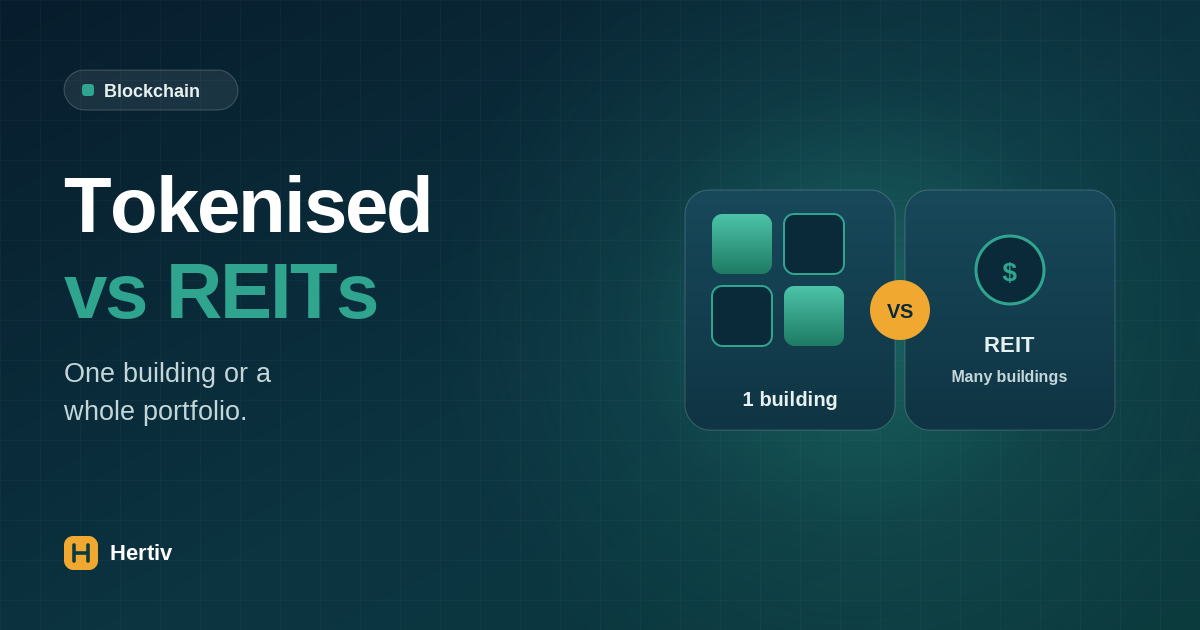
Tokenised real estate gives you tokens in one building; a REIT gives you shares in a company with many. This guide compares ownership, income, costs and control.
On this page
Short answer
Tokenised real estate and REITs both let you invest in property without buying a whole building, but they differ in what you own, how you trade, how income reaches you and how much control you have. A REIT offers diversification and easy trading, while tokens offer a direct stake in one building and a vote on how it is run.
What is tokenised real estate, and what is a REIT?
Tokenised real estate is property whose ownership is split into digital tokens on a blockchain, so many people can own small shares of one building. A REIT, or real estate investment trust, is a company that owns income-producing property and sells shares on a stock exchange, paying most of its income out as dividends.
Both let an investor put money into property without buying a whole building, but they work in different ways. A REIT share is a stake in a company that manages a portfolio of properties. A token is a direct share of one specific property, recorded on a ledger, and it can be traded peer to peer if a market exists for it.
For background on how property tokens are created, what real estate tokenization is explains the process step by step.
How do tokenised real estate and REITs differ?
Tokenised real estate and REITs differ in what you own, how you trade it, how income reaches you and how much control you have. The table below sets out the main differences.
| Factor | Tokenised real estate | REIT |
|---|---|---|
| What you own | Tokens in one specific property | Shares in a company with many properties |
| Trading | Peer to peer on a token market, if one exists | On a stock exchange during market hours |
| Income | Rent paid to token holders, often monthly | Dividends, usually quarterly |
| Minimum investment | Low, sometimes under $100 | Price of one share |
| Diversification | None, unless you buy many tokens | Built in, across a portfolio |
| Regulation | Varies by country and is still developing | Well-established securities rules |
The biggest practical difference is liquidity. A REIT share can usually be sold in seconds on an exchange. A property token can only be sold if a buyer is waiting on the same market, and for many tokenised buildings that market is still thin.
What does each one cost to hold?
The cost of holding tokenised real estate and REITs differs in what you pay and who takes it. A REIT charges management fees inside the company, and you pay brokerage fees when you buy or sell shares. Those costs are familiar and easy to compare between funds.
Tokenised property has a different cost stack. There are platform fees for issuing and managing the tokens, custody costs for holding them, and network fees when tokens move. Some platforms also charge for the legal structure that ties the token to the property. These costs are often higher per dollar invested, because the market is young and each deal is small.
Tax treatment also differs. REIT dividends are taxed as income in most countries, and the rules are settled. Tokenised rent may be taxed differently depending on how the token is classified, and the rules are still being written in many places. Check the tax position with a local adviser before investing in either.
Which is better for income?
For steady income, a REIT is usually the simpler choice. REITs must pay out most of their income as dividends by law in many countries, and a large REIT holds dozens or hundreds of properties, so one empty unit barely moves the payout. The dividend arrives on a schedule you can plan around.
Tokenised property can pay rent directly to token holders, sometimes monthly, and the yield on one good building can look attractive. But the income depends on that single building. If its main tenant leaves, the rent stops until a new tenant is found, and the token holders carry that risk alone.
A holder who wants income from property without managing it will usually find a REIT easier. A holder who wants income from one specific building, and is comfortable with the risk of that building, may prefer tokens. For examples of tokenised income in practice, RWA tokenization use cases shows where the model is working today.
Which is better for growth and control?
For growth, the two work differently. A REIT grows by buying more properties, raising rents and developing new sites, and its share price reflects the whole portfolio. An investor shares in that growth without choosing any single building.
Tokenised property grows with one building. If the building's value rises, the token price should rise with it, and the holder keeps the full gain on that building rather than sharing it across a portfolio. The trade-off is that a fall in that one building's value hits the holder in full.
Control is where tokens are genuinely different. Some tokenised properties let holders vote on decisions such as a major repair or a change of manager. A REIT shareholder votes only at annual meetings on company-wide matters, and has no say in how one building is run. That control is real, but it is only useful if holders actually read the proposals and vote.
Example (hypothetical): the same $10,000 in each
Example (hypothetical): an investor puts $10,000 into a REIT and $10,000 into tokens of one office building. The REIT pays a 5% dividend, so the investor receives $500 a year, spread across four quarterly payments of $125. The building pays rent of 6% a year, so the token holder receives $600 a year, paid monthly at $50.
In year two, the building's main tenant leaves and the unit sits empty for four months. Rent for those months is zero, so the token holder receives $400 that year instead of $600. The REIT, holding 80 properties, loses one tenant too, but its dividend falls only slightly, from $500 to $485.
Over the two years, the REIT holder receives $985 and the token holder receives $1,000. The token paid slightly more in total, but the income was uneven and depended on one tenant. The REIT paid slightly less, but the income was steady.
What are the common mistakes?
The most common mistakes when comparing tokenised real estate and REITs are assuming tokens are as easy to sell as shares, ignoring the legal structure, and judging one building by the average of a whole market.
- Assuming tokens are liquid. A token is only as easy to sell as its market is deep. Many token markets have few buyers, so an exit can take weeks.
- Ignoring the legal structure. A token is only worth something if the law ties it to the property. Read the structure before buying.
- Judging one building by market averages. A REIT's return is an average across many buildings. One building can be far better or far worse.
- Forgetting the costs. Platform, custody and network fees can eat a small holding. Add them up before investing.
- Treating yield as a promise. Rent and dividends both depend on tenants paying. Neither is guaranteed.
How to choose between tokenised real estate and a REIT
You choose between tokenised real estate and a REIT by matching the investment to your goal, your time horizon and how much risk one building can carry.
- Start with the goal. Steady income and diversification point to a REIT. A stake in one specific building points to tokens.
- Check the exit. If you may need the money within a year, a REIT's exchange listing matters more than a token's yield.
- Read the legal structure. For tokens, confirm what the token actually gives you: a share of rent, a share of sale proceeds, or both.
- Compare the full costs. Add platform, custody and network fees to the token side, and brokerage fees to the REIT side.
- Limit the single-building risk. If you buy tokens, keep them a small part of your portfolio, so one empty building cannot hurt you.
To see how a token is created before you invest, how to tokenize real estate walks through the steps a platform follows.
Key takeaways
- A REIT gives you shares in a company with many properties; tokens give you a stake in one building
- REIT shares trade easily on an exchange; tokens depend on a thin secondary market
- REIT income is steady and diversified; token income can be higher but stops if one tenant leaves
- Tokens can give holders a vote on the building; REIT holders vote only on company matters
- Check the legal structure and the full costs before buying either
Frequently asked questions
What is a REIT?
A REIT, or real estate investment trust, is a company that owns income-producing property and sells shares on a stock exchange. It must pay most of its income out as dividends, and its portfolio usually holds many properties, which spreads the risk of any one tenant leaving.
What is tokenised real estate?
Tokenised real estate is property whose ownership is split into digital tokens on a blockchain. Each token represents a share of one specific building, and holders receive rent and a share of any sale proceeds according to the legal structure behind the tokens.
Can you sell tokenised real estate quickly?
Only if a secondary market exists and buyers are active on it. Many token markets are still thin, so selling can take weeks. A REIT share, by contrast, can usually be sold in seconds on a stock exchange during market hours.
Do REITs pay more than tokenised property?
Not always. A single good building can pay a higher yield than a REIT average, but that yield depends on one tenant. A REIT pays a steadier dividend because it holds many properties, so one empty unit barely changes the payout.
Is tokenised real estate regulated?
It depends on the country and how the token is structured. Some tokens are treated as securities and fall under securities law, while others sit in a grey area. The rules are still developing in most places, so check the local position before investing.
Which is safer for a first property investment?
A REIT is usually the safer first step, because it offers diversification, regulated trading and a long track record. Tokens suit an investor who understands one building well and can accept the risk that its income may stop.


