Tokenized Private Credit vs Traditional Markets: What Changes
Tokenized private credit puts loans on a blockchain so investors can buy small shares and trade sooner. Here is how it differs from traditional markets.
On this page
Short answer
Tokenized private credit differs from traditional private credit mainly in access, liquidity and transparency: loans are split into digital tokens that smaller investors can buy, trade and track, while traditional private credit is sold in large units, held to maturity and reported through slow, paper-based processes.
What is tokenized private credit?
Tokenized private credit is a loan, or a pool of loans, that is recorded on a blockchain as a set of digital tokens. Each token stands for a defined share of the loan book, and the rights to interest payments and repayment are tied to holding the token.
The loan itself is a normal private credit agreement between a borrower and a lender or fund. Tokenization adds a digital layer on top: ownership is recorded on a shared ledger, transfers are settled by smart contracts, and the loan book can be divided into far smaller pieces than a traditional fund unit.
The idea matters because private credit has traditionally been a market for large investors only. Tokenization lowers the size of each unit and makes the holding easier to move, which is why it is often compared with the traditional market rather than treated as a separate asset class.
How do traditional private credit markets work?
Traditional private credit is lending that happens outside public bond markets and banks. A fund, or a direct lender, agrees a loan with a company, holds it to maturity and collects interest and principal over the life of the loan.
Investors buy into the fund with large minimum commitments, often in the hundreds of thousands of dollars or more, and their money is usually locked in for several years. They receive periodic reports on the portfolio, but they cannot see the loan book in real time and they cannot easily sell their position before the fund matures.
Administration is handled by fund managers, custodians, lawyers and auditors through documents, spreadsheets and reconciliations. That structure works, but it is slow, costly to run and closed to anyone who cannot meet the minimum commitment or the lock-in period.
Where do the two models differ?
The two models differ most in access, liquidity, transparency and administration. Tokenization changes how the loan is held and moved, not what the loan is.
| Feature | Traditional private credit | Tokenized private credit |
|---|---|---|
| Minimum investment | Large commitments, often six figures or more | Small token units, far below fund minimums |
| Liquidity | Locked in for years, no easy exit | Tokens can trade on a secondary market |
| Transparency | Periodic reports, months behind the loan book | On-chain record of holdings and payments |
| Settlement | Days of paperwork and reconciliation | Smart contracts settle transfers in minutes |
| Administration | Manual, handled by several intermediaries | Partly automated, fewer manual steps |
| Investor base | Institutions and wealthy individuals | Broader, including smaller professional investors |
The comparison is about structure, not about returns. A tokenized loan carries the same credit risk as the same loan held in a traditional fund, because the borrower and the loan terms have not changed. What changes is how the exposure is packaged, priced and moved. For a fuller picture of how the tokens are created, see how tokenizing private credit works.
What changes for investors?
For investors, the main change is that private credit becomes easier to enter, exit and monitor. Smaller units mean an investor can take a modest position in a loan book instead of committing a large sum to one fund, and can spread money across several loan books.
Secondary trading is the second change. In a traditional fund, an investor who needs cash early must wait or negotiate a private sale. With tokens, the investor can sell part of a position on a marketplace, provided buyers are present. That liquidity is not guaranteed: a thin market can still leave an investor unable to sell at a fair price.
The third change is visibility. The on-chain record shows how many tokens exist, who holds them and when payments are made, which makes it harder for a manager to hide a problem in the loan book. Investors still need to read the loan documents and check the manager, because a token cannot fix a bad loan.
Investors comparing fund structures can also read about fund tokenization for asset managers.
What changes for borrowers and fund managers?
For borrowers, tokenization changes little about the loan itself. The borrower still agrees terms, draws the money and repays on schedule. The difference is on the funding side: the lender can raise money from a wider set of investors, which can make it easier to fund a loan book that a single fund would struggle to fill.
For fund managers, tokenization changes the back office. Issuing tokens, recording transfers and distributing interest payments can be handled by smart contracts instead of manual reconciliation, which can cut administration cost and error. The manager still has to originate loans, check credit quality and chase late payments, and none of that is automated by the token.
There is also new work. The manager needs a licensed structure for the tokens, a custodian for the underlying assets, and a plan for investor checks and reporting that satisfies regulators. Teams exploring this route usually start with RWA tokenization guidance and a legal review before writing any code.
Example (hypothetical): a fund tokenizes a loan book
Example (hypothetical): a private credit fund holds a loan book worth $50,000,000, made of loans to 40 mid-sized companies. It issues 500,000 tokens at $100 each, so the full token supply matches the $50,000,000 loan book exactly.
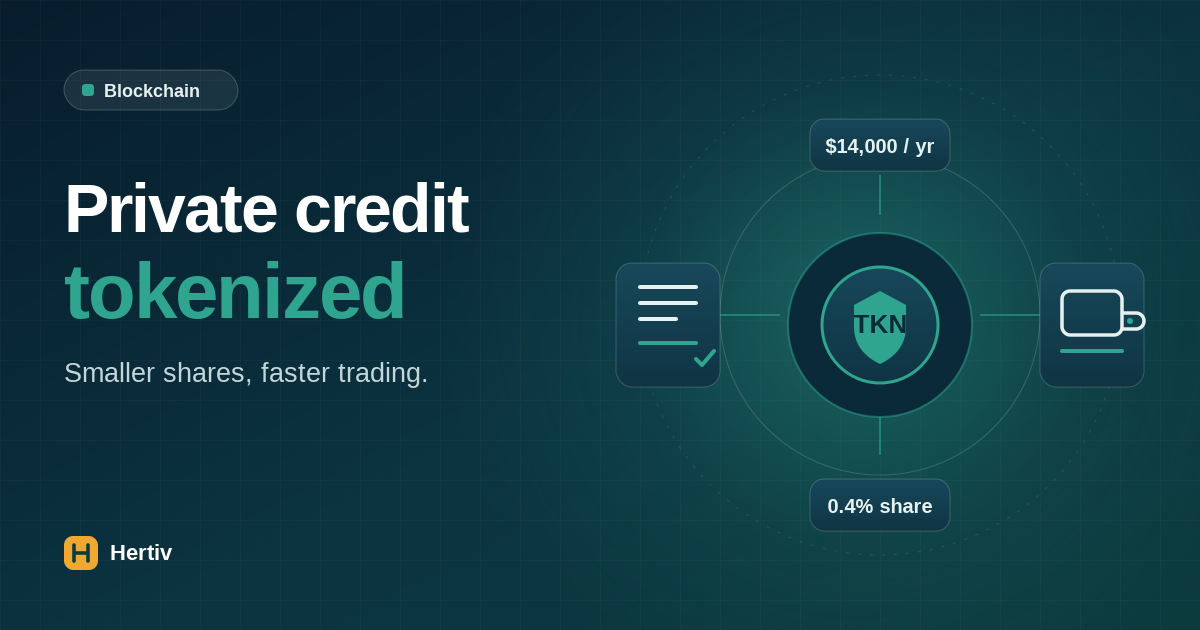
An investor buys 2,000 tokens for $200,000. That is 2,000 out of 500,000 tokens, or 0.4% of the loan book. The loan book pays $3,500,000 in interest in a year, so the investor's share is 0.4% of $3,500,000, which is $14,000 for the year, paid out as the loans pay interest.
Six months later the investor needs cash and sells 500 tokens on a secondary market at $102 each, receiving $51,000 before fees. In a traditional fund the same investor would have been locked in and unable to sell part of the position. The example shows the structural difference clearly, and it also shows the risk: if no buyer appears, the tokens cannot be sold at any price.
For the mechanics behind this example, see how RWA tokenization works.
What are the common mistakes?
The most common mistakes are treating tokenization as a return booster, assuming liquidity is automatic, and skipping the legal structure.
- Expecting higher returns. Tokenization does not change the borrower or the loan terms, so it cannot raise the return of the same loan. It changes access and liquidity, not credit quality.
- Assuming a buyer will always appear. A secondary market needs real buyers. Without them, tokens are no easier to sell than a fund position.
- Skipping licensing and custody. Tokens that represent a loan are usually regulated securities, and the underlying assets need a custodian and a legal wrapper.
- Ignoring the smart contract risk. A bug in the contract that issues or moves tokens can freeze or misdirect payments, so the code needs an audit.
- Buying without reading the loan book. A token is only as good as the loans behind it, so the investor still has to check borrower quality and concentration.
Key takeaways
- Tokenized private credit splits loans into small digital tokens that can be bought, traded and tracked on a blockchain
- Traditional private credit uses large minimums, long lock-ins and slow paper-based administration
- The main gains are smaller units, faster settlement and a visible loan book, not higher returns
- Secondary trading helps only when real buyers are present; thin markets can still trap an investor
- The loan terms and credit risk stay the same, so check the borrower before the token
- Tokens usually need a licensed structure, a custodian and an audited smart contract
Frequently asked questions
Does tokenized private credit pay more than traditional private credit?
No. The return comes from the same loans, so tokenization does not raise it. What changes is access, liquidity and transparency: smaller units, faster settlement and a visible record of holdings and payments. Any extra return would come from a different loan, not from the token.
Can I sell tokenized private credit whenever I want?
Only if a buyer is willing to buy. Tokens can be listed on a secondary market, which is an improvement over a locked-in fund, but a thin market can leave you unable to sell at a fair price. Check trading activity before assuming you can exit quickly.
Is tokenized private credit safer than traditional private credit?
It is not safer in credit terms, because the borrower and loan terms are the same. It can be more transparent, since the on-chain record shows holdings and payments, but it adds new risks such as smart contract bugs and regulatory uncertainty.
Who can invest in tokenized private credit?
That depends on the jurisdiction and the token's legal structure. Many offerings are limited to professional or accredited investors, even though the token units are small. Check the offering documents and the rules in your country before investing.
What happens if the borrower defaults?
The token holders bear the loss in proportion to their holding, just as fund investors would. The smart contract can automate the distribution of any recovery, but it cannot recover money from a borrower that cannot pay.
How is tokenized private credit different from tokenized treasuries?
Tokenized treasuries represent government bonds, which are low-risk and highly liquid, while tokenized private credit represents loans to companies, which carry higher credit risk and less liquidity. The token mechanics are similar, but the underlying asset and the risk are very different.


