How Does RWA Tokenization Work, Step by Step?
RWA tokenization turns a real asset into tokens through a legal owner, a smart contract and checked buyers. Here is each step and who is involved.
On this page
Short answer
RWA tokenization turns a real-world asset such as a building, loan or fund share into digital tokens on a blockchain, so ownership can be split and transferred. A legal company holds the asset, a smart contract records who owns which tokens, and only checked buyers can trade them.
What is RWA tokenization?
RWA tokenization is the process of turning a real-world asset, such as a building, a loan or a fund share, into digital tokens on a blockchain, so that ownership can be recorded, split and transferred without paper certificates. Each token stands for a defined share of the asset or of the income it produces.
The tokens are not the asset itself. The asset is held by a legal owner, usually a company set up for that purpose, and the token is a record of who owns a share of it. That separation is what makes the process work: the blockchain handles the record-keeping and transfers, while the legal owner holds the asset and deals with the law.
Common examples include commercial property, private credit, government bonds and fund shares. A building worth several million can be split into many tokens, so more people can invest smaller amounts, and the tokens can change hands faster than a traditional property sale. The RWA tokenization guide for issuers covers who can issue these tokens and what it takes.
How does RWA tokenization work, step by step?
RWA tokenization works by moving an asset through a fixed sequence: check the asset, set up the legal structure, create the tokens, sell them to approved buyers, and then manage income, trading and redemption. The table below shows each step and who is involved.
| Step | What happens | Who is involved |
|---|---|---|
| 1. Check the asset | The asset is valued and its papers are checked | Valuer, lawyers, issuer |
| 2. Set up the legal owner | A company is formed to hold the asset | Lawyers, issuer, regulator |
| 3. Write the rules | Who can buy, hold and sell is written down | Lawyers, compliance team |
| 4. Build the smart contract | The token and its rules are coded and audited | Developers, auditors |
| 5. Create and sell the tokens | Tokens are minted and sold to checked buyers | Issuer, investors, platform |
| 6. Manage income and trading | Rent or interest is paid out, tokens change hands | Issuer, investors, market |
| 7. Redeem or sell the asset | Tokens are bought back or the asset is sold | Issuer, investors, buyer |
The order matters. A token created before the legal owner exists, or before the rules are written, is hard to fix later. Most failed projects are not coding failures; they are projects where the legal and compliance steps were rushed. How tokenization works in general explains the basic idea behind the token itself.
What is the legal wrapper, and why does it matter?
The legal wrapper is the company or trust that holds the real-world asset on behalf of token holders. It is usually a special purpose vehicle, a company formed only to hold that asset, so that the asset is kept separate from the issuer's other business and from the token holders' other assets.
The wrapper matters because a token on a blockchain does not, on its own, give you a legal right to a building or a loan. The right comes from the legal documents: the token holder's claim on the wrapper, the wrapper's ownership of the asset, and the rules for income, voting and sale. If those documents are weak, the token is worth little even if the code works.
Regulation shapes the wrapper. In most places these tokens are treated as securities, which means the issuer must follow securities rules, check who buys them and report as required. The exact rules depend on the country and the type of asset, so a lawyer who knows that market is part of the team from the start. RWA tokenization platform development covers how the legal and technical pieces are built together.
Where does the asset live, and who holds it?
The asset lives where it always lived: a building stays in its city, a loan stays in the lender's books, and a fund share stays with the fund. Tokenization does not move the asset; it changes how ownership of it is recorded and transferred.
Custody is the job of holding the asset safely. For property, that means the title deeds and the legal owner. For bonds and fund shares, it means a licensed custodian. For loans, it means the loan documents and the servicing agreement. The custodian's job is to make sure the asset cannot be sold or pledged twice, and that token holders can prove what they own.
Price information usually comes from an oracle, a service that brings off-chain facts onto the blockchain. An oracle might report a property valuation, a loan's interest rate or a fund's net asset value. Oracles matter because the smart contract cannot see the real world on its own, and a wrong price feed can break the token's logic, so teams pick oracles with a clear source and a way to check the data.
How do people buy, sell and redeem the tokens?
People buy RWA tokens through a platform that checks their identity and whether they are allowed to hold the token. That check happens before the sale, because securities rules limit who can buy. Once approved, the buyer pays and receives tokens in a wallet, and the transfer is recorded on the blockchain.
Selling works the same way in reverse, but with one extra limit: the buyer must also pass the checks. A token that can only be sold to approved buyers is less liquid than a token anyone can buy, which is the trade-off for following the rules. Some platforms run a secondary market where approved buyers can trade with each other, while others only allow sales back to the issuer.
Redemption is how a token holder gets their money back. When the asset is sold, or a loan is repaid, the issuer uses the proceeds to buy back the tokens at their share of the value. If the asset produces income, such as rent or interest, that income is usually paid out in stablecoins or bank transfer rather than in more tokens. Fund tokenization for asset managers covers how this works for fund shares.
Example (hypothetical): tokenizing a $10M building
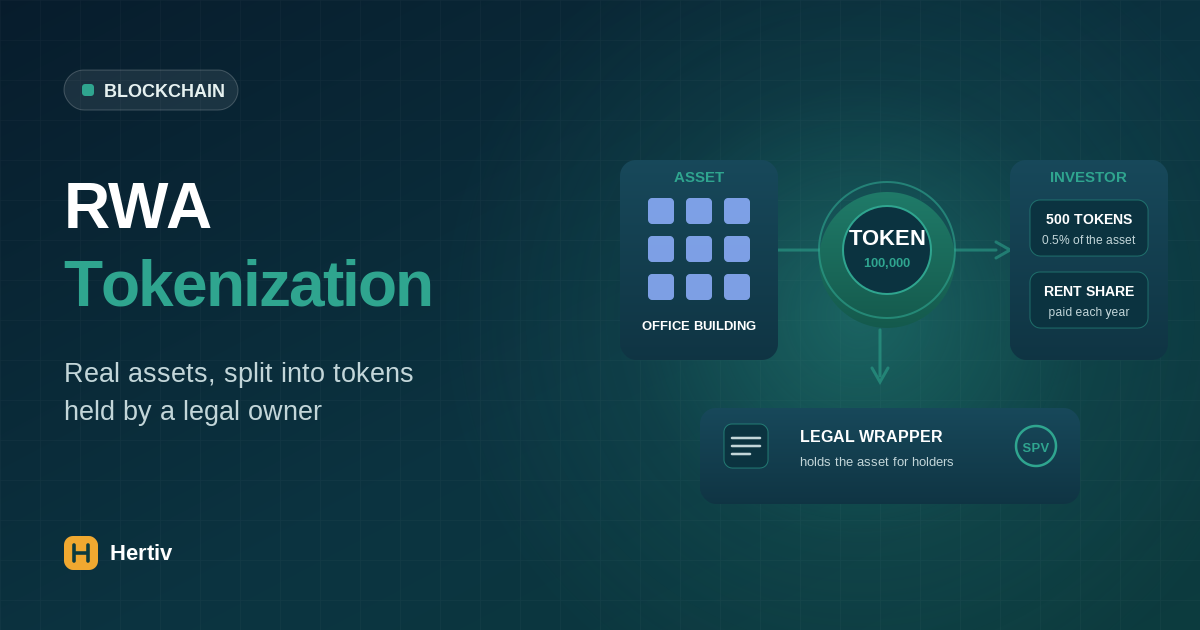
Example (hypothetical): a property company owns an office building valued at $10,000,000 and wants to sell a share of it to investors. It forms a company to hold the building, writes the rules for who can buy, and creates 100,000 tokens at $100 each, so the full token supply matches the building's value.
An investor buys 500 tokens for $50,000. That is 0.5% of the 100,000 tokens, so the investor owns 0.5% of the building's value and 0.5% of its income. If the building earns $500,000 a year in net rent, the investor's share is 0.5% of $500,000, which is $2,500 a year.
Two years later the investor sells the 500 tokens to another approved buyer on the platform. If the building is then worth $11,000,000, each token is worth $110, so the 500 tokens sell for $55,000. The buyer must pass the same identity checks, and the transfer is recorded on the blockchain, while the legal owner of the building never changes.
What are the common mistakes?
The most common mistakes are treating the token as the asset, skipping the legal work, and promising liquidity that does not exist. Each of these is easy to make and hard to fix once tokens are sold.
- Thinking the token is the asset. The token is a record of a claim; the legal documents decide what that claim is worth.
- Skipping the legal wrapper. A token with no clear owner of the asset leaves holders with nothing to enforce.
- Promising easy trading. Tokens limited to approved buyers trade slowly, so do not promise stock-market liquidity.
- Weak price feeds. An oracle with no clear source or check can feed the contract wrong values.
- No audit of the contract. A bug in the token rules can lock funds or allow transfers that should be blocked.
- Ignoring redemption. If holders cannot get their money back when the asset is sold, the token has no clear exit.
RWA tokenization works when the legal structure, the custody and the code all agree with each other. A smart contract audit is the usual last check before tokens are issued.
Key takeaways
- The token is a record of a claim, not the asset itself; the legal owner holds the asset
- Tokenization follows a fixed order: check the asset, set up the owner, write the rules, then code
- Securities rules limit who can buy and sell, which limits how fast tokens trade
- Custody and price feeds decide whether holders can trust what the token is worth
- Redemption is the exit: holders get their share when the asset is sold or a loan is repaid
Frequently asked questions
What does RWA mean?
RWA stands for real-world asset. It means an asset that exists outside the blockchain, such as property, a loan, a bond or a fund share, as opposed to a crypto asset that only exists on-chain. RWA tokenization is the process of recording ownership of such an asset as tokens.
Do token holders own the building or loan directly?
Usually not. A legal company holds the asset, and the token gives the holder a claim on that company, set out in legal documents. The token is the record of the claim, while the documents decide what the claim is worth and how it can be enforced.
Why can only some people buy RWA tokens?
Because in most places these tokens are treated as securities, so the issuer must check buyers and follow securities rules. That limits who can buy and sell, which is why RWA tokens trade more slowly than crypto assets that anyone can buy.
What happens if the asset loses value?
The tokens lose value with it, because each token is a share of the asset's value. If a building's value falls, or a loan is not repaid, the token price and the income paid to holders fall too. Tokenization does not protect against the asset itself losing value.
How is the token price decided?
The price comes from the asset's value, usually reported by an oracle or a valuer, divided by the number of tokens. For a building, that means a valuation; for a loan, the remaining balance; for a fund, the net asset value. The source of that figure must be clear and checkable.
Can RWA tokens be traded like shares?
In some cases, yes, on a platform that checks every buyer. But the checks slow trading down, and many tokens can only be sold back to the issuer. A team should not promise stock-market liquidity for tokens that only approved buyers can hold.


