Tokenizing Private Credit: How Loans Become Tokens
Tokenizing private credit records loans as digital tokens so payments, ownership and compliance run on shared rails. Here is how it works and what it does not fix.
On this page
Short answer
Tokenizing private credit means recording loans made outside public markets as digital tokens on a blockchain, so the loan terms, ownership and payments live on one shared record. It makes servicing faster and clearer, but it does not change the loan, create buyers or remove the legal work.
What is tokenizing private credit?
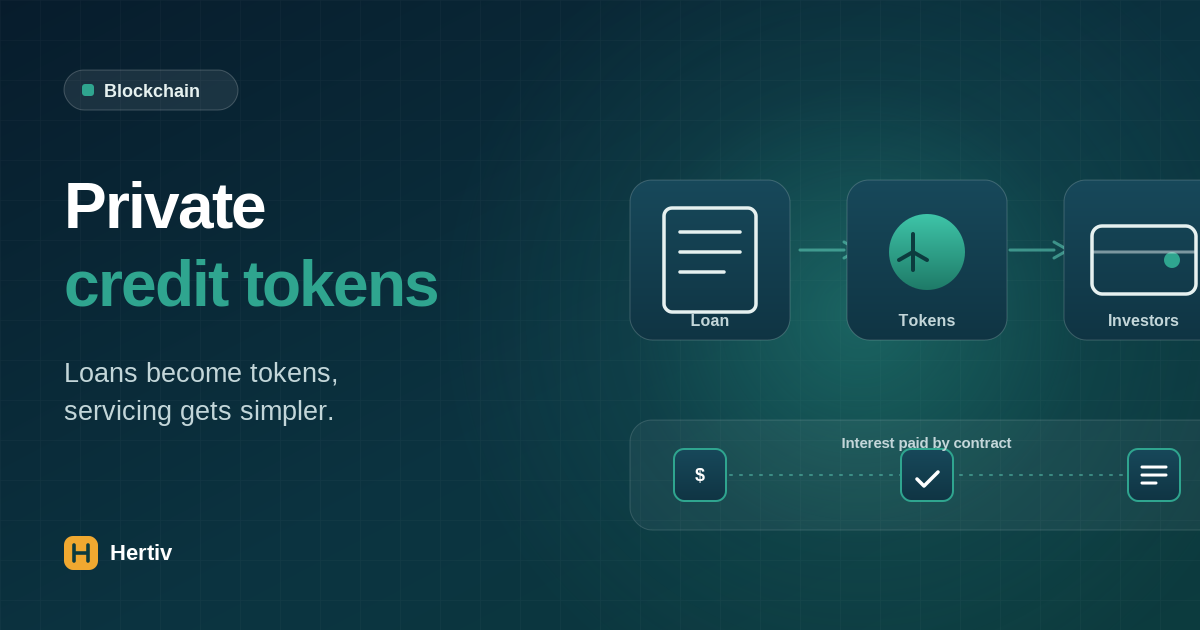
Tokenizing private credit is the process of recording loans that are not traded on public markets as digital tokens on a blockchain, so the loan, its terms and its ownership can be tracked, transferred and settled on shared rails. The loan itself does not change; the record-keeping and settlement around it do.
Private credit means loans made outside banks and public bond markets, usually by funds and specialist lenders to mid-sized companies, property projects or other borrowers. These loans are normally held in paper agreements and spreadsheets, settled slowly, and hard to sell before maturity.
Tokenization puts the loan's key facts, such as the borrower, the amount, the interest rate, the repayment schedule and who holds it, into a token contract that the parties can read and act on.
The point is not to make private loans trade like stocks. It is to make the administration of a loan book faster, clearer and cheaper: payments can be distributed automatically, ownership can move without re-papering the whole loan, and every party can see the same record of what is owed and what has been paid.
Why tokenize private credit at all?
Private credit is tokenized because the current process is slow, manual and opaque, and the fixes are mostly about records and settlement rather than about the loan itself. A loan book with hundreds of loans means hundreds of agreements, payment schedules and investor reports, each maintained separately.
| Problem today | What tokenization changes |
|---|---|
| Payments reconciled by hand | Interest and principal distributed by contract rules |
| Ownership tracked in spreadsheets | One shared record of who holds each loan |
| Transfers take weeks of paperwork | Transfers settle when the contract conditions are met |
| Investors wait for quarterly reports | Positions and payments visible as they happen |
| Compliance checks repeated each time | Eligibility rules checked by the token contract |
The benefits are real but narrow. Tokenization does not make a bad loan good, and it does not create buyers for a loan nobody wants. It makes a well-run loan book cheaper to run and easier to prove. RWA tokenization covers the wider pattern of putting real assets on chain.
How does tokenizing a private loan work?
You tokenize a private loan by setting up the legal structure first, then issuing tokens that represent the loan or a share of it, and then running servicing through the token contract. The legal work comes before any code, because the token is only useful if it clearly represents a real claim.
- Structure the loan legally. Decide who the borrower is, who the lender is, and what vehicle holds the loan, so the token has a clear legal meaning.
- Choose the token standard and chain. Pick a standard that supports transfer rules and identity checks, on a chain your investors and custodians can use.
- Build the compliance rules into the token. Encode who may hold it, in which countries, and what lock-up or limit applies.
- Issue the tokens to verified investors. Each investor passes identity checks before receiving tokens, and the contract records the holding.
- Run servicing on chain. Interest and principal payments are distributed through the contract, and the record updates as payments arrive.
- Handle transfers and exits. When an investor sells, the contract checks the buyer is eligible and updates the record.
Off-chain data still matters: the loan agreement, the borrower's financial reports and any valuations live outside the chain, and the token points to them. Blockchain development covers the build choices for this kind of platform.
What changes for lenders, borrowers and investors?
For lenders, tokenization changes the back office most. Servicing a loan book becomes a matter of watching contract events rather than chasing spreadsheets, and reporting to investors can be generated from the same record everyone already shares. The lender still does the credit work: underwriting the borrower, setting the terms and chasing late payments.
For borrowers, little changes on the surface. The loan terms, the repayment schedule and the person they call when something goes wrong stay the same. What changes is the plumbing behind the loan: the lender may be able to fund faster and report more clearly, but the borrower still owes the same money on the same dates.
For investors, the main change is visibility and, in some cases, earlier exits. An investor can see what the loan book holds and what has been paid without waiting for a quarterly report, and may be able to sell a position to another eligible investor instead of holding to maturity. That only works if a buyer exists, which depends on the loan, not on the token.
What are the risks and compliance questions?
The risks are mostly legal and operational, not technical. A token that represents a loan is usually a security in most jurisdictions, which means the issuer needs the right licences, the right investor checks and the right disclosures. Getting this wrong can mean the token cannot legally be sold or transferred.
Valuation is the second hard question. Private loans have no market price, so someone must decide what the token is worth, and that decision affects reporting, redemptions and secondary sales. A token does not solve valuation; it only records whatever value the parties agree on.
Operational risk is the third. If the servicing data is wrong, the contract distributes the wrong amounts, and fixing that after the fact is harder than fixing a spreadsheet. Smart contract audits, clear data ownership and a named person responsible for the loan book are not optional. Tokenization platform costs are worth reading before scoping a build.
Example (hypothetical): a lender tokenizes a small loan book
Example (hypothetical): a specialist lender holds 20 loans to mid-sized companies, worth $50 million in total, and wants to offer parts of the book to 40 verified investors. Each loan pays interest quarterly, and the lender's team spends about 30 hours a month reconciling payments and preparing investor reports.
The lender sets up a fund vehicle, issues tokens worth $50 million in total, and sells $20 million of tokens to the 40 investors, keeping $30 million itself. Each investor buys an average of $500,000 of tokens, which is $20 million divided by 40 investors. The token contract distributes each quarterly interest payment in proportion to holdings, so an investor holding 1% of the tokens receives 1% of each payment.
If the book pays 8% a year in interest, the annual interest is $4 million, and the investors' $20 million share earns $1.6 million a year, which is 8% of $20 million. The lender's reporting time falls from 30 hours a month to about 10, because the contract record feeds the reports directly. The loans themselves are unchanged; only the record-keeping and distribution have moved on chain.
What are the common mistakes?
The most common mistakes are treating tokenization as a sales tool, skipping the legal structure, and assuming a token creates a market. Each of these is easy to make and expensive to fix.
- Tokenizing before the legal work. A token with no clear legal claim behind it is a record of nothing.
- Assuming liquidity appears. A token does not create buyers; only a loan someone wants to buy creates a market.
- Ignoring valuation. Without an agreed valuation method, reporting and exits become arguments.
- Weak servicing data. If the payment data fed to the contract is wrong, the contract distributes the wrong amounts.
- No audit or kill switch. A contract that moves real money needs an audit and a way to pause it if something goes wrong.
- Overpromising to investors. Describing tokenization as making a loan liquid or low-risk misleads the people whose money is at stake.
Tokenization is a record-keeping and settlement upgrade for a loan book that already works. DeFi development covers the related work on lending protocols.
Key takeaways
- Tokenizing private credit records a loan as tokens; the loan terms and credit risk do not change
- The gains are faster servicing, clearer records and automatic payment distribution
- Legal structure comes before any code, because the token must represent a real claim
- A token does not create liquidity; only a loan someone wants to buy creates a market
- Valuation, audits and a pause mechanism are essential before real money moves
- Start with a loan book that already works on paper, then tokenize it
Frequently asked questions
What is private credit?
Private credit is lending outside banks and public bond markets, usually by funds and specialist lenders to mid-sized companies, property projects or other borrowers. The loans are held in private agreements, settled slowly and hard to sell before maturity, which is why their administration is a natural fit for tokenization.
Does tokenizing a loan change the loan terms?
No. The borrower, the amount, the interest rate and the repayment schedule stay the same. Tokenization changes how the loan is recorded, serviced and transferred, not what the borrower owes or when it is due.
Can anyone buy a tokenized private loan?
No. Tokenized private credit is usually a security, so only verified investors who meet the eligibility rules in the token contract may hold it. The contract checks identity, country and limits before every transfer, and ineligible buyers are blocked.
Does tokenization make private credit liquid?
Not by itself. A token makes a position easier to transfer, but a buyer still has to want the loan at the price offered. Loans with strong borrowers and clear terms attract buyers more easily, while weak or opaque loans do not gain a market from being tokenized.
How are interest payments handled on chain?
The token contract distributes each interest and principal payment in proportion to holdings, so an investor holding 1% of the tokens receives 1% of each payment. The payment data still comes from the servicer, so accurate off-chain data is essential for the contract to pay the right amounts.
What does it cost to tokenize a loan book?
It depends on the legal structure, the chain, the compliance rules and the servicing integration. A small pilot with one loan and a handful of investors is the cheapest way to learn the real cost before committing to a full platform. See vendor sites for current rates.


