Tokenization vs Traditional Fundraising: Which Fits?
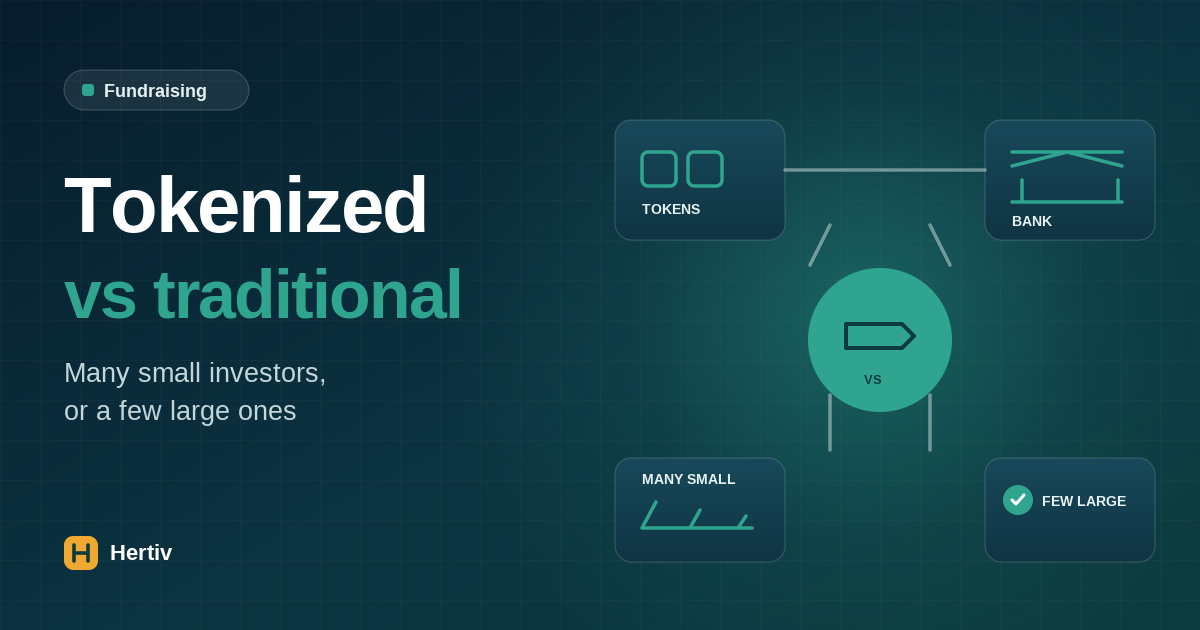
Tokenization lets many small investors buy into an asset, while traditional fundraising relies on banks and funds. Here is how the two compare.
On this page
Short answer
Tokenization is the process of turning an asset, such as a building, a fund share or a loan, into digital tokens on a blockchain that investors can buy, hold and trade. Traditional fundraising raises the same money from banks, funds or a small group of large investors through paper contracts and intermediaries. The difference is who can invest, how fast money moves, and how much middlemen handle.
What is tokenization vs traditional fundraising?
Tokenization vs traditional fundraising is a choice between two ways of raising money for an asset or a project. In tokenization, the asset is split into digital tokens on a blockchain, and many investors buy small pieces, each recorded on a shared ledger. In traditional fundraising, the money comes from a bank loan, a fund, or a small group of large investors, and the deal is recorded in contracts held by lawyers and banks.
The token is not the asset itself. It is a digital record of a claim on the asset, and the legal rights sit in the documents behind it. What changes is the plumbing: tokens can be split into small pieces, moved between investors, and settled on a shared ledger, while traditional fundraising moves money through accounts and paper that take longer to clear.
The two are not rivals in every case. Many projects use both, raising a large anchor round the traditional way and a smaller tokenized round for a wider set of investors.
How do the two compare?
The two routes differ on who can invest, how fast money moves, and what the process costs. The table below compares them on the points a team actually decides on.
| Factor | Tokenization | Traditional fundraising |
|---|---|---|
| Who can invest | Many small investors | Few large investors |
| Minimum ticket | Small, often under $1,000 | Large, often $100,000 or more |
| Speed to close | Weeks once the setup is done | Months of negotiation and paperwork |
| Secondary trading | Tokens can change hands on a market | Hard to sell before exit |
| Legal work | New rules, still settling in many places | Well-tested contracts and case law |
| Intermediaries | Fewer, but new ones appear | Banks, lawyers, brokers, custodians |
The minimum ticket is the clearest difference. A tokenized building can take a hundred investors at $1,000 each, while a traditional fund needs a handful of investors at $100,000 or more. That changes who the project can reach, and it changes how the team talks to investors. For the background on the tokens themselves, how tokenization works explains the mechanics in plain terms.
How does tokenized fundraising work?
Tokenized fundraising works in five steps, and the legal work comes before the technology.
- Structure the asset. Lawyers set up the entity that holds the asset and write the rights each token carries, such as a share of income or a vote.
- Check the rules. The team confirms which securities rules apply in each market where investors live, and what disclosures are needed.
- Build the tokens. A smart contract creates the tokens, sets the transfer rules, and records who holds what on the chain.
- Offer the tokens. Investors pass identity checks, sign the documents, and pay, and the tokens move into their wallets.
- Manage the asset. Income is paid to token holders, reports go out, and tokens can be traded on a market that accepts them.
The identity checks are not optional. A tokenized offer still has to know its investors, and the checks are usually stricter than in a traditional private round, because the investor base is wider. For the rules that shape these offers in Europe, what MiCA regulation means is a useful starting point.
What does traditional fundraising look like?
Traditional fundraising follows a familiar path. The team writes a pitch and a set of financial documents, meets a small group of funds or banks, negotiates the terms, and signs contracts that take weeks to close. Each investor is known to the team, and the deal is recorded in paper and in bank accounts.
Its strength is certainty. The contracts are well tested, the rules are clear, and every party knows what happens if the deal goes wrong. A bank or a fund that has done a hundred deals knows the paperwork, and the team knows what to expect.
Its weakness is reach and speed. A team that needs many small investors cannot use it, and a team that needs money fast will find the negotiation slow. It also locks the money up: an investor in a traditional fund usually cannot sell their share until the project exits, which can take years.
Example (hypothetical): a team raises $2 million for a building
Picture a team that wants to raise $2 million to buy and refurbish a small commercial building.
The traditional route finds four investors at $500,000 each. The team spends three months on meetings, documents and negotiation, and pays $60,000 in legal and advisory fees. The investors hold their shares until the building is sold, and the team reports to four people it knows well.
The tokenized route structures the same building into 2,000 tokens at $1,000 each. The team spends two months on the legal setup and the token build, pays $80,000 in legal, technical and platform fees, and sells the tokens to 400 investors. The tokens can be traded on a market after a lock-up period, and the team reports to 400 holders through a portal.
The tokenized route costs more up front and reaches more people, while the traditional route costs less up front and closes with people the team knows. The right choice depends on which of those the team values more, not on which is newer.
What are the common mistakes?
The most common mistakes when choosing between tokenization and traditional fundraising are treating tokens as a shortcut past the law, and underestimating the work of managing many investors.
- Treating tokens as unregulated. A token that carries a claim on income is usually a security, and the rules still apply. Get legal advice before the token is built.
- Ignoring the investor base. Four hundred small investors need a portal, reports and support. Four large investors need phone calls. The work is different, not smaller.
- Promising a liquid market. Tokens can be traded only if a market accepts them. A token with no buyers is no more liquid than a private share.
- Underestimating setup cost. The legal setup and the token build cost money before a single investor signs. Budget it before the offer opens.
- Choosing on novelty. The newer route is not better by default. If the investors are few and known, the traditional route is usually simpler and cheaper.
For real projects that have used tokenization, RWA tokenization use cases shows where the model has actually worked.
How to choose between the two
Choose by the investors, the timeline and the rules, not by the technology.
- Count your investors. If you need many small investors, tokenization fits. If a few large ones will do, the traditional route is simpler.
- Check the rules first. Confirm which securities rules apply in each market, and get that answer in writing before you build anything.
- Price the whole raise. Count the legal setup, the token build, the platform and the investor support, not just the headline fee.
- Ask about the exit. If investors need to sell before the project ends, tokenization needs a market that accepts the tokens.
- Test with one asset. Tokenize a single asset first, learn how the reporting and the trading work, then decide whether to do more.
The teams that do this well treat tokenization as a new way to reach investors, not as a replacement for the legal and financial work that fundraising has always needed.
Key takeaways
- Tokenization splits an asset into tokens many small investors can buy; traditional fundraising takes money from a few large investors
- Tokenization offers smaller tickets and a possible secondary market, but costs more up front
- Traditional fundraising is slower and less flexible, but its contracts and rules are well tested
- A token that carries a claim on income is usually a security, and the rules still apply
- Test with one asset first, and price the legal setup, the build and the investor support
Frequently asked questions
Is tokenization legal?
It can be, but the rules depend on the country and on what the token promises. A token that carries a claim on income is usually treated as a security, which means disclosures, identity checks and limits on who can buy. Get legal advice for each market before the offer opens.
Can anyone buy a tokenized asset?
Not always. Many tokenized offers are limited to certain investors, such as accredited or professional investors, depending on the rules in each country. The offer documents state who can buy, and the platform checks identity before the sale.
What is the minimum investment in a tokenized asset?
It varies by project, but tokenization is designed for small tickets, often under $1,000. The exact minimum is set in the offer documents, and it depends on the asset, the rules and the platform.
Can I sell my tokens if I need the money back?
Only if a market accepts them. Some tokens trade on a platform after a lock-up period, and some do not trade at all. A token with no buyers is no more liquid than a private share, so check the trading options before you invest.
How long does tokenized fundraising take?
The legal setup and the token build usually take one to two months, and the offer itself can close in weeks once that is done. The traditional route often takes longer to negotiate but less time to set up, because the contracts already exist.
Does tokenization replace banks and lawyers?
No. It removes some intermediaries, such as transfer agents and some brokers, but it still needs lawyers for the structure, a custodian or platform for the tokens, and a way to pay investors. The work moves, it does not disappear.


