Tokenization in Telecom: How Carriers Turn Assets Into Tokens
Tokenization in telecom turns network assets, spectrum rights and customer balances into digital tokens. Here is how it works, where it helps and what limits it.
On this page
Short answer
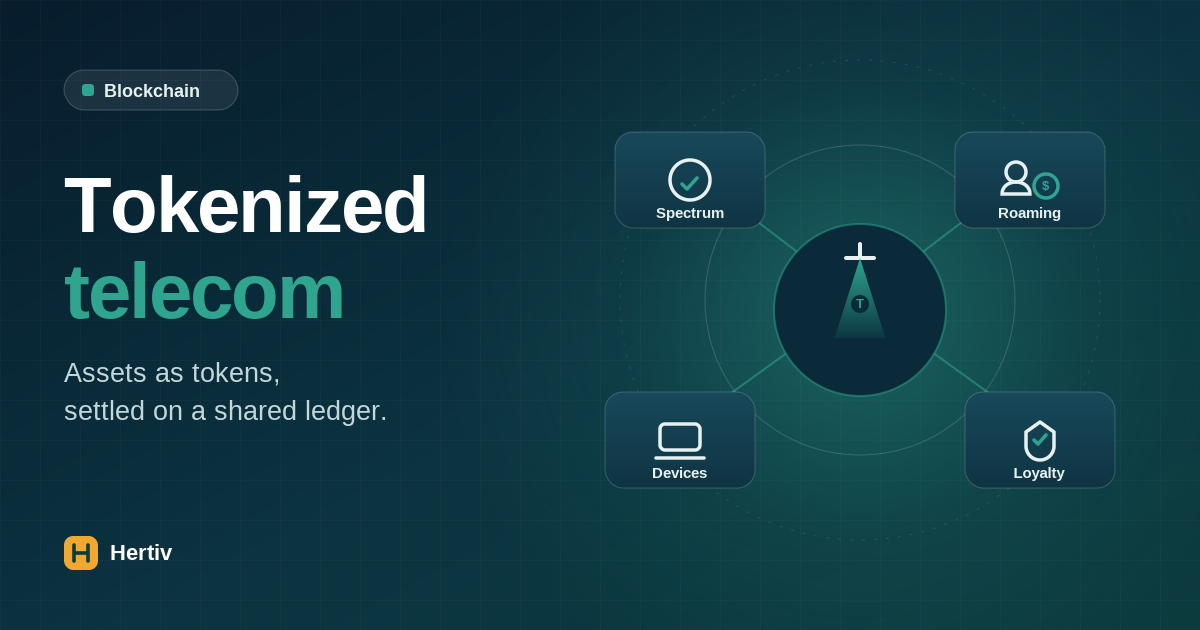
Tokenization in telecom means representing a telecom asset, right or balance as a digital token on a blockchain, so it can be transferred, split or settled without manual paperwork. Operators use it for spectrum licences, roaming settlement, device financing, loyalty points and network capacity.
What is tokenization in telecom?
Tokenization in telecom is the practice of representing a telecom asset, right or balance as a digital token on a blockchain, so ownership and transfers can be recorded and settled on a shared ledger instead of in separate operator databases.
The token is a digital record that stands for something real: a slice of spectrum, a roaming agreement, a block of network capacity, a customer loyalty balance or a financed handset. The blockchain records who holds the token and every transfer, which removes the need for each party to keep its own copy of the same facts.
Tokenization does not replace the network. It replaces the paperwork and reconciliation around commercial relationships in telecom. The radio network, billing system and customer records stay where they are; the token layer records the commercial rights and movements between parties. For a wider view of the idea, see tokenization in cryptocurrency.
What can telecom operators tokenize?
Operators can tokenize almost any commercial asset that is currently tracked in a spreadsheet or a bilateral agreement, provided the underlying right is clear and the token has a defined issuer and rules.
| Asset | What the token represents | Why tokenize it |
|---|---|---|
| Spectrum licences | A time-limited right to use a frequency band | Leasing and sharing become auditable |
| Roaming settlement | Minutes and data used by visiting subscribers | Faster clearing between operators |
| Network capacity | A slice of bandwidth or compute on the edge | Capacity can be sold in small units |
| Device financing | A handset loan split into shares | Investors can fund devices at scale |
| Loyalty points | Customer rewards as transferable tokens | Points can move between partner brands |
| IoT connectivity | Data allowances for connected devices | Automated top-ups and resale |
Spectrum is the most talked-about case, because licences are expensive, long-lived and often underused in some regions. A token that records a lease of spectrum for a defined period lets a smaller operator buy access without a full licence transfer.
How does tokenization work in a telecom network?
Tokenization in telecom works by issuing a token against a verified asset, recording transfers on a ledger, and settling payments or rights when the token changes hands, with the operator's existing systems still doing the operational work.
- Define the asset. The operator writes down exactly what the token stands for, who issues it and what rights it carries.
- Issue the token. A smart contract mints tokens in the agreed quantity, for example one token per megahertz of spectrum for one month.
- Record ownership. Every transfer is written to the ledger, so all parties share one version of who holds what.
- Automate the rules. The contract enforces expiry, payment and transfer limits without manual checks.
- Settle. When a token is used or transferred, payment moves in the agreed currency or stablecoin.
- Redeem or expire. The token is burned or returned when the underlying right ends.
The ledger is usually a permissioned chain or a consortium chain run by the operators involved, not a public chain, because telecom settlement data is commercially sensitive and regulators expect identifiable participants.
Where does tokenization help operators most?
Tokenization helps operators most where settlement is slow, manual or disputed: roaming, wholesale capacity trading and spectrum sharing, where the same transaction is recorded by several parties and then reconciled weeks later.
Roaming is the classic case. A subscriber uses a visited network, the visited operator records usage, the home operator is billed, and the two sides reconcile records that rarely match on the first pass. A shared token ledger gives both sides the same record from the start, which shortens the dispute cycle.
Wholesale capacity trading is a second case. Operators with spare capacity in one region can sell it to operators that need it, in units small enough for short-term demand. Tokens make those small trades practical because the contract handles the terms.
A third case is device financing. An operator that finances handsets can tokenize the loan book, letting investors buy slices of it. The operator gets working capital back sooner, and the token records each investor's share. AI agents in telecom are a separate trend that often runs alongside these systems.
What are the limits and risks?
The limits of tokenization in telecom are legal, operational and commercial, not technical. A token is only as good as the right behind it and the willingness of the other parties to accept the ledger as the record.
- Regulatory status. Spectrum and financial instruments are regulated in most countries. A token that represents a regulated right needs a legal framework, not just a smart contract.
- Interoperability. Each consortium chain is its own island. Tokens that cannot move between operator systems lose much of their value.
- Oracle risk. The ledger only knows what it is told. If usage data fed into the chain is wrong, the settlement is wrong too.
- Privacy. Subscriber-level usage data on a shared ledger raises privacy questions that need a design answer, such as keeping detail off-chain.
- Adoption. A settlement ledger only helps when both sides of a trade use it. One operator alone gains little.
These limits explain why most telecom tokenization projects start as small pilots between two or three operators, rather than as industry-wide platforms. DePIN in the telecom industry shows a related model where network infrastructure itself is shared.
Example: a roaming settlement pilot between two operators
Example (hypothetical): two operators agree to settle roaming on a shared ledger. Operator A has 50,000 of its subscribers visiting Operator B's country in a month, and each uses an average of 2 GB of data, so the pilot covers 100,000 GB in total.
Operator B charges a wholesale rate of $0.40 per GB, so the monthly bill is 100,000 x $0.40 = $40,000. Instead of exchanging spreadsheets, Operator B issues tokens that represent each block of 1,000 GB, so 100 tokens cover the month. Operator A accepts the tokens as the usage is recorded, and payment of $40,000 is released when the tokens are redeemed at month end.
Before the pilot, reconciliation took 45 days and disputed about 6% of the total, or $2,400. After the pilot, both sides read the same ledger, disputes fall to 1%, or $400, and settlement closes in 5 days. The saving is $2,000 a month in disputed amounts plus 40 days of faster cash flow.
The numbers are illustrative, but the mechanism is the point: one shared record replaces two separate ones, and the token makes the record machine-readable.
What are the common mistakes?
The most common mistakes in telecom tokenization are treating the token as the product, ignoring the legal status of the underlying right, and building a ledger that only one operator uses.
- Tokenizing before defining the right. If the contract cannot say exactly what the token entitles its holder to, the token is a record of nothing.
- Ignoring regulation. Spectrum, finance and subscriber data are all regulated. Legal review belongs at the start, not after the pilot.
- Building a single-operator ledger. A shared record only helps when the counterparty is on it too.
- Putting raw subscriber data on-chain. Usage detail belongs off-chain, with only hashes or totals on the ledger.
- Expecting instant settlement. Tokens speed up reconciliation, but payment terms, credit limits and disputes still need commercial agreements.
Key takeaways
- Tokenization records telecom rights as digital tokens on a shared ledger
- Spectrum, roaming, capacity, device loans and loyalty points are the main assets operators tokenize
- Most pilots use permissioned or consortium chains, not public chains
- The biggest gains are faster roaming and wholesale settlement, not new revenue
- Legal status, interoperability and counterparty adoption decide whether a pilot survives
Frequently asked questions
What is the difference between tokenization and a loyalty programme?
A loyalty programme is a database of points owned by one company. Tokenization puts the record of a right on a shared ledger, so the token can move between companies, be split into smaller units, and be settled without each side keeping its own copy of the same facts.
Can telecom spectrum really be tokenized?
The spectrum itself is licensed by a regulator and cannot be sold as a token. What can be tokenized is the right to use a defined slice of spectrum for a defined period under an agreement, with the regulator's rules still applying to the underlying licence.
Do telecom tokenization projects use public blockchains?
Most use permissioned or consortium chains, because settlement data is commercially sensitive and participants need to be identifiable. Public chains are used mainly for assets that are meant to trade openly, such as tokenized loyalty points.
Is tokenization the same as DePIN in telecom?
No. DePIN rewards people for running physical network infrastructure, such as hotspots or small cells. Tokenization records commercial rights, such as spectrum leases or roaming usage, on a ledger. A project can use both, but they solve different problems.
What should an operator check before starting a tokenization pilot?
Check three things: that the underlying right is defined in a contract, that the regulator accepts the arrangement, and that the counterparty will join the same ledger. Without all three, the pilot will not produce a settlement both sides trust.
How long does a telecom tokenization pilot take?
A small pilot between two operators, covering one settlement flow such as roaming, typically takes a few months to design and run. Industry-wide platforms take far longer, because they need common standards and many participants to agree.


